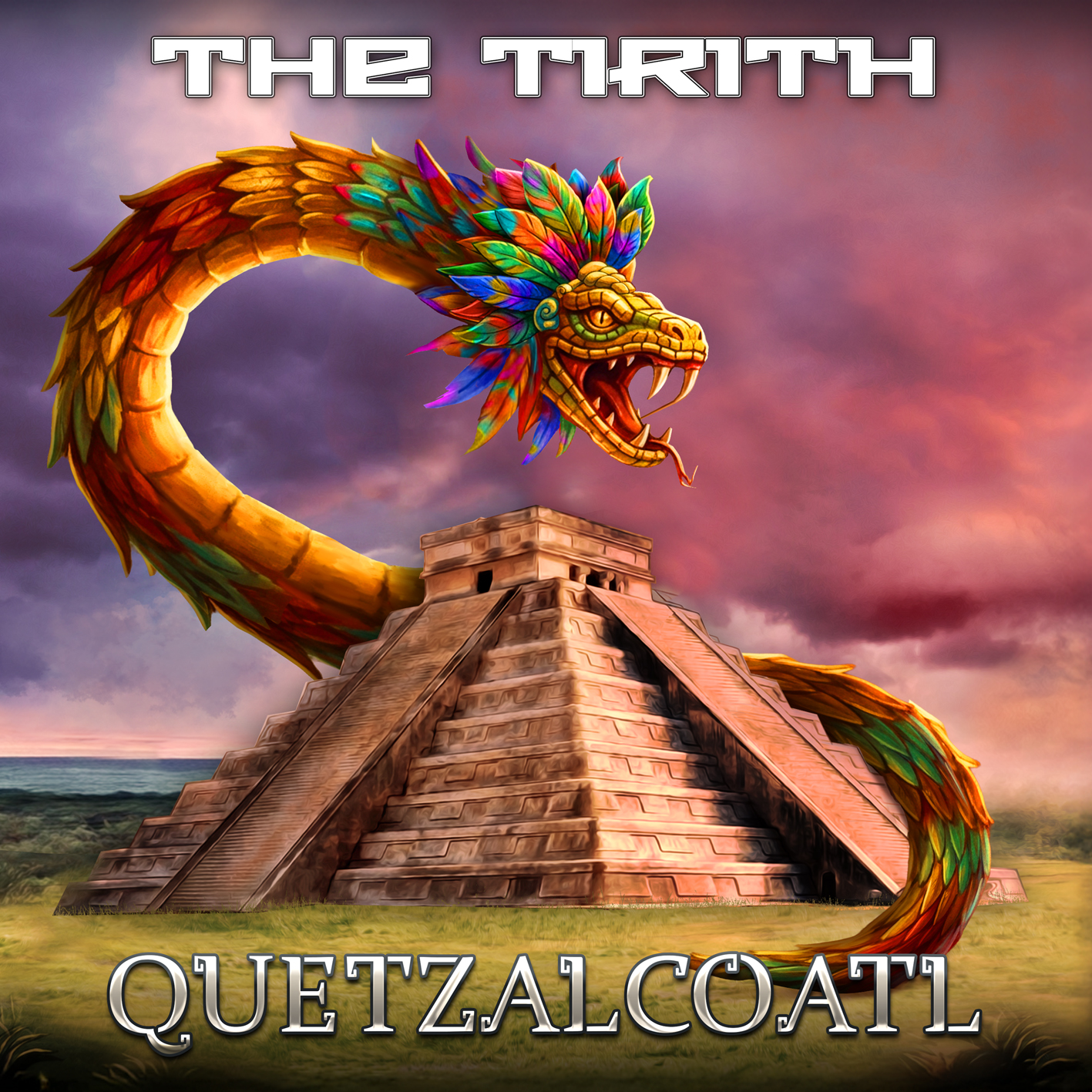
UK progressive rock outfit The Tirith announce the release of their new album, Quetzalcoatl, out July 3, 2026, independently released. Produced, arranged, and mixed by guitarist Tim Cox, and featuring Dick Cory on vocals, bass, and acoustic guitar, Anthony Hill (Ant) on keyboards, and Paul Williams on drums and percussion, it is the fullest and most unified statement the band have made in over fifty years of shared musical history — and the most adventurous record of their current chapter by some distance.
The lead single “Save the Oak” is available now ahead of the album’s July 3rd release.

Quetzalcoatl takes its name and its spirit from the feathered serpent deity at the heart of Aztec, Toltec, and Maya civilisation — a god of wind, Venus, dawn, knowledge, and the union of earth and sky. The name is pronounced KET-suhl-koh-AHT-uhl, and the legend carries with it the image of an old man with a long beard who disappeared over the sea and never returned. It is, in other words, a myth about departure, transformation, and the things that endure across time. Fitting, for a band with this particular history.
Across twelve tracks, Quetzalcoatl moves with the range and confidence of a band that has genuinely found its groove. The influences are wide — folk, jazz, heavy rock, country, prog — and the album wears them all without strain, shifting between expansive cinematic arrangements and lean, hard-driving riffs, between introspective acoustic passages and full-band eruptions, between ancient mysticism and cosmic absurdism. Fans of Rush, Porcupine Tree, Yes, Genesis, Pink Floyd, Dream Theater, Opeth, and Spock’s Beard will find themselves deep in familiar and exciting territory.
Each track earns its place:
“Back to Space” revisits the space privateer narrative begun on Tales from the Tower — one of the spacemen, stranded in New York after his crewmates have all passed, unable to adapt to the nightmare of city life, makes a decision. The only way forward is back up. The song opens with a huge, dirty guitar riff from Tim Cox before cascading through chaotic verses, withholding its first chorus until the three-minute mark. Worth the wait.
“Rabbit Ings” is a foray into prog folk-rock — nylon string acoustic guitar introducing a song that moves between delicate acoustic passages and hard rock sections. The title draws from old Norse, referring to the marshy water meadows still embedded in Northern English place names. The flute? That’s Ant on keyboards.
“Dancing With Vampires” is a romantic waltz with a twist: the alluring female vampire, the beauty and the sweet perfume, and then — “we turn as she sinks her teeth into my neck.”
“No Mind (Mushin)” explores the Japanese Zen concept of the empty, thought-free mental state — that place of total presence where action becomes intuitive and effortless, free from ego, fear, and hesitation. Born from improvisation, it carries that quality throughout.
“The Riddles” closes the album with a rock song whose lyrics contain many common riddles — and one that has no solution: M.O.A.I., Malvolio’s riddle from Shakespeare’s Twelfth Night. The album plays out, as ever, with a guitar solo from Tim Cox.
The Tirith‘s origins run all the way back to the 1970s, when guitarist Tim Cox and vocalist/bassist Dick Cory were schoolmates at Loughborough Grammar School — two boys facing each other with acoustic guitars, one a songwriter and Beatles-influenced folkie, the other a guitar player with a habit of writing strange songs. They formed a band called Minas Tirith (yes, that Minas Tirith — they were all deeply into Tolkien), performed exclusively original material from the very beginning, and played gigs around Loughborough with Paul Williams on drums before the band dissolved when Dick went to university.
What followed was over thirty years of parallel lives. Tim Cox went on to a career as a professional musician — playing in London bands including Escape from New York, Fracture, and Airstrip One, before moving into dance music production as part of the Band of Gypsies songwriting and production team. Their work with Rozalla produced “Everybody’s Free (to Feel Good)” — still a major dancefloor anthem to this day. Dick continued playing and writing throughout those decades, quietly building a body of work that would eventually find its home on later Tirith records.
They stayed in touch. In 2010, at the instigation of drummer Paul Williams, they came back together as The Tirith and have not stopped since. Three albums followed — Tales from the Tower (2015), A Leap into the Dark (2019), and Return of the Lydia (2022) — each noted for its conceptual scope and Tim Cox’s expressive guitar work. Keyboardist Anthony Hill joined in 2022, and with the current lineup now fully settled, the band have reached a new level of cohesion. Quetzalcoatl is the proof.
Over the past fifteen years The Tirith have performed across the UK — Sheffield, London, Leicester, Nottingham, Newcastle, Southampton, Hull, and beyond — as well as Rotterdam, and at festivals including the Cambridge Rock Festival, HRH Prog VI and XIII, Nene Valley Rock Festival, Sonic Rock Solstice, and Prog for Peart. They have supported Focus (twice), Karnataka, Gnidrolog (twice), and toured with Paul Menell (ex-IQ).
The Tirith are a UK progressive rock band formed in 2010, built on the partnership of guitarist/producer Tim Cox and vocalist/bassist Dick Cory, with Paul Williams on drums and Anthony Hill on keyboards. With roots stretching back to the 1970s and a discography that includes Tales from the Tower (2015), A Leap into the Dark (2019), and Return of the Lydia (2022), the band blend prog rock with folk, jazz, heavy rock, and conceptual storytelling rooted in mysticism, mythology, and the darker corners of the human imagination. Quetzalcoatl is their fourth album, out July 3, 2026.