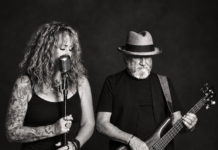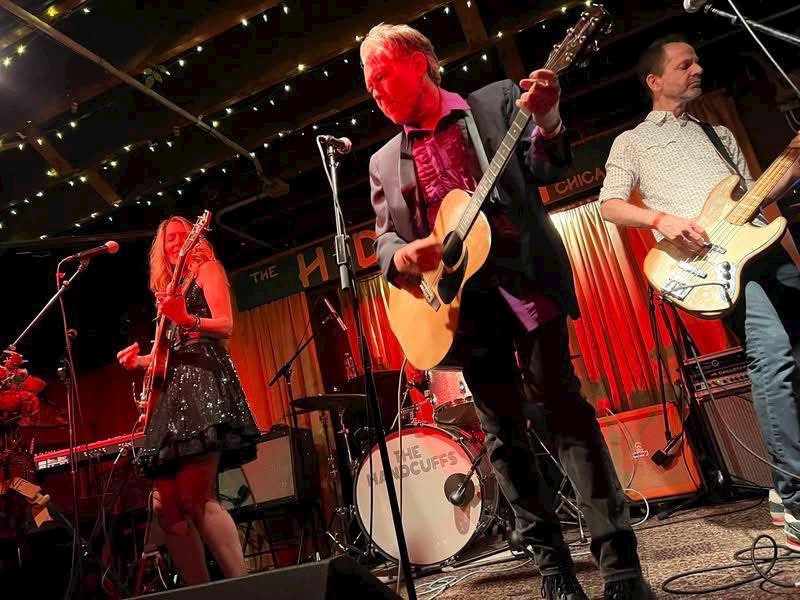
New York has always bred a particular kind of rock and roll — raw, unpolished, and unapologetically real. St. Divine are exactly that kind of band. Formed in 2024 by the songwriting partnership of Will Croxton and Judy Ann Nock, the duo have built a reputation fast: over 350 radio spins worldwide, placements on NPR’s Sound Opinions, WFMU, and Little Steven Van Zandt’s Underground Garage on SiriusXM, and comparisons to PJ Harvey & Nick Cave, the Kills, and Lee Hazelwood & Nancy Sinatra. Now they arrive with their debut full-length “The Devil You Know”, out June 12th via Reel to Reel Records — a whiskey-soaked, punk-blooded, Americana-tinged molotov cocktail of bad romance, dark humor, grief, and carpe diem defiance. This is a record that came straight from life — all of it, including the parts that hurt the most. We sat down with St. Divine to talk about the album, the partnership, and the uncut rock and roll at the heart of it all.

- “The Devil You Know” is described as a direct transmission of pure, uncut rock and roll — brazen, scrappy, dangerous, and morbidly fun. When you were making it, was there a conscious decision to strip everything back to that raw honesty, or did the album just arrive that way?
Croxton: As a songwriter, performer, engineer, and producer, I suppose I’ve got more fingerprints on this than anyone. I can’t say I’m displeased that the record’s being thought of in those terms, but it’s not a conscious decision. I think it speaks to how we approach the songs. The five of us always work in the favor of making the song work. So, I suppose, the answer to your question is that it reflects who we are as musicians and as a band.
- The title track is one of the most personally significant songs on the record — Judy Ann, you wrote it as a meditation on your husband David’s death by suicide and your attempt to understand the experience of his aural hallucinations. What did it take to turn something that devastating into a song — and what do you hope listeners who’ve experienced similar loss take from it?
<Nock> There is a huge stigma surrounding mental health and suicide in particular. There are many musicians who use madness as an inspiration and as sort of an abstract concept, while for some of us, it’s not poetic. It’s our lived experience. The stigma can be extremely isolating so the song has a lot to do with my attempt to shatter the silence and break through, and hopefully connect through music with other people who have endured something similar so that we can realize we are not as alone as we feel. The end of the song was a deliberate attempt for me to understand what his experience might have been like, having to deal with auditory hallucinations and not knowing where the voices were coming from, or if they were real. Exploring that through art and creativity was illuminating. When Will played the first rough mix for me, it sounded about as crazy as I thought it was going to be.
- The chorus of “The Devil You Know” wails about the guilt that suicide survivors often carry. Suicide loss is something millions of people live with in silence. Did you feel any weight of responsibility in putting that experience into a rock and roll song — and has the response from listeners confirmed that the decision was the right one?
<Nock> It’s really new and I’ve vacillated between owning my choice and regretting sharing something so deeply personal and frankly, disturbing. So right now, it’s impossible to know if it has done its job or not. One thing I can say is that the song is loaded with deliberate artistic choices from the opening riff that was meant to feel like a sharp descent into insanity and even the way I use my voice, letting all the breaks show. In vocal training, you spend a lot of time making the separation between your chest voice and your head voice seamless so that listeners can’t tell the difference between the two. In Devil, I absolutely leaned in to where my voice cracks because I just feel so broken most of the time. I understand the need for silence, but that time for me is over. There is enough silence when someone you love is gone.
- The “his, hers, and ours” songwriting dynamic between Will and Judy Ann is central to what St. Divine is. How does that collaboration actually work in practice — and what does each of you bring to the table that the other couldn’t arrive at alone?
Croxton: Songwriting isn’t a science– and in our case, especially, there are no rules. In most cases, it can start with an idea that’s bandied around– or, ‘hey, here’s some lyrics’ or ‘here’s a progression I really like.’ Those kinds of things are where things bloom. More often than not, I’m backed in a corner lyrically or musically, and Judy Ann digs me out.
- You’ve been compared to PJ Harvey & Nick Cave, the Kills, and Lee Hazelwood & Nancy Sinatra — all partnerships or creative dialogues with a particular tension and chemistry between two distinct voices. Do those comparisons feel accurate to you, and which of them resonates most?
Croxton: I respect all those artists a great deal, but I didn’t write any of those comparisons. I get influenced by everything I encounter– both good and bad.
<Nock> The comparisons have been really flattering and also humbling. I feel that they are aspirational but there is a definite resonance. I actually share a birthday with PJ Harvey and I found her early releases to be really inspiring.
- Which tracks on “The Devil You Know” are the closest to your hearts — and why?
Croxton: All of ‘em! In the digital age, it’s borderline criminal to release an album. It automatically means certain tunes are dispensable. It’s just not the way people listen anymore.
- The album conjures fast cars, dive bars, heartbreak, New York subculture, and a hint of hope for tangled times. How much of this record is autobiographical — and is there a version of St. Divine that exists separately from the lives that made it?
Croxton: Don’t know about fast cars! But, it sounds like the New York City that I know. An old friend warned me when I moved here, “the city likes to remind you it’s here at least once a day.”
<Nock> Will and I both had important cars that inspired us. His was a Mustang and mine was a classic 1957 Chevy Belair. As a writer, I am pretty direct and I am coming from an authentic place. That being said, once a song is out in the world, people will get from it what they need. There are songs that Will wrote that I fought to have on the album because they got me through some tough times, so I figured they were meant to connect with a wider audience than just me
- You’ve racked up hundreds of independent and college radio spins since 2024, landed on Sound Opinions, WFMU, and Little Steven’s Underground Garage, and built genuine momentum in a remarkably short time — all without major label backing. What has driven that traction, and what does it tell you about where the audience for this kind of music actually lives?
Croxton: It was pretty amazing how quickly people either got what we were doing– or seemed like they were hungry for it. That said, we’re a damn good band, and we work really hard to achieve everything we’ve gotten. There’s a high bar we set for ourselves. No one gives anything less than 100%.
<Nock>I wanted to celebrate when we hit 100 radio spins and now that we’re over 500, I think it really speaks to our listeners and how they also move with intention just like we do. Think about it. You tune in to the radio because you are actively seeking that music rather than just mindlessly scrolling and passively accepting what’s being shown to you. The driving force, I think, is the band itself. We have five people pulling in the same direction so it makes sense that we picked up speed.
- You’ve shared stages with bands on Pravda, Rum Bar, and Jem Records, and your debut EP landed to wide acclaim in May 2025. How has the live experience shaped the sound and attitude of this full-length — and what does St. Divine look and feel like on stage?
Croxton: While I’m the producer, and help shape the sound of the band in the studio, nothing replaces what we do when we play live. It informs every step I take behind the board. I’m eternally blessed by the talent I have 5-10 feet on every side of me onstage. I trust every member of our band inherently. That’s a rare thing.
<Nock> On stage, we are an elevated musical and visual catharsis. At least that is what I strive for. There are hallmarks where you know you are at a St. Divine show and it looks and feels different than any other live act. We pay attention to details and give the audience a unique experience. Often we record songs before performing them so the albums have absolutely shaped and built the live experience.
- The punk and garage rock world has always prided itself on authenticity and community over commercialism. How do you navigate that ethos while also trying to reach the widest possible audience for music this personal and this important?
Croxton: In this day and age, those lines are so fucking blurred its not funny. At this point in the game, I don’t care. I know our stuff. If you don’t get it, that’s all good, too.
<Nock> I try to spend as much time as I can supporting my local music community and being a part of it. If I’m going to spend five hours hyping my shit on the socials then my ass had better be in the clubs or in the studio for double that time or more.
- In such an AI-driven era, how do you see the future of indie artists in particular — and the music industry in general?
Croxton: Funny you ask. I was approached recently by a college professor friend who was dealing with a student who didn’t see a problem replacing musicians with AI substitutes– mostly as a cost cutting tool. They asked how I would respond. I posed this question …. if you could go back in time and give someone a pill to make them dance as well as Michael Jackson, which one would you hire as a dance teacher? It’s kind of like using a fake pic at a dating site. In the latter, you get short term gain and gratification, but there’s nothing underneath you to sustain it. In the former, you get a model, but without the blood and sweat and technique. Ultimately, AI, when effective, is the sum of current collective knowledge— but art doesn’t work like that. You’re establishing a lowest common denominator ceiling that you’re living under. You’re replacing spark with familiar tropes. You’re gonna get that easy dopamine hit, but you ain’t an artist, you’re a curator of common knowledge at best– and mostly a shopper at walmart.com.
To really answer your question, pop music is about pleasing masses. AI, in the short term, can probably please the hell out of them.
<Nock> There is right now a growing backlash against AI where even the major streaming platforms are proceeding with caution and imposing disclosure requirements and limits. Music is, and for me will always be, about community. In the future, we are going to return to touch instead of tech because this hyper tech direction is clearly unsustainable. It hasn’t even scaled to potential yet and it’s already destroying the environment, dampening creative expression, and dividing communities. I don’t see that as a net good. Rather, it’s the opposite.
- “The Devil You Know” is your debut full-length — but it already feels like a band operating with complete confidence in who they are. What comes after this record, and where does St. Divine go from here?
Croxton: With complete confidence comes utmost silence. Stay tuned!
<Nock> I want to take it as far as we possibly can.