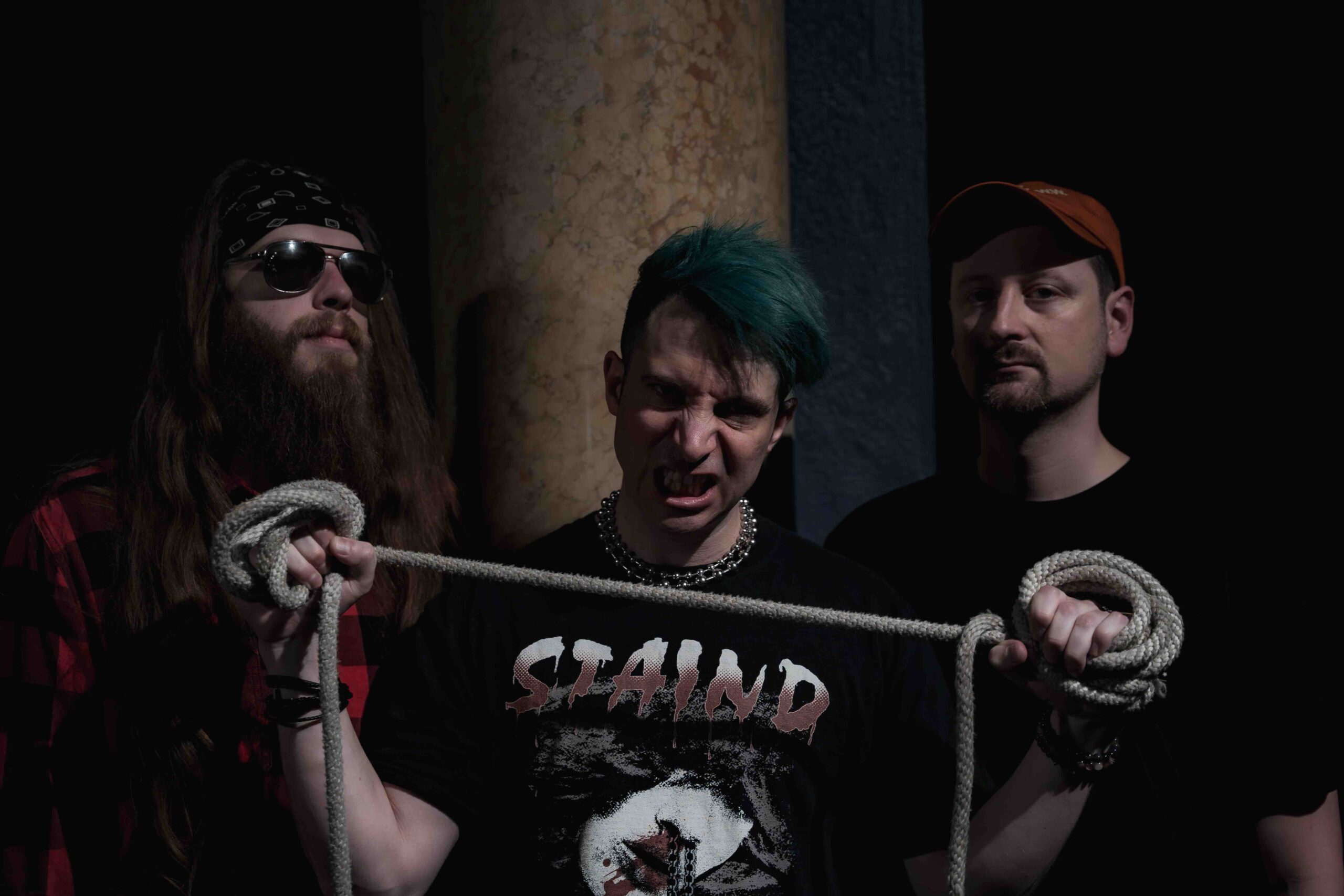
Pittsburgh’s GUIDES are back — and they’re hitting harder and going deeper than ever. The band’s new single “FAILURE/DEFINES” drops June 17th, continuing the emotionally charged momentum of their previous release “DRAIN” and marking another step forward in their collaboration with producer Zac “ZROKK” Diebels of Simon Says, Key to Arson, and Automatic Static. Blending the textured aggression of nu metal with the urgency of post-hardcore, the track confronts identity, self-worth, and the struggle to rebuild in the face of failure — channeling personal unrest into something cathartic, vulnerable, and crushing all at once. With a growing reputation built on stages alongside Sevendust, Taproot, Cold, Orgy, and Attack Attack!, GUIDES are entering this next chapter with sharper focus and renewed purpose. We sat down with the band to talk about the new single, the journey, and where they’re headed next.
- How did GUIDES first start or form, and what brought the three of you together around this particular sound?
Jonathan: GUIDES actually started in 2014 with a completely different lineup. Funny enough, nu-metal wasn’t particularly cool at the time. Bands like Thrice were dominating the alternative rock conversation, and we wrote most of what would eventually become our EP When Everything Reverses during that era.
The original lineup fell apart before we ever got the chance to record those songs, but I decided to reform the band in 2019. The pandemic slowed things down, but we continued writing and recording throughout that period.
Interestingly, we really started gaining momentum around 2022, just as nu-metal and adjacent genres began experiencing a resurgence. A new Limp Bizkit record, the rise of bands like Ice Nine Kills, and the announcement of Sick New World all signaled renewed interest in the music that inspired us. In a lot of ways, it felt like the perfect time for GUIDES to exist.
- “FAILURE/DEFINES” was written during a period marked by uncertainty, pressure, and constant transition. Jonathan, how much of yourself did you have to put on the line lyrically to write something this personal — and was it difficult to revisit that headspace once the song was finished?
- Jonathan: The story unfolding in the verses of this song was drawn directly from events happening in my life as it was being written. It was a period of upheaval, conflict, and personal transformation. I felt judged, abandoned, and let down by people I cared about at a time when I needed support the most.
Because of that, the song is deeply personal. It contains all of the anger, frustration, and determination I was carrying at the time. The first time we played it live, I dedicated it to the people who walked away when I needed them most. That should tell you everything you need to know about where I was emotionally when these lyrics were written.
That said, revisiting the song has never been difficult. If anything, it’s been cathartic. Finishing and releasing it helped me process that chapter of my life and ultimately move forward.

- The title itself, “FAILURE/DEFINES,” suggests a tension between being broken down by failure and being shaped by it. Where do you land on that tension personally, and how did you want the music to embody that push and pull?
Jonathan: That’s the interesting thing—this song is ultimately about triumph. It’s about winning.
The tension comes from the fact that we all suffer and we all have reasons to hurt. In my life, the periods of greatest growth have always begun with heartbreak, disappointment, or failure. Those experiences force you to learn, adapt, and become something stronger than you were before.
Failure is often where motivation and inspiration are born. You never want to relive those moments, so they push you to evolve. That’s really what the song is about: the idea that failure inspires the change that ultimately defines who you become and the legacy you leave behind.
- This is your continued collaboration with producer Zac Diebels, who Jonathan has called a defining creative milestone. What has working with him sharpened or unlocked in GUIDES’ sound that you hadn’t fully accessed before?
Jonathan: Working with Zac “ZROKK” Diebels was a dream come true. His band Simon Says was one of the first bands I ever saw live when I was twelve years old.
Zac essentially made us start over. We scrapped our existing demos and rebuilt everything from the ground up. The challenge was to rethink our chemistry, our songwriting process, and what we wanted this band’s identity to be.
After experimenting with a few approaches, I ended up taking the lead on the writing for these sessions. I locked myself in my home studio for nearly a month and immersed myself completely in the work. Through that process, I learned a lot about myself as a songwriter and what I’m capable of when it comes to composition and execution.
The biggest lesson Zac reinforced was simple: a song isn’t going anywhere unless it makes you feel something. That mindset has influenced every decision we’ve made creatively since.
- You’re drawing heavily from the late 90s and early 2000s Sacramento heavy music scene, alongside influences like Deftones, Taproot, Staind, Finch, Thursday, and AFI. What is it about that specific era and sound that still feels so vital and worth building on today?
Jonathan: I don’t know if it’s that it feels vital so much as it’s simply the music we genuinely love. It’s what we grew up with, and it’s what we naturally gravitate toward as songwriters.
That said, we’ve been fortunate to see a resurgence in these styles over the last few years. It started with the legacy acts and festivals like Sick New World, but now there’s an entirely new generation of artists carrying those influences forward and putting their own spin on them.
That’s been incredibly exciting to watch. I’m proud of what these younger bands are doing, and we’re grateful to be part of a scene where this music is finding a new audience. We just hope to continue carving out our place within it.
- You’ve shared stages with Sevendust, Taproot, Cold, Orgy, and Attack Attack! — heavy hitters with serious history in this genre. What have those experiences taught you about your own live show, and how has it evolved since your 2023 debut EP “When Everything Reverses”?
Jonathan: Every one of those opportunities has been special to us. When you stop and think about how few people actually get the chance to open for their favorite bands, it’s something you never take for granted. I used to jump around in my bedroom pretending to be in those bands. Getting to share a stage with them is literally the dream come true.
We’ve always approached those opportunities with the mindset that we have to prove we belong there. Every show is a chance to earn our place. I think we learned that early on with Taproot, especially when we ended up covering Limp Bizkit with Stephen Richards during our set without any rehearsal beforehand. Moments like that build confidence and reinforce your belief in what you’re doing.
The ultimate test was opening for Sevendust in a sold-out 1,000-capacity room. It was the biggest crowd we’d ever played for. You never really know how you’ll respond until you’re standing in front of that many people. Once you do it, though, you just want to do it more.
- “FAILURE/DEFINES” follows “DRAIN” as part of a clear creative evolution. With new material continuing to roll out through 2026, what does the bigger picture look like — is there a larger body of work or a specific direction you’re building toward?
Jonathan: Absolutely. There’s always a bigger picture. The material we’re releasing now is building toward a larger body of work that will ultimately function as an EP. From a logistical standpoint, working with ZROKK made it more practical to split the project into two separate releases rather than tackle everything at once.
We’re currently finishing the writing for the second half and plan to record it this fall. Because all of these songs originated from the same creative period and writing sessions, they share a common DNA and naturally build upon one another. I think when people eventually hear the complete collection, it’ll feel cohesive, intentional.
- In such an AI-driven era, how do you see the future of indie artists in particular — and the music industry in general?
Jonathan: First of all, let me get this out of the way: no, I don’t support people using AI to create music and pass it off as their own art.
That said, I’m a technologist professionally, so my perspective on AI is probably different from what I hear from a lot of people in my music circles. I see a lot of value in AI as a tool for solving problems, and I think the conversation around it is often oversimplified.
Frankly, if you’re a musician or creative who feels seriously threatened by AI, I think you’re probably focused on the wrong things. There are so many layers to this discussion, but at the end of the day, a computer can’t build a local scene, load into a venue, play a great show, or create a genuine connection with an audience.
Honestly, I’m more concerned about the advantages enjoyed by artists with unlimited resources than I am about a computer generating streams on the internet. Independent bands have always had obstacles to overcome. AI is just the latest thing people are arguing about.