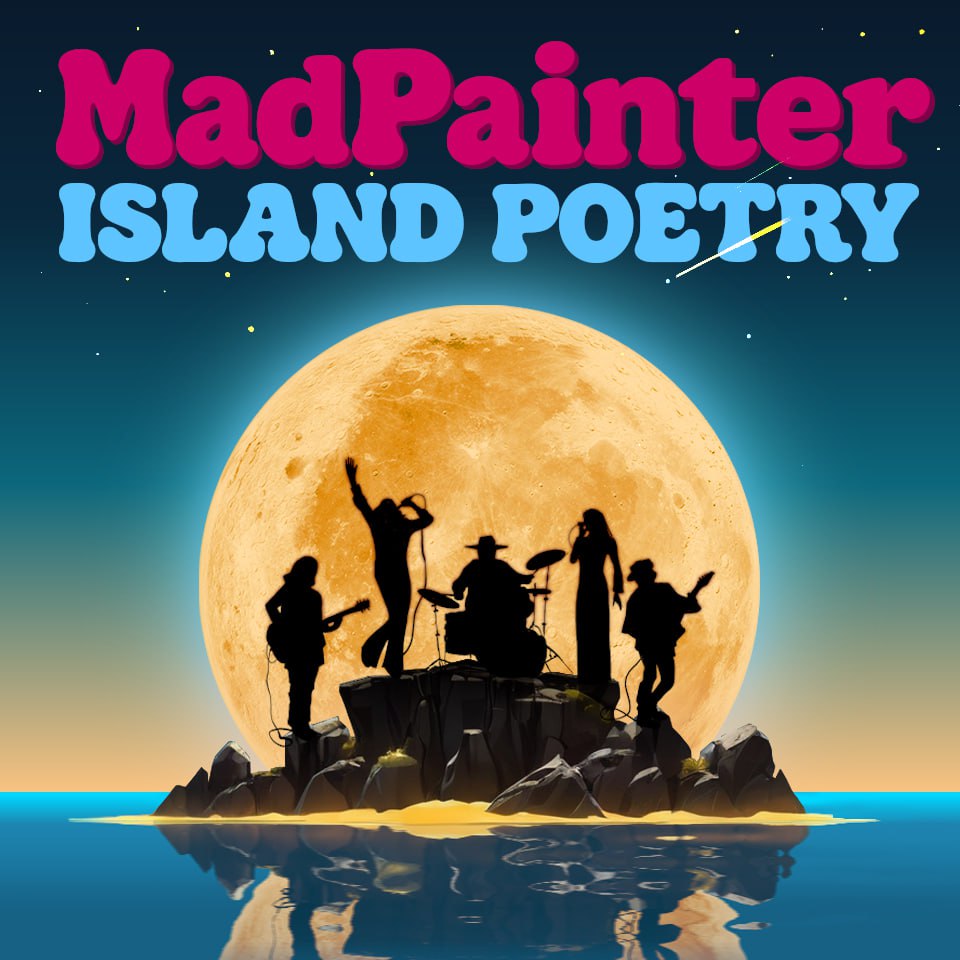
Mad Painter has spent years building a reputation in Boston as a band devoted to the weight and theatrics of 1970s British rock, and Island Poetry, out October 1st through the Italian label Epictronic, is their most ambitious swing at that sound yet. Led by songwriter, vocalist, and keyboardist Alex Gitlin, backed by drummer Al Hendry, bassist Kenne Highland, and guitarist Al Naha, with newer additions Sharon Crumrine and Julie Gee on backing vocals, the band leans on Hammond organ as a genuine lead instrument rather than texture, the same way Deep Purple and Uriah Heep once did. Across twelve tracks, each one built from a different reference point in that era, from Status Quo boogie to AC/DC’s leaner drive to Queen’s theatrical sweep, the album was recorded with a full band playing together and warm, analog-style production, six of the tracks carrying lyrics from music journalist Dmitry M. Epstein.
Overall, the album has a very hopeful tone and feels like a huge-sounding jam, yet not random or directionless. It feels like a jam in the way the band has impeccable chemistry. It sounds like the way rockers used to write songs back in the day, so it is vintage in that sense, but it definitely is not nostalgia bait; the narrative has nothing to do with the good old days, and there are many attempts to innovate here with harmonic choices and tonal and textural choices as well.
“Debt Collector” is the first song on the album, and while it defines the album’s sound and sets the tone, it doesn’t burn all the cards in one go and leaves many surprises to be had throughout the album. It shows that bluesy foundation of the band members as the song starts with a very well-worn bluesy rock rhythm, but it doesn’t stagnate in it for long; the band jumps into a very catchy chorus with a clever call and response between the vocals and the band that is incredibly well executed.
“Empty Bottles” is probably the brightest song I’ve heard with that kind of title and discussion about empty bottles, with the chorus literally spelling out that you should just try again because you can do anything you set your mind to. The rock sound, driven by that organ, makes it not cheesy; it doesn’t sound like a nursery rhyme or a cheesy pop song because of that rock shuffle pushing the momentum forward.
“Suit Of Worries” has a really catchy bluesy intro melody played on a very specific electric piano sound, complete with drum stops to emphasize its rhythmic accents and then smoothly transitioning into the verses. Man, this would be a great song to listen to live.
“I Am The King” is the height of the dramatic flare the band has a knack for that has been showcased in some of the songs leading up to this. It’s the longest song on the album, a 6-minute epic with incredible storytelling and pacing. I was very pleasantly surprised with the harmony here, as it complements the sorrow expressed in the lyrics as the king of tears tells his story, but also the entire band shifts into a brighter sound when it fits thematically; it’s like a theatrical play in that way.
Twelve tracks and this many reference points could easily have turned into a scattered tribute record, but Island Poetry holds together because the band’s own chemistry stays the constant underneath all the borrowed vocabulary. This is Mad Painter’s most varied release to date, and it earns that variety rather than just claiming it. For a band that plays this style of rock live with the energy the press materials describe, it’s easy to hear how these songs would translate to a stage, and Island Poetry stands as a genuinely strong entry point for anyone who still wants a Hammond organ pushed all the way to the front.