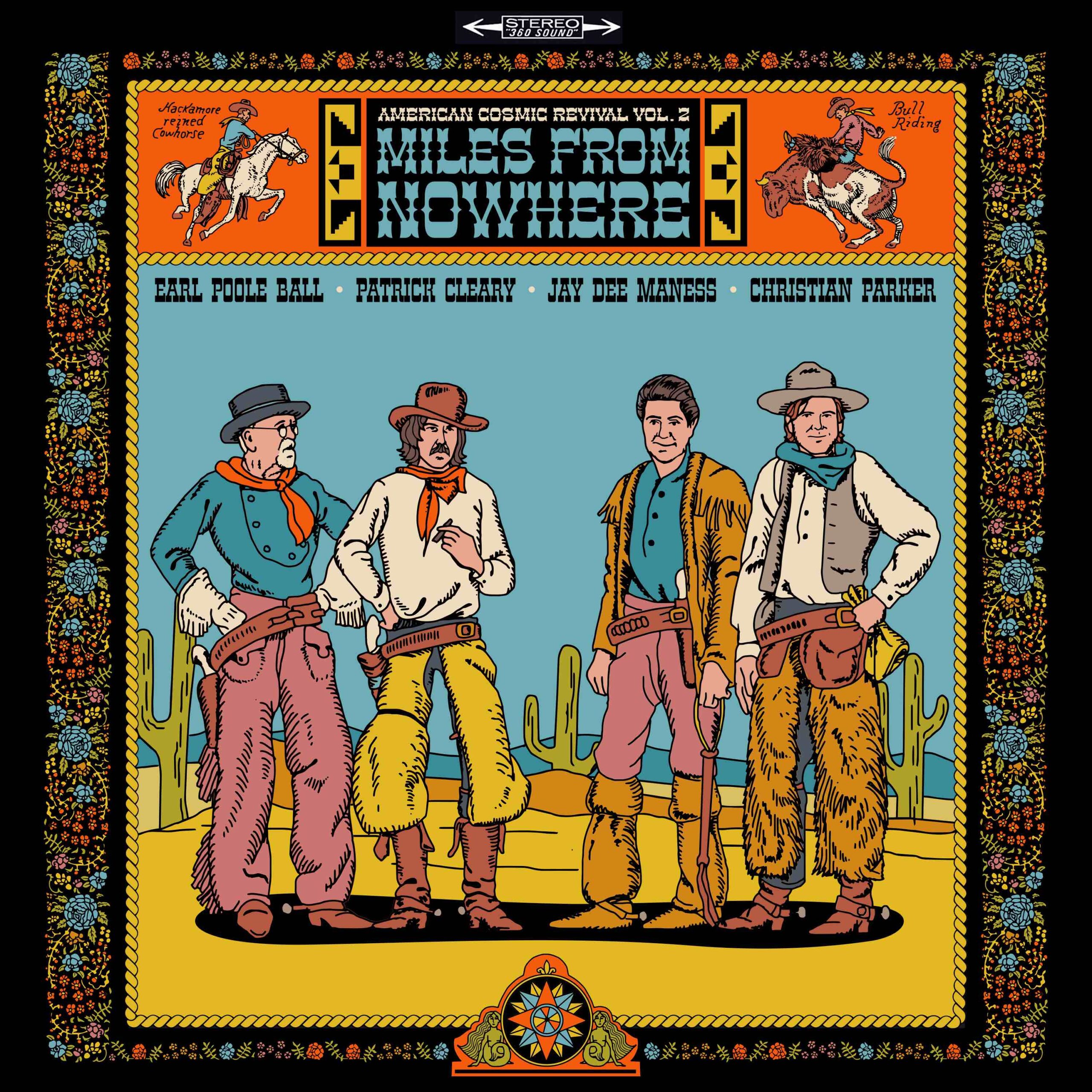
A great country song has never needed much decoration. Give it a road, a broken heart, a missed opportunity, a hard winter, and somewhere to go, and it can say more than an elaborate production ever could. American Cosmic Revival Vol. 2: Miles From Nowhere by CHRISTIAN PARKER, PATRICK CLEARY & EARL POOLE BALL understands that economy, bringing together twelve songs that feel less like a collection of covers than a map of places: physical, emotional, and musical, that have already been left behind. Across the worlds of Gram Parsons, Gene Clark, The Byrds, The Flying Burrito Brothers, the Everly Brothers, Bob Dylan, Merle Haggard, and others, the album finds its common ground not simply in Americana or country-rock, but in the complicated act of looking back.
Following American Cosmic Revival Vol. 1: Back At Home, the second volume expands the series beyond the International Submarine Band material that defined its predecessor. The result is a broader and more emotionally varied journey through the traditions that shaped Cosmic American Music. Yet despite the different origins of these songs, they seem to arrive at remarkably similar destinations: heartache, loneliness, regret, resilience, redemption, and the elusive idea of home.
There is something fitting about beginning that journey with “Wheels.” Written by Gram Parsons and Chris Hillman, the track immediately establishes the album’s restless emotional geography. Acoustic and electric guitars move alongside rich vocal harmonies, while pedal steel introduces that familiar sense of distance, the sound of something beautiful already slipping away. The performance is polished without becoming overly pristine, preserving the song’s character while allowing the musicians to inhabit it rather than merely reproduce it.
That balance becomes even more apparent on “Brand New Heartache.” The Boudleaux and Felice Bryant composition, forever intertwined with the Everly Brothers’ vocal tradition, is treated with an impressive understanding of restraint. Parker and Cleary allow the harmonies to carry the emotional tension, resisting the temptation to overinterpret the heartbreak. There is almost something conversational about the delivery, which makes the song’s pain feel less theatrical and more lived.
If “Wheels” gives the album its road, “Train Leaves Here This Morning” gives it one of its clearest images of departure. Written by Gene Clark and Bernie Leadon, the song captures that peculiar emotional space between leaving and being left. It is not necessarily the dramatic moment of goodbye, but the quieter realization that something has already begun moving beyond your reach. The band’s treatment preserves that ambiguity, allowing the song to remain wistful without becoming sentimental.
That same emotional restraint shapes “So Sad.” The Everly Brothers classic receives a beautifully measured performance, with Patrick Cleary leading the vocals and Parker reinforcing the harmonies. Stevie Blacke’s strings add atmosphere without drowning the song in melancholy. The result is striking precisely because it doesn’t try to make sadness bigger than it already is. Sometimes the simplest delivery leaves the deepest mark.
Elsewhere, the album’s road widens. Bob Dylan’s “I Threw It All Away” brings a different kind of regret into the collection, its Nashville Skyline-era country sensibility sitting naturally alongside the surrounding material. “If We Make It Through December” takes that introspection into harsher territory. Merle Haggard’s portrait of hardship and endurance feels particularly resonant here, with Earl Poole Ball’s piano providing warmth and movement beneath the song’s underlying vulnerability.
Then there is “There Must Be Someone (I Can Turn To),” which deepens the record’s preoccupation with isolation, and Gene Clark’s “Hear The Wind,” whose poetic atmosphere gives the album another moment of quiet reflection. Even “Wild Horses,” the Jagger-Richards composition, fits the journey more naturally than it might initially appear. Its inclusion reminds us that Cosmic American Music was never a closed system. Country, rock, folk, blues, and Americana have always existed in conversation, borrowing emotional languages from one another as freely as musicians crossed geographical and stylistic borders.
The presence of Earl Poole Ball and JayDee Maness makes that conversation particularly tangible. Their histories are embedded in the very musical world being revisited here, connecting the album to the artists and recordings that helped establish country-rock’s vocabulary. Yet Miles From Nowhere never turns their participation into a museum exhibit. Ball’s piano and Maness’s pedal steel are living elements of the arrangements, surrounded by Gary Jacob’s steel work, Michael Rinne’s bass, Ron Keck’s drumming, Stevie Blacke’s strings, and the guitars and vocals of Parker and Cleary.
And perhaps that is the album’s greatest strength: it understands that preserving a musical tradition does not require freezing it in time.
These songs have already travelled through other voices, decades, places, and interpretations. What Parker, Cleary, Ball, and their collaborators offer is another stop along that journey. There is reverence here, certainly, but not the kind that turns familiar material into untouchable relics. The performances remain warm, direct, and sufficiently individual to remind us that every generation hears an old song from a slightly different place.
It is also why the album’s title feels particularly apt. Miles From Nowhere suggests movement without necessarily promising arrival. The songs themselves are populated by departures, consequences, memories, and attempts at reconciliation. They understand that sometimes home is not a destination at all, but the place we keep measuring ourselves against after we’ve left it.
Perhaps that is what makes these songs endure. They were written in another America, shaped by another musical landscape, yet their emotional coordinates remain strangely recognizable. The road changes; the scenery disappears; the people move on. The feeling remains.
And so American Cosmic Revival Vol. 2: Miles From Nowhere by CHRISTIAN PARKER, PATRICK CLEARY & EARL POOLE BALL becomes more than an exercise in musical preservation. It becomes a collection for anyone who has ever looked back at a place, a person, a version of themselves, or simply a time that cannot be returned to. These are songs for the roads we left behind; and for the parts of ourselves that, somewhere along the way, may still be travelling them..