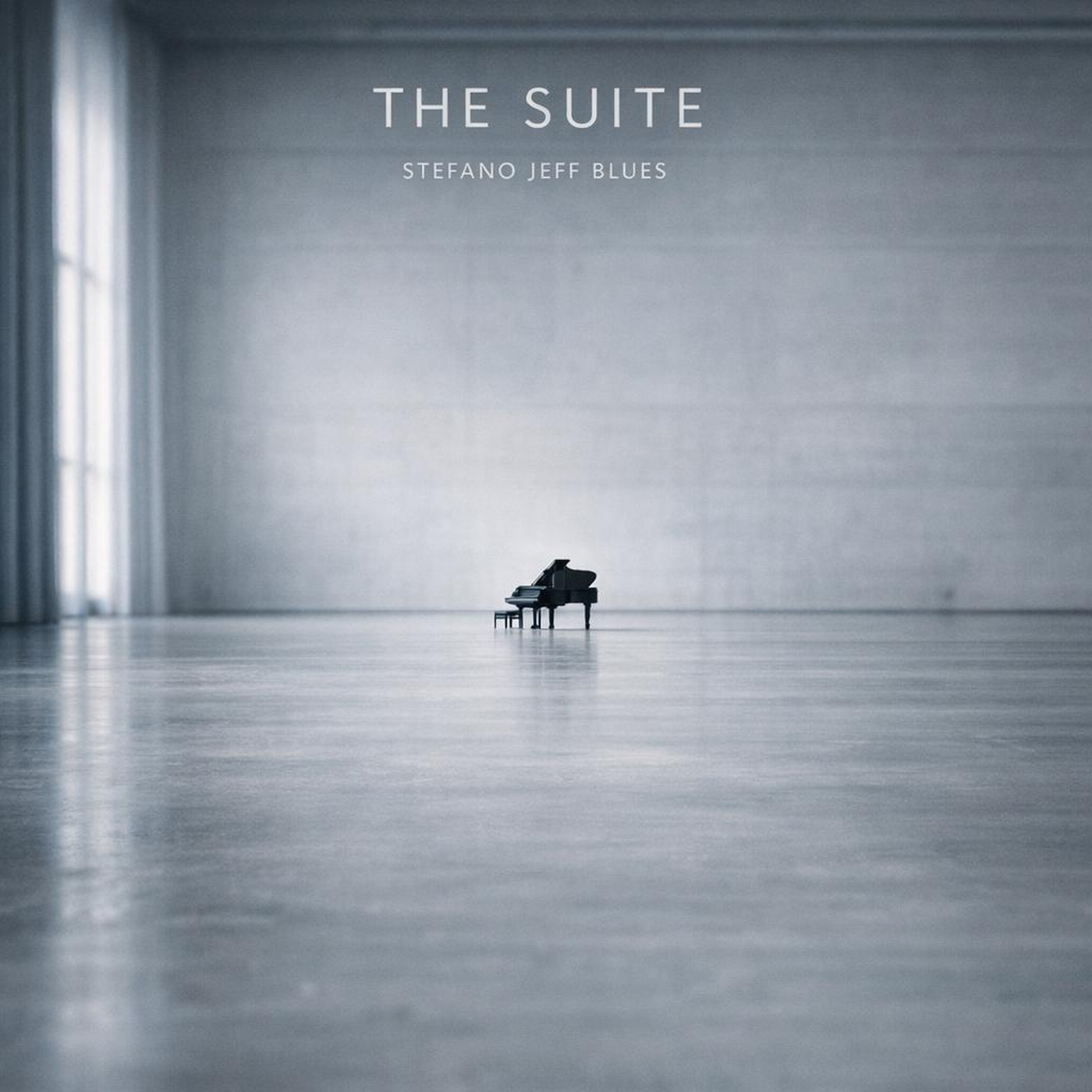
THE SUITE is not an album you press play on. It is an album you enter.
Independent artist Stefano Jeff Blues announces the release of The Suite — eleven tracks conceived as eleven rooms, each one a threshold between presence and absence, light and silence. Built around piano, carefully placed silences, and a rarefied atmospheric sensibility that moves between blues, jazz, cinematic textures, and contemporary sonic exploration, it is a record that does not tell a story so much as inhabit one.
“Eleven rooms, a single breath. The Suite does not tell a story: it inhabits it. Each track is a threshold between presence and absence, light and silence.”

The Album as Architecture
The Suite is a passage through rooms suspended in time. Each piece is a fragment of solitude, memory, and waiting. Between piano, silences, and rarefied atmospheres, the listener walks interior corridors where the boundary between space, memory, and perception slowly dissolves.
The Suite unfolds as a sequence of interiors. Each piece is a room. Each room is a different way of listening to silence.
The eleven tracks move through distinct emotional and spatial states — each one described not through musical terminology, but through the experience of entering it:
A Chair in Silence opens the journey with an empty chair at the centre of the room. No one enters, no one leaves. All that remains are a few notes and time slowing almost to a halt.
Corridor One opens into shadow. Steps move with no precise destination, accompanied by the distant sound of something that seems to remember.
Corridor Three finds the air growing denser — the same path, yet every detail appears different, as if the place had absorbed the thoughts of whoever passes through it.
Corridor Two offers an almost imperceptible detour. The walls seem to draw closer, while a hidden emotion surfaces and at once hides again.
Dust in the Air sees old memories rising slowly, suspended between what has been and what remains.
Interlude: Static Light crosses the darkness with intermittent flashes — no melody, only electrical traces and fragments of light that appear and disappear.
Interlude creates a space of passage where the resonances of the previous rooms mingle with those to come, forming a fleeting point of balance.
Room Without Time stops movement entirely. Every gesture repeats itself unchanged, like a memory left trapped.
Soft Walls absorbs every sound and every word. The outside world disappears, leaving only a warm, silent stillness.
Suite (Exit) opens a door slowly. Space seems to widen for an instant, then everything dissolves, leaving only a distant trace.
The Last Room closes the album in near-emptiness. The notes stay suspended in the air before vanishing — without a true conclusion, without a farewell.
Stefano Jeff Blues is an independent artist whose music begins with the blues but refuses to stay within its boundaries. Blending blues, jazz, blues-rock, gospel, and contemporary R&B with cinematic atmospheres and electronic textures, he has built a personal language centred on guitar, piano, synthesisers, space, and silence.
His approach is rooted in tradition but driven by exploration: classic blues grit, groove, and emotional honesty meet jazz harmony, unexpected dynamics, and a contemporary sonic sensibility. Rather than treating the blues as a destination, he uses it as a starting point for new musical directions. Each album is conceived as a complete journey rather than a collection of individual tracks — music and imagery developing together, compositions becoming scenes, spaces, and stages of a wider narrative. Silence is part of that language, sometimes carrying as much expressive weight as the notes themselves.
Recording, producing, arranging, and curating his projects independently allows Stefano Jeff Blues to preserve a coherent artistic vision from the first idea to the final result. At the centre of everything is not numbers or trends, but a simple principle: authentic music made for people who still take the time to truly listen.
The Suite is his fullest expression of that principle yet.