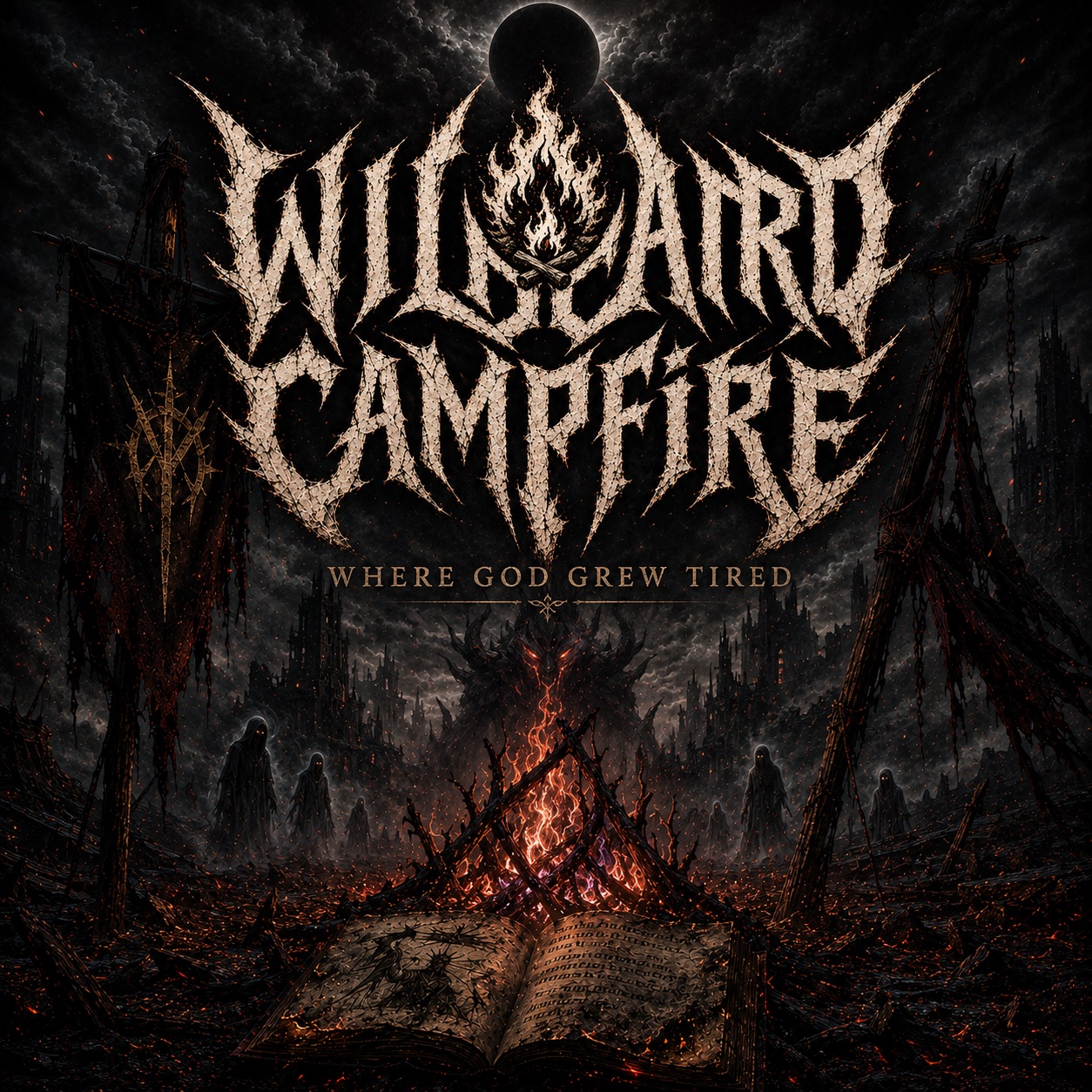
A promise of salvation can become a justification for destruction. This tension lies at the heart of Wildcard Campfire’s Where God Grew Tired, a ten-track concept album that examines how faith and ideology can be transformed into instruments of power. Anchored by the three-part suite The Ashen Gospel, the record follows the progression from hollow promises to rebellion, war, and eventual collapse. Its world is one where the language of liberation can become indistinguishable from the rhetoric of oppression; and where the fall of a leader rarely means the end of the system.

The album opens with The Beast With My Name, immediately establishing a world in which authority and destruction are inseparable. Its central figure builds a kingdom only to become consumed by the violence that sustains it. “I made a kingdom out of ash / Now it’s my turn,” the lyrics declare, framing power as a self-defeating pursuit. The track’s relentless aggression reinforces this collapse, introducing one of the album’s recurring ideas: those who wield destruction in the name of a greater cause may eventually become its victims.
That contradiction takes centre stage in The Ashen Gospel – I. Before the Banners Burn, the first instalment of the album’s three-part narrative backbone. Here, salvation is presented as a political instrument, with promises of righteousness concealing a desire for control. “You built your throne from fear and silence / You fed the crowd a holy lie” exposes the mechanisms through which belief can be manipulated into obedience. The ensuing rebellion appears to offer an escape, but the album leaves room for a more troubling possibility: resistance may challenge the symbols of authority without necessarily dismantling the structures that give them power.
In The Ashen Gospel – II. When the Banners Burn, that possibility becomes a devastating reality. The conflict escalates, and the rhetoric of liberation gives way to the brutality of competing factions. “No peace / No throne / No light / No savior!” captures a world in which the promise of a better order has dissolved into a struggle for survival. The banners may fall, but the desire to dominate remains. Rather than presenting revolution as an uncomplicated victory, Wildcard Campfire explores how movements born in opposition can become trapped in the same logic of coercion they initially sought to overcome.
The album’s political concerns become more pointed on The Tion Revolution, where rapid-fire wordplay turns oppression, distraction, and institutional control into a relentless verbal barrage. “Revolution, burn in my head / Evolution, back from the dead” captures the tension between the desire for transformation and the difficulty of escaping established patterns. The track complements The Ashen Gospel by widening the scope of the critique: manipulation is not sustained by force alone, but also through language, ideology, and the narratives societies accept as truth. A revolution can change the vocabulary of power without changing its underlying grammar.
Yet Where God Grew Tired does not confine its exploration of control to rulers and institutions. On Paradise Has Walls, the struggle becomes intimate, as love encounters the barriers imposed by religious or social expectations. “Your love became my holy war” recasts romantic longing as a conflict against forces that dictate who may love whom. The imagery connects private rebellion to the album’s wider concerns, suggesting that the mechanisms of authority operate not only through kingdoms and political movements, but also through the boundaries imposed on individual lives. The language of faith can offer belonging and meaning, but it can also be used to justify exclusion.
Elsewhere, the album turns from external systems of control to the damage they leave within individuals. The Ghosts of My Past shifts towards a more melodic and introspective sound, bringing guilt and trauma into focus. “What you cannot heal / You learn to carry” offers a quieter counterpoint to the record’s larger conflicts. The line suggests that even when the immediate source of suffering disappears, its consequences endure. In Shackles of Blood, that burden becomes more claustrophobic: “I built my prison / I can’t be saved” captures the moment when guilt and self-perception become another form of confinement. The movement between these tracks and the album’s grander political narrative creates a meaningful parallel: just as societies can perpetuate destructive systems, individuals can become trapped in patterns they struggle to escape.
For all its darkness, however, Where God Grew Tired makes space for absurdity. Khinkali Inferno turns a Georgian dumpling feast into a chaotic battle cry, with “Juice on my knuckles, fire in my heart” capturing its exaggerated, gleefully unruly spirit. The track provides a striking tonal shift, interrupting the album’s ideological conflicts with food, humour, and communal excess. The Legend of the Shanenigator pushes the absurdity further, transforming domestic chaos into an outsized legend about a tiny, unstoppable force of destruction. These tracks may appear far removed from the album’s political and spiritual concerns, but their irreverence gives its fictional world texture. They also prevent the record from becoming a uniformly grim exercise, reminding the listener that human experience cannot be reduced to grand historical narratives.
All these threads converge in The Ashen Gospel – III. Where God Grew Tired, the closing chapter of the suite and the album. The conflict now stretches across centuries, outliving the leaders, institutions, and symbols that first gave it shape. “The riders died, but war kept marching / Wearing nations like a cloak” distils the record’s central argument: power can change its appearance while preserving its underlying logic. The banners, borders, and doctrines may be replaced, but the machinery of violence continues to find new justifications. The resulting vision of civilisational collapse is not simply an apocalyptic finale; it is the consequence of a world unable to distinguish genuine transformation from the repeated rearrangement of authority.
Wildcard Campfire reinforces this expansive narrative through contrasts between low-tuned riffs, crushing breakdowns, melodic passages, and cinematic atmosphere. Drawing on melodic metalcore, djent, deathcore, progressive metal, and post-metal, the album shifts between overwhelming force and moments of introspection. Its more aggressive passages lend weight to the conflicts, while the melodic tracks reveal their psychological consequences. The variety of styles serves the album’s narrative ambitions, allowing political upheaval, personal suffering, and dark humour to occupy the same fictional universe.
The project’s creative process adds another dimension to the listening experience. Rom Burla develops the lyrics, guitar-written riffs, melodies, song structures, and overall creative direction, using generative AI to render and perform the material before editing, arranging, and final mastering. This distinction is important when considering the album’s authorship: its narrative architecture and compositional direction originate with Burla, while AI forms part of the performance and production process. The project’s faceless presentation further places the emphasis on the music and the interconnected world it constructs.
Where God Grew Tired is concerned with the ruins left behind when ideals become instruments of power. Through its three-part The Ashen Gospel, its portraits of intimate suffering, and its unexpected moments of absurdity, Wildcard Campfire examines how faith can become control, rebellion can reproduce oppression, and violence can survive long after its original justification has disappeared. The release builds a world out of the remnants of failed promises, asking whether humanity can ever escape the systems it inherits; or whether it is destined to keep rebuilding the same ruins under different banners..