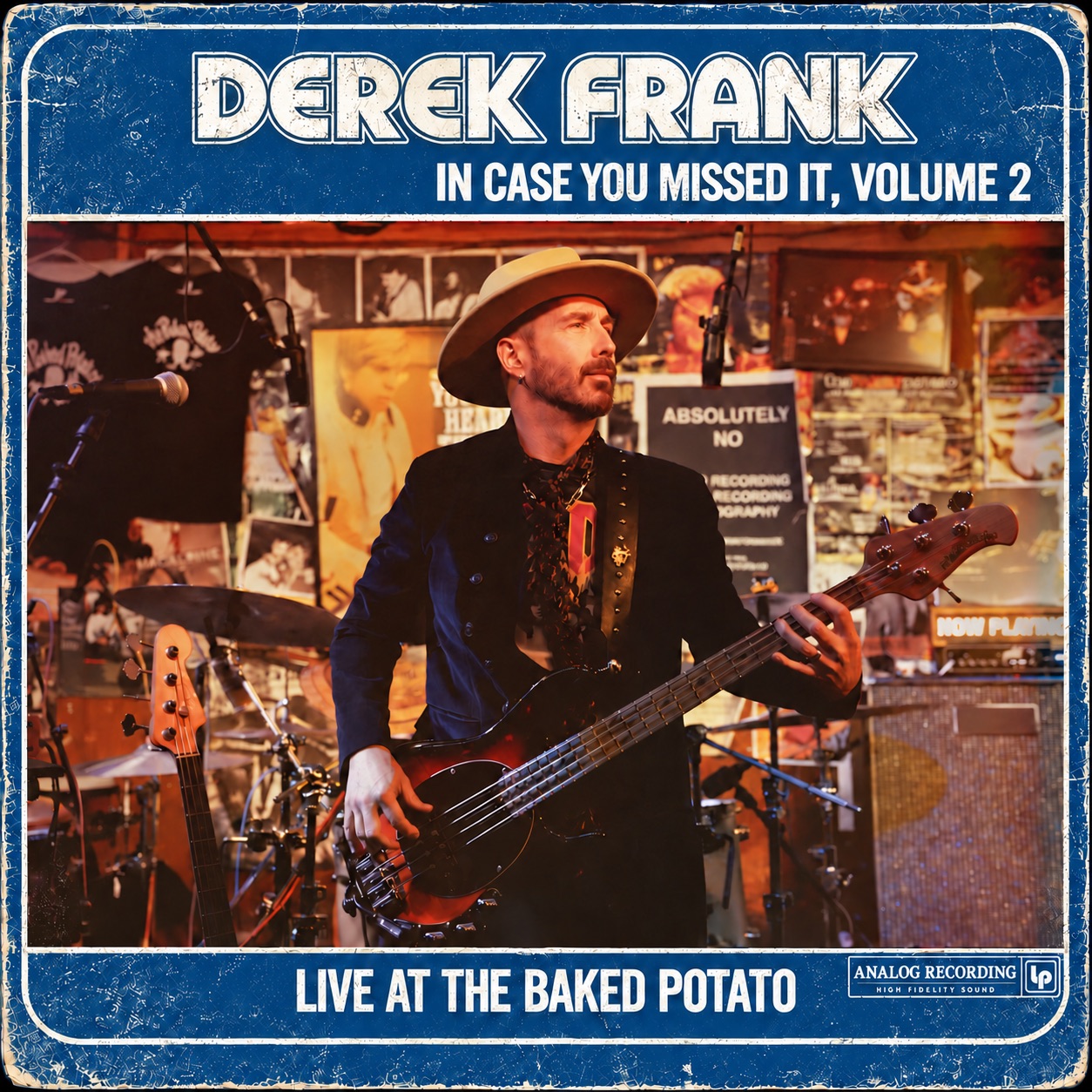
There’s a disease running through modern music, and it’s called perfection. Everything’s polished, quantized, compressed, corrected, and sterilized until the last trace of human personality has been scrubbed out. Somewhere along the way, somebody decided music was supposed to sound flawless instead of alive. Well, Derek Frank apparently never got that memo, and thank God for small miracles, because In Case You Missed It, Volume 2 – Live at The Baked Potato, arriving November 7, 2026, is built around an idea so beautifully irresponsible it ought to be illegal: put seven ridiculously talented musicians onstage without rehearsing and see what the hell happens.
Now, understand something. Frank isn’t some guy who bought a bass guitar last Christmas and discovered Jaco Pastorius on YouTube. This is a man who’s spent decades providing the bottom end for Shania Twain, Gwen Stefani, Shakira, Kelly Clarkson, Melissa Etheridge, Don Felder, and enough other household names to fill a Grammy Awards afterparty.
But here’s the beautiful irony: after all that superstar machinery, Frank’s solo music finds its identity in the simple business of musicians playing together.
On May 21, 2026, during a two-week break between touring with Etheridge and Felder, Frank booked a show at The Baked Potato in Studio City, California. Founded in 1970 by Wrecking Crew keyboardist Don Randi, the intimate club has spent decades serving as a sanctuary for musicians who believe jazz, rock, funk, and whatever other sonic mutant crawls through the door belong together.
Frank’s band couldn’t rehearse. Scheduling conflicts. Different commitments. Everybody running around Los Angeles trying to keep the lights on. So he sent out charts, recordings, and a set list and told everyone to do their homework.
Even substitute keyboardist Michael Bluestein, a longtime member of Foreigner, was tackling most of the material for the first time.
After the first set, Frank announced, “Rehearsal is overrated.”
That’s either the funniest thing a bandleader can say or the most dangerous, depending on who you’ve hired.
The resulting eight-track album opens with “Da Break/Breakout,” stitching together bassist Oskar Cartaya’s “Da Break” and Frank’s own “Breakout.” It’s a fitting introduction to a record built around the principle that rhythm isn’t merely something happening underneath the music. Rhythm is the music. Everything else is decoration, argument, seduction, or glorious interference.
Frank’s musical vocabulary is wonderfully filthy in the best possible sense. We’re talking funk with grease under its fingernails, jazz that hasn’t forgotten how to dance, soul that doesn’t need a singer to communicate emotion, and the kind of bluesy instrumental swagger that recalls a forgotten 1970s detective show where everybody drives a Cadillac and nobody can be trusted.
The album contains five originals and three covers, and those covers tell you practically everything about Frank’s musical religion. The Meters’ “Give It What You Can” invokes New Orleans funk, where the space between notes matters as much as the notes themselves. Tower of Power’s “Squib Cakes” represents horn-driven sophistication, while The Greyboy Allstars’ “Happy Friends” connects the music to a generation that understood jazz could be intelligent without becoming terminally self-important.
This is music with a bloodstream.
Frank’s band includes drummer Matt Hankle, guitarist Anthony King, percussionist Demian Arriaga, trumpeter Dan Fornero, saxophonist George Shelby, and Bluestein on keyboards. Together, they provide the ingredients for Frank’s intoxicating combination of deep grooves, vintage soundtrack influences, and instrumental conversation.
And here’s what separates Frank from the endless parade of virtuosos desperate to demonstrate their superiority: he understands that playing music isn’t an athletic competition. A lesser bandleader might deliver an hour of extended bass solos designed to impress seventeen people on an internet musicians’ forum. Frank builds his compositions around the ensemble.
Fortunately, house engineer Jeremy Krull recorded the performance. Frank listened back days later and realized the first set deserved an album. Jim Scott, whose credits include Tom Petty, Wilco, and Red Hot Chili Peppers, mixed the recordings, with Benjamin Knapp assisting and Whynot Jansveld mastering.
There’s something wonderfully subversive about a musician accustomed to massive touring productions making a record that celebrates the unpredictable intimacy of a small club.
In an age when practically anything can be manufactured, repaired, or simulated digitally, Frank’s project champions something increasingly precious: musicians trusting one another enough to take chances.
In Case You Missed It, Volume 2 isn’t trying to reinvent jazz or rescue funk. Its ambition is considerably more appealing: reminding people that instrumental music can possess personality, humor, intelligence, and a healthy disregard for the rules.
Because sometimes the magic isn’t in getting everything right.
It’s in making something happen that nobody could have planned.
And in an increasingly synthetic musical universe, that might be the most gloriously rock-and-roll idea of all.
By Leslie Banks