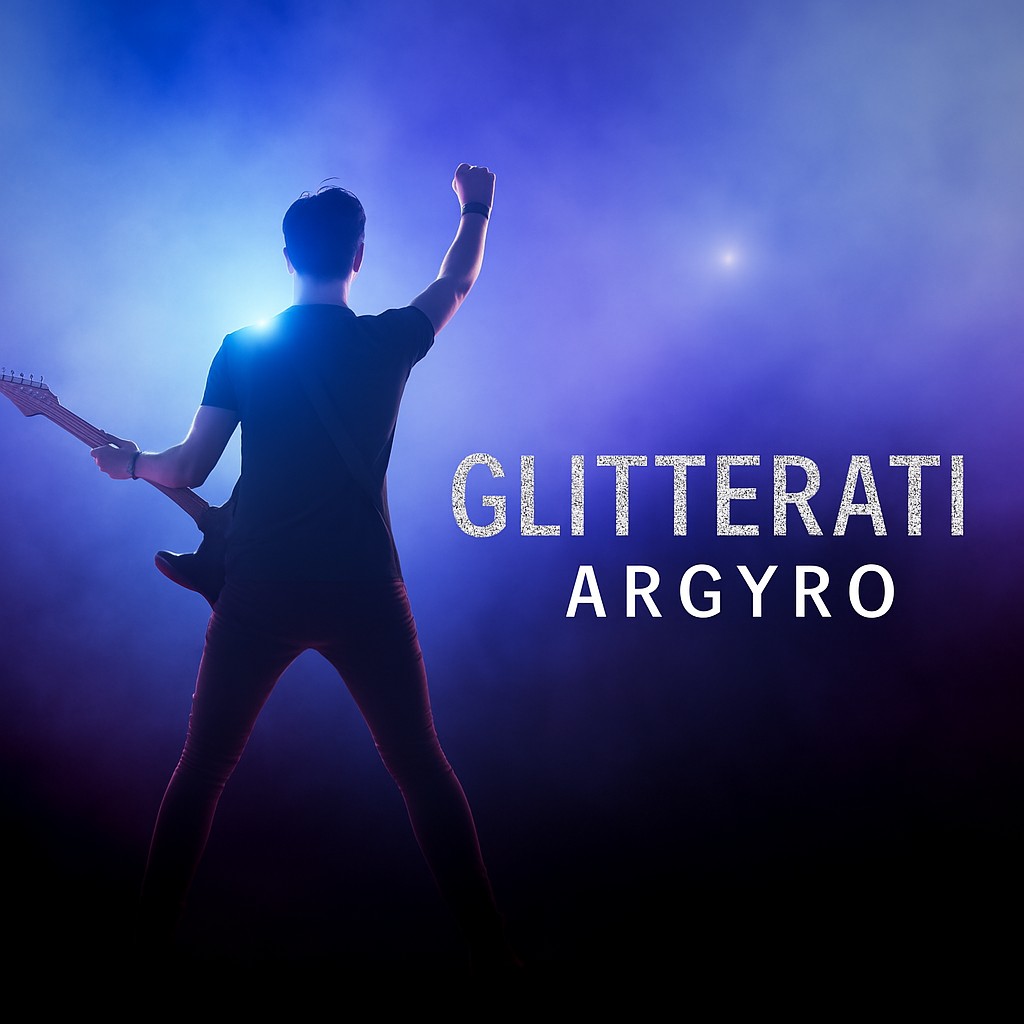
ARGYRO’s Glitterati is an album preoccupied with surfaces—how they’re constructed, how they shimmer, and how quickly they dissolve. It’s a record that treats fame not as a destination but as a texture: something you move through, something that coats the skin. Across its runtime, ARGYRO builds a sleek, stylized world of red carpets, coastal escapes, and late-night introspection, only to quietly question whether any of it holds.
The title track sets the tone with blunt clarity. “Part-time movie star” becomes both aspiration and diagnosis, a self-aware nod to the gig economy of identity in the digital age . The song is buoyant, almost cheeky, but beneath that is a subtle unease. The narrator throws his name around “like a star-shaped boomerang,” suggesting that recognition is less about permanence and more about repetition—visibility as a loop rather than a ladder.
That idea—of selfhood as something performed and re-performed—echoes throughout the album.
Musically, Glitterati operates in a hybrid space that blends polished pop instincts with rock traditionalism and a light electronic sheen. The production is clean but not sterile, allowing ARGYRO’s voice to remain central: slightly detached, occasionally yearning, always aware of its own presentation. There’s a cinematic quality to the arrangements, but it’s less about grandeur and more about framing—each song feels like a carefully composed shot.
“Cool Shades” leans into that aesthetic most effectively. It’s languid and sunlit, with a melodic drift that mirrors its lyrical escapism. The imagery—water, sand, intimacy—suggests retreat, but not necessarily relief. Even in this softer setting, the performance remains intact. The coolness is deliberate, curated. Pleasure here is something to be staged.
That tension sharpens on “She’s So LA,” which treats Los Angeles not just as a place but as an idea: speed, beauty, and distance all at once. The song moves quickly, almost breathlessly, as if trying to keep up with its subject. The woman at its center is less a person than a projection—“a drive-by shot of sunshine”—and the narrator’s pursuit feels less romantic than compulsive. It’s desire filtered through spectacle.
If those songs explore the allure of the image, “The Phenomenon” interrogates its construction. It’s the album’s most overtly declarative moment, full of bravado and self-mythologizing. ARGYRO positions himself as both creator and product, leaning into the language of dominance and visibility. But there’s a hollowness embedded in the performance. The repeated affirmations feel less like confidence and more like maintenance—an identity that requires constant reinforcement to remain intact.
That sense of fragility becomes more explicit in the album’s second half.
“House Upon the Mountainside” is a pivot inward, trading the urban gloss for something quieter and more reflective. The imagery shifts—fog, fire, memory—and with it, the tone. Here, ARGYRO allows space for stillness, for the possibility that meaning might exist outside of performance. It’s one of the few moments on the album that feels unguarded, or at least less mediated.
Similarly, “So One of a Kind” and “Perfect Endings” explore intimacy with a degree of skepticism. These are love songs, but they resist resolution. The recurring metaphors—lightning in a bottle, fleeting encounters—emphasize transience over permanence. Even nostalgia is unstable, something that can be revisited but not reclaimed. The reference points are familiar, but the emotional grounding is deliberately uncertain.
The album closes with “Lifeline,” its most direct and arguably most revealing track. Here, the focus shifts from individual performance to collective experience. The lyrics gesture toward division—“everyone’s tongue is shaped like a knife”—before pivoting to a plea for connection . It’s a notable shift in perspective, one that suggests the limitations of the persona ARGYRO has been inhabiting. The lifeline isn’t just emotional; it’s existential. It’s about finding coherence in a world that feels increasingly fragmented.
What Glitterati ultimately offers is not a critique of fame so much as an immersion in its mechanics. ARGYRO doesn’t stand outside the system he’s describing; he moves within it, documenting its rhythms and contradictions from the inside. The album’s strength lies in that proximity. It understands that the appeal of visibility is inseparable from its instability.
There are moments where the aesthetic cohesion works against it—where the polish becomes predictable, where the emotional distance feels less intentional and more habitual. But even those moments reinforce the album’s central concern: the difficulty of distinguishing between authenticity and performance when both are constantly being negotiated.
In that sense, Glitterati is less about who ARGYRO is than about how he appears—and how that appearance shifts depending on the angle, the light, the audience. It’s an album that doesn’t resolve its questions because it’s not trying to. Instead, it lingers in the ambiguity, allowing the listener to sit with the tension between image and identity.
And in that tension, it finds its most compelling voice.
–John Carmen