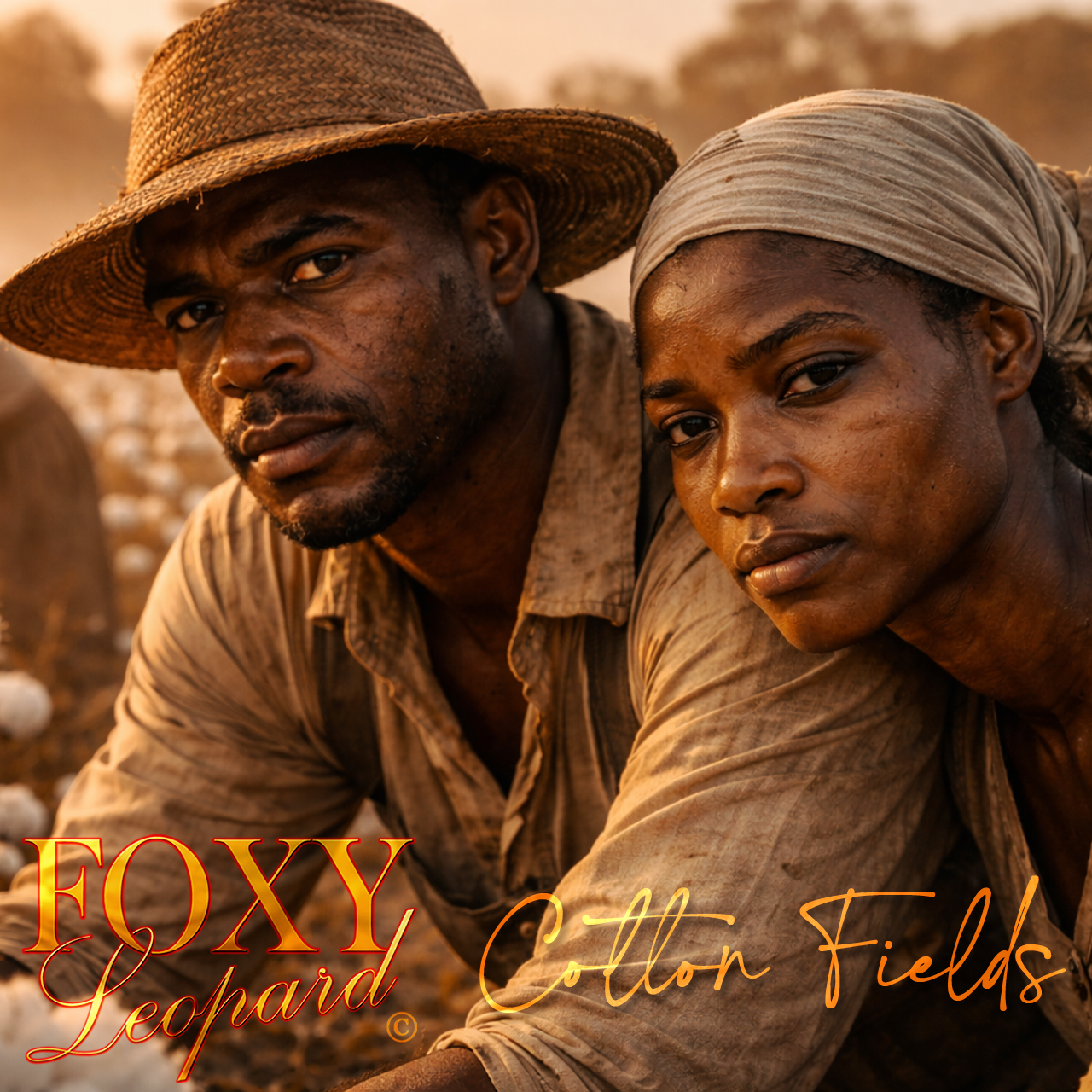
Rather than focusing on grand historical events, Cotton Fields narrows its lens toward ordinary existence: repetitive labor, inherited routines, and the quiet emotional exhaustion people carry without realizing how deeply they’ve been shaped by the world around them. That human focus is exactly what gives the song its weight. Instead of dramatizing conflict itself, Foxy Leopard captures the atmosphere that exists before fracture fully reveals itself, where life continues normally on the surface while something underneath is already beginning to decay.
Built around raw resonator guitar, sparse percussion, and weathered vocals that feel pulled from another lifetime, the production sounds intentionally exposed. Nothing here feels polished for the sake of polish. The song breathes through dust, silence, and empty space. Foxy Leopard creates something that feels less like a studio recording and more like a memory preserved inside static and worn tape.
“Cotton Fields” says so much by refusing to say everything outright. The writing leans heavily on imagery and implication, allowing the listener to sit inside the atmosphere rather than simply observe it. Lines like “You say nothing here is wrong / Just the weight they carry on” quietly become the emotional center of the track. There’s denial buried inside routine, comfort tangled with exploitation, and an unsettling sense of people continuing forward simply because they no longer know another way to exist.
The repeated refrain “Cotton fields / White and wide / Thread and wheels / Turn our side” almost functions like machinery itself, cyclical and hypnotic. Meanwhile, images like “Pink and white in summer’s sun” create this eerie collision between beauty and hardship, softness and exhaustion. Even the final repetition of “The spark got in / The bell shifts once” lands less like a climax and more like an omen quietly echoing in the distance.

Foxy Leopard avoids theatricality entirely, which works perfectly for the song’s emotional landscape. The vocal delivery feels intimate and worn; and when the subtle backing vocals emerge behind the lead during the chorus, “Cotton Fields” suddenly expands into something communal, as though generations of voices are quietly bleeding into one another.
What makes the track even stronger is the broader conceptual framework surrounding it. Positioned between War & Peace and the upcoming Before project, “Cotton Fields” exists in the uneasy space before fracture becomes visible. Not war itself, but the ordinary emotional climate that allows division to slowly take root unnoticed. That perspective makes the song feel surprisingly contemporary despite its historical framing. Foxy Leopard understands that collapse rarely announces itself loudly at first. Sometimes it grows quietly through routine, repetition, economics, and inherited silence.
There’s also something genuinely fascinating about how the project merges cinematic Americana with AI-assisted composition. In many cases, that combination could feel emotionally detached. Here, though, it actually deepens the atmosphere. The music feels suspended between eras, caught somewhere between old folk traditions and modern existential unease.
Cotton Fields feels immersive, reflective, and intentionally heavy in its stillness. Through “Cotton Fields,” Foxy Leopard delivers a haunting meditation on how division quietly grows inside ordinary life long before anyone notices the fracture beginning to form..