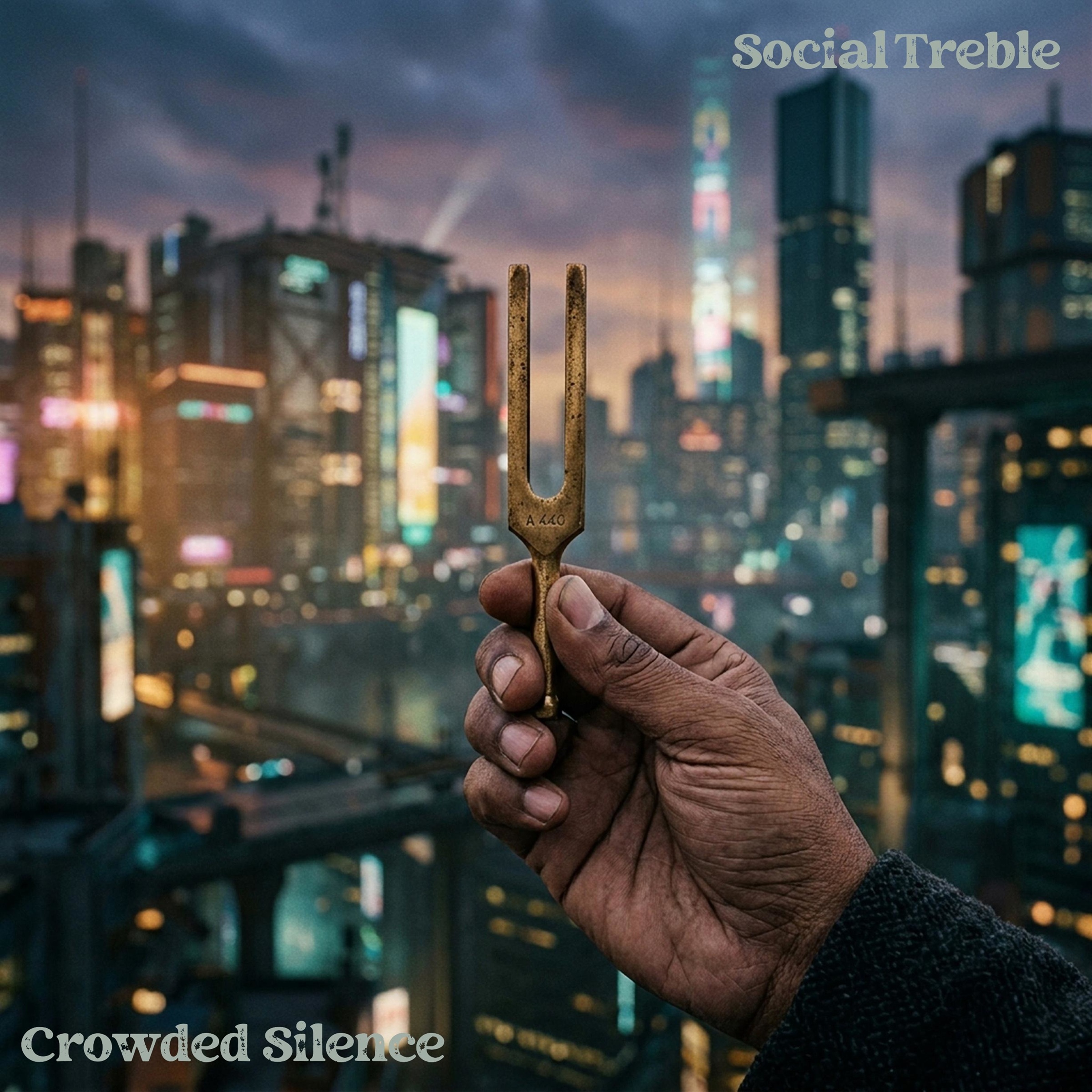
There is something terrifyingly plausible about the world Social Treble constructs on “Crowded Silence (Binaural Audio).” Not because it imagines a dystopian future, but because it barely feels like fiction at all. Set in a hyper-surveilled Bengaluru of 2031, the track follows Token AS-1133, a “Persistent Cognitive Token” whose thoughts, labor, attention span, and creative output have been absorbed into the SOMA Network’s endless extraction economy. “There are no employees anymore. Only engaged tokens and silenced ones.” That single line hangs over the entire composition like fluorescent corporate lighting: cold, artificial, and almost impossible to escape..
What makes “Crowded Silence” intriguing is that Social Treble understands dystopia not as spectacle, but as procedure. The horror here is contractual. Hidden inside the Token Activation Contract is a forgotten clause permitting voluntary decommissioning if a token can remain cognitively and biometrically invisible to the surveillance mesh for almost 229 seconds. The system wrote the clause. The system forgot the clause. He found it anyway. “He reads it more carefully than the system reads him, and the reading is the exit.” That sentence becomes the emotional thesis of the entire project: resistance not through violence, but through interpretation.
“Crowded Silence” refuses conventional structure entirely. No chorus, no verses, no lyrical hooks begging for replay value. Instead, the track unfolds as a six-act cinematic sequence moving through “Boot Sequence,” “Algorithmic Colonization,” “Structural Collapse,” and “Reabsorption Failure” with unnerving precision. The composition behaves like an escape protocol unfolding in real time. Industrial textures grind against ambient post-rock atmospheres while electronic pulses flicker like malfunctioning telemetry signals. The influence of Nine Inch Nails is present in the mechanical density, while echoes of Steven Wilson and Vangelis emerge through the track’s patient, cinematic architecture. Yet the result never feels derivative. Social Treble calls it “cyber-prog,” and honestly, that description fits perfectly: less a genre than a psychological environment.
The binaural production is where the experience fully mutates into something immersive and strangely physical. “ON HEADPHONES, OR NOT AT ALL” is not marketing language here; it is an instruction. Dragonfly drones circle the listener’s skull. Metallic reverbs stretch behind your shoulders. Waves from the brass tuning fork move through the listening field rather than merely across it. Through headphones, “Crowded Silence” stops sounding like a song and starts behaving like a monitored space. You are not observing the surveillance system anymore. You are standing inside it.

The visual component deepens the paranoia beautifully. The glitched subtitles, collapsing holograms, fragmented rendering artifacts, and unstable dragonflies are framed not as stylistic flourishes but as evidence of system failure. The SOMA Network can no longer render AS-1133 correctly because it can no longer read him. One of the strongest moments arrives during the “Compliance Court” sequence when synthetic architectural walls peel away to reveal a real park beneath the simulation, as though reality itself had been buried underneath endless layers of optimization. “What the system could not see, you are now seeing.” It is both a narrative reveal and a philosophical one.
There is also something quietly radical about how transparent this entire release is. Social Treble openly discloses every tool used in the creation process: MIDI guitar, virtual instruments, AI-generated visuals, DAWs, editing software; stripping away the illusion of technological mysticism. The project never pretends the machines created themselves. The systems are part of the medium, but the emotional architecture remains primarily human; and perhaps that is what gives “Crowded Silence” its emotional weight beneath all the cybernetic aesthetics: this is ultimately a story about reclaiming unreadability in a world obsessed with quantifying every fragment of existence.
“Crowded Silence” by Social Treble leaves behind more than an immersive audio experiment or a dystopian concept piece. The track becomes an argument for opacity itself. For the right to remain partially unknowable in systems designed to monetize total visibility. If “Skyline Motherboard… The Burden of Being Known” was the diagnosis, then “Crowded Silence” truly feels like the escape protocol: 229 seconds of disappearing from the grid without ever needing to run..