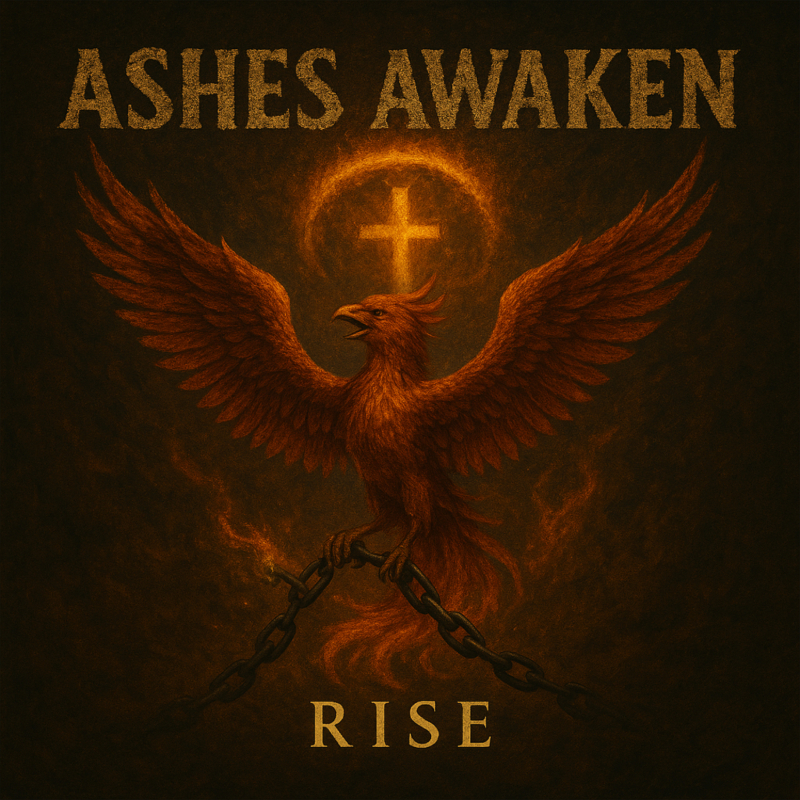
Christian music has long negotiated a tension between proclamation and artistry, between delivering a clear message and creating music compelling enough to carry it. Ashes Awaken’s “Hallelujah” succeeds because it doesn’t treat those goals as mutually exclusive. Instead, the Pittsburgh-based band’s latest single builds a bridge between modern metal’s physical intensity and congregational worship’s communal spirit, allowing each to strengthen the other.
Written by Michael Stover, “Hallelujah” is a song with an unusual history. Before its transformation into a metal anthem, it found success as a Top 5 hit on the CDX Positive Country chart through Stover’s project Dust and Grace. The shift in genre reveals something fundamental about the composition itself. The melody and message are sturdy enough to survive dramatically different arrangements, suggesting that the song’s core lies less in its instrumentation than in its emotional clarity.
The opening lyric is deceptively simple:
“I wanna sing something to ya
I wanna sing hallelujah.”
There’s little ornamentation here. Rather than constructing elaborate metaphors, Stover relies on direct language, trusting repetition and musical development to provide emotional momentum. It’s a strategy rooted as much in gospel tradition as in rock music, where repetition can transform a phrase from statement into experience.
The song gradually expands outward. The verses provide personal context, culminating in perhaps its most revealing lines:
“I wasn’t born a believer
I was a desperate deceiver
Until I found my Redeemer.”
Those words establish “Hallelujah” as testimony rather than abstraction. The lyric doesn’t dwell on the details of transformation, but it doesn’t need to. Its effectiveness comes from its economy. In a few short lines, the song sketches a movement from alienation to faith, allowing listeners to fill in the emotional landscape themselves.
Musically, Ashes Awaken resist the temptation to let heaviness become an end in itself. The guitars are dense and forceful, anchored by a rhythm section that gives the song considerable weight, yet the arrangement continually opens toward melody rather than collapsing inward. The choruses broaden harmonically, creating space for voices rather than simply volume. The result is a performance that feels expansive instead of oppressive.
That balance is central to the song’s appeal. While modern Christian metal often emphasizes confrontation and spiritual warfare, “Hallelujah” emphasizes celebration. The repeated refrain—
“Hallelujah… Hallelujah…
Everybody praise the Lord.”
—functions less as a lyrical hook than as an invitation. It imagines worship not as an individual act but as a shared experience, echoing the participatory traditions found in both church services and arena rock concerts.
The production reinforces this communal quality. Rather than burying the vocals beneath layers of instrumentation, the mix consistently prioritizes clarity. Every repetition of the title carries the same purpose: to draw the listener further into the song’s central act of praise. The guitars retain their aggression, but they serve the melody instead of competing with it.
“Hallelujah” also occupies an important place within Ashes Awaken’s broader body of work. Previous singles such as “A Better Way,” “For You,” and “Amazing Grace, Again” explored addiction, repentance, and redemption with notable candor. “Hallelujah” arrives after those struggles, functioning as the emotional resolution to that narrative. Its optimism feels earned because it follows songs willing to confront pain without minimizing it.
In the end, “Hallelujah” demonstrates that contemporary Christian metal need not choose between musical power and spiritual accessibility. Ashes Awaken have created a song that embraces both. It celebrates faith without sacrificing intensity and delivers worship without abandoning the visceral energy that defines the genre. The result is a single that is as persuasive musically as it is spiritually, finding strength not in complexity but in conviction.
–John Parker