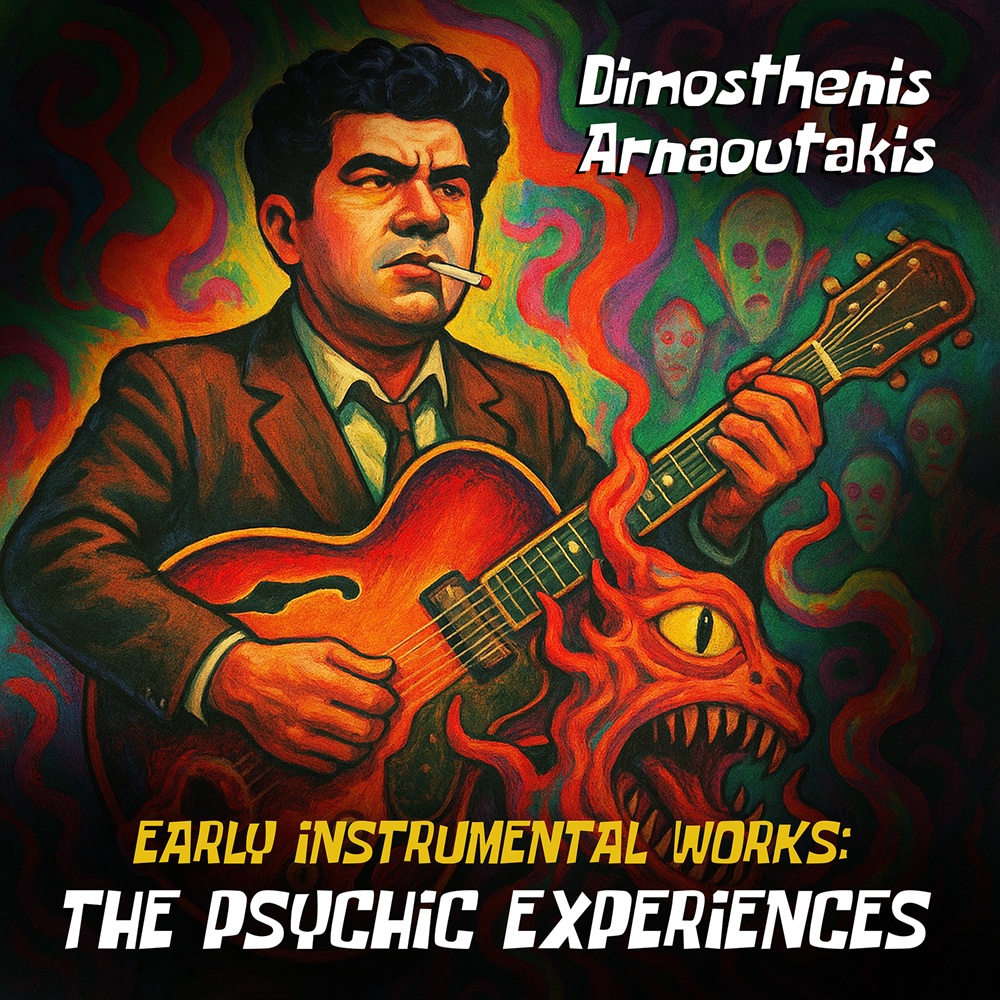
Dimosthenis Arnaoutakis has been a professional musician since 2020, first making a name for himself through Roswell 47, a one-man project built around Greek-language lyrics and instrumental work, its name borrowed from the famous 1947 incident in New Mexico. Since parting ways with his former label, Music Mirror, earlier this year, he’s gone fully independent and shifted his focus almost entirely to instrumental music, blending Greek folk traditions like dimotiko and rebetiko with American roots influences: spaghetti-western scoring, blues, country, and vintage guitar records. Early Instrumental Works: The Psychic Experiences, out June 19th, gathers together previous singles and unreleased material into his second full-length of the year, and it plays as a genuine survey of everywhere his instrumental writing has gone recently.
The album’s throughline shows up clearly across its three guitar-led singles. “Salamandra,” the first of the trio, builds on the Greek syrtos rhythm, layering electric guitar improvisation and reverb-soaked slide guitar over that traditional pulse, and it sets the record’s whole character early. “Jugador Blues” follows in a moodier, more American vein, plucked guitar and unhurried rhythm forming a patient blues instrumental with winding lead lines. “Il Traditore” ends that trilogy by combining the best parts of the first two, which include rhythm parts from one song and quoting melodies from another. Together, the three make the clearest case for what Arnaoutakis is actually doing on this record: treating folk rhythm and guitar improvisation as two ends of the same idea rather than separate traditions bolted together.
The second half of the album shifts into a much more atmospheric style; it borders on horror, actually, and my personal favorite tracks are “Conspiracy” and “Seance.” The former because of how harmonically interesting it is, and the latter because of how texturally interesting it is. The harmony of “Conspiracy” is fittingly very creepy, and the bassline is so off-putting, like a lurking evil in the shadows, while the chords are like flickering candlelight and a church organ being played ritually to usher in some eldritch monstrosity. The textures of “Seance” stand out because there are multiple synthesizer sounds that are used effectively here, and so it’s very different from the traditional approach of most of the other tracks. Harmonically, it’s very similar to “Conspiracy” actually, but that big fuzzy lead guitar sound that comes in abruptly is like the eldritch abomination itself awakening and speaking in short, ominous, incoherent sentences.
That tonal swing, from folk-rooted guitar pieces into something considerably darker and more atmospheric by the album’s back half, is what keeps Early Instrumental Works from playing like a simple singles compilation. It’s a genuinely varied listen that still holds together, closing out on a gentler, more melodic note with “Waltz” after all that atmospheric weight. For an artist barely a year into working fully independently, this record makes a strong case that instrumental music alone can carry as much range and personality as anything with lyrics attached.