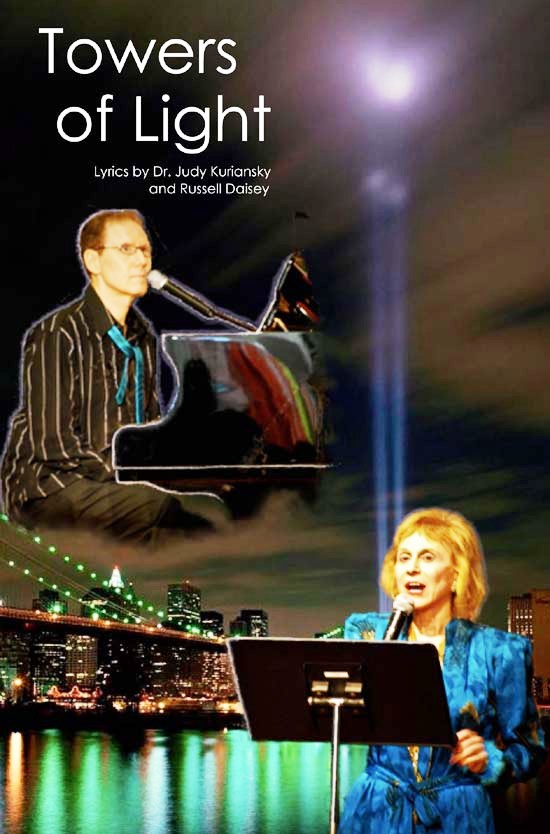
Two beams of light once rose above the Manhattan skyline where the Twin Towers had stood. From that haunting image came Dr. Judy Kuriansky & Russell Daisey’s “Towers of Light,” a song that transforms an emblem of profound loss into one of remembrance, resilience, and hope. More than two decades later, its central metaphor still carries an extraordinary emotional weight: light not as an escape from grief, but as something that can exist alongside it.
Written in the aftermath of September 11, “Towers of Light” begins from a deeply personal place. “I feel like I’m broken inside me / I feel that it’s so hard to heal,” the opening lyrics admit, immediately establishing the song’s emotional landscape. Rather than rushing toward consolation, the song gives space to the confusion of loss, capturing the longing to return to a world that existed before tragedy: “I want to wake up and remember / that morning before it all changed.”
That vulnerability gradually gives way to the song’s defining image. “Towers of Light shine in the night / A pathway for new stars,” the chorus sings, turning the memorial beams above Lower Manhattan into a celestial metaphor. The departed become “new stars,” while the light becomes a symbol of continuity; an image that allows remembrance and hope to occupy the same space.
“Towers of Light” by Dr. Judy Kuriansky & Russell Daisey draws from a classic/soft-rock palette, with an accessible, anthem-like quality that suits its communal message. Its emotional progression is mirrored in the lyrics, moving from the individual experience of being “broken” toward a broader recognition of those who were lost: “They’re our friends. They’re our lovers. / They’re our sisters and our brothers.” The song’s focus on relationships rather than historical specifics is what ultimately gives it a universal quality.
That universality is reflected in its remarkable journey. Since its creation, “Towers of Light” has been performed on five continents and at more than 170 occasions, from memorials and houses of worship to peace summits and international gatherings. One of its most significant moments came in Hiroshima in 2006, where Daisey performed the song with Kuriansky and vocalist Neil Walsh in the presence of the Dalai Lama, Archbishop Desmond Tutu, and Nobel Peace Laureate Betty Williams. The Dalai Lama’s response was simple: “Powerful. Very powerful.”
The song later found another life in Japan, where soprano Tomoko Shibata translated it into Japanese and performed it in connection with the 2011 earthquake, tsunami, and nuclear disaster. In doing so, a song born from one tragedy became a musical language through which another community could express grief and hope.
Perhaps that is the lasting strength of Dr. Judy Kuriansky & Russell Daisey’s “Towers of Light.” It does not suggest that healing means returning to normal. In fact, “normal’s so far from my mind,” the song acknowledges. Instead, it arrives at a quieter form of hope: “We’re still here, / Gazing at new stars.”
Twenty-five years later, the light still remains!