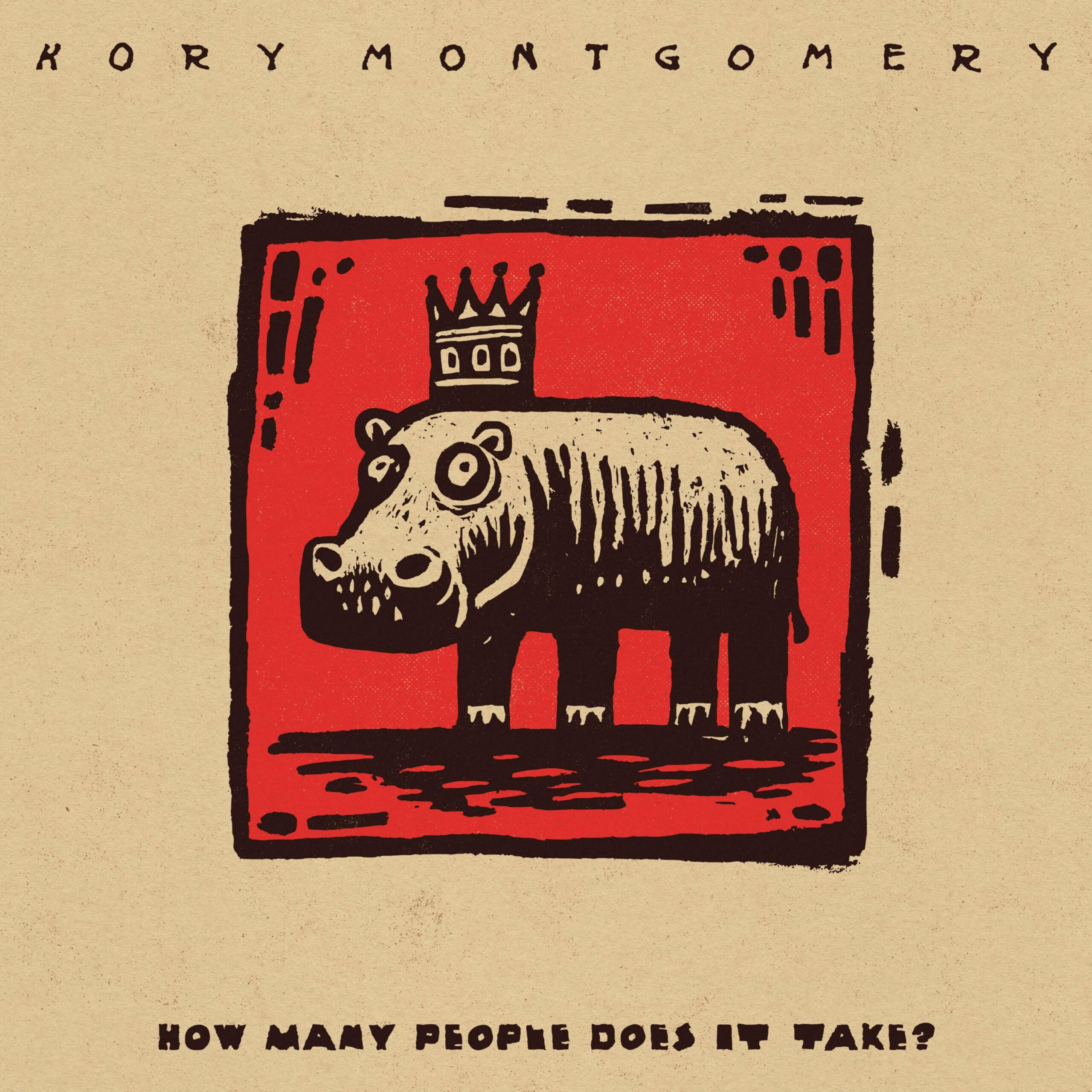
The blues has always been more than a fixed musical vocabulary; it is a foundation from which countless other sounds have developed. On How Many People Does It Take?, Kory Montgomery explores that versatility, moving between blues-driven grooves, jazz-inflected brass, funk rhythms, and more introspective passages. The album embraces the looseness of a musician comfortable across genres, finding its character in the contrasts between its arrangements rather than in any single stylistic identity.
 Montgomery’s relationship with music began early, with his band opening for B.B. King when he was just 15. Since then, he has performed alongside artists spanning blues, rock, and the jam-band scene, toured with Andy Frasco & The U.N. and The Blues Brothers Revue, and collaborated with musicians from diverse backgrounds; and after a decade without a full-length release of his own, How Many People Does It Take? brings together songs accumulated throughout that journey, with contributions from members of the Sturgill Simpson Band, Blind Boys of Alabama, Lettuce, Dopapod, and others.
The album opens with “dying breed,” a relatively slow-burning track built around a hypnotic swing. Its lyrics explore the experience of being judged from a distance, with lines such as “they’re looking down on me” suggesting a tension between outside perceptions and personal conviction. The understated groove gives the song room to breathe, allowing its character to emerge gradually.
The title track takes a more overtly blues-driven direction. Brass adds a distinctive presence to the arrangement, creating a lively musical conversation around the pointed question, “How many people does it take to do nothing?” There is an intriguing contrast between the lyric’s frustration and the music’s magnetic, almost playful energy, giving the track an irreverent edge.
“delta glare” follows with a drum roll that suggests a grand entrance before settling into a relaxed, groove-oriented arrangement. Subtle gospel influences and understated instrumental details lend it an easygoing character. Meanwhile, “settle in” takes a more intimate approach, opening with ambient textures that establish a sense of space. Its lyrics touch on family struggles, vulnerability, and resilience, particularly in the lines “sad days I just can’t reverse” and “but I’m lucky just to be alive.” These moments introduce emotional depth that contrasts with the album’s more playful and energetic passages.
Elsewhere, “humanity” brings a more driving intensity, while “name song” returns to a laid-back sensibility. “nene” introduces a distinctly coastal atmosphere, adding another shade to the album’s varied sonic palette. Alongside “try” and “blush,” these tracks reinforce the record’s willingness to move between moods without becoming confined to a single stylistic identity.
How Many People Does It Take? by Kory Montgomery feels like the work of a musician bringing years of experience into the present. Its shifting grooves, expressive arrangements, and candid lyrical moments reflect an artistic identity shaped by collaboration and exploration. Rather than simply returning to the blues, Montgomery uses it as a starting point, allowing the music to move wherever the stories and sounds take it. Providing us with a collection that feels less like a retrospective than a continuation of a lifetime spent learning, playing, and discovering.