Rock Era Magazine has been contacted by multiple bands across multiple countries who are actively taking steps to reclaim their music, their rights, and their reputations from Darkside Records and its founder Saïd Chebacheb. Today, we share two significant updates — one marking a concrete victory, and one serving as a sobering reminder that for some bands, the damage done has still not been fully repaired years later.
We publish these accounts because silence protects the wrong people.

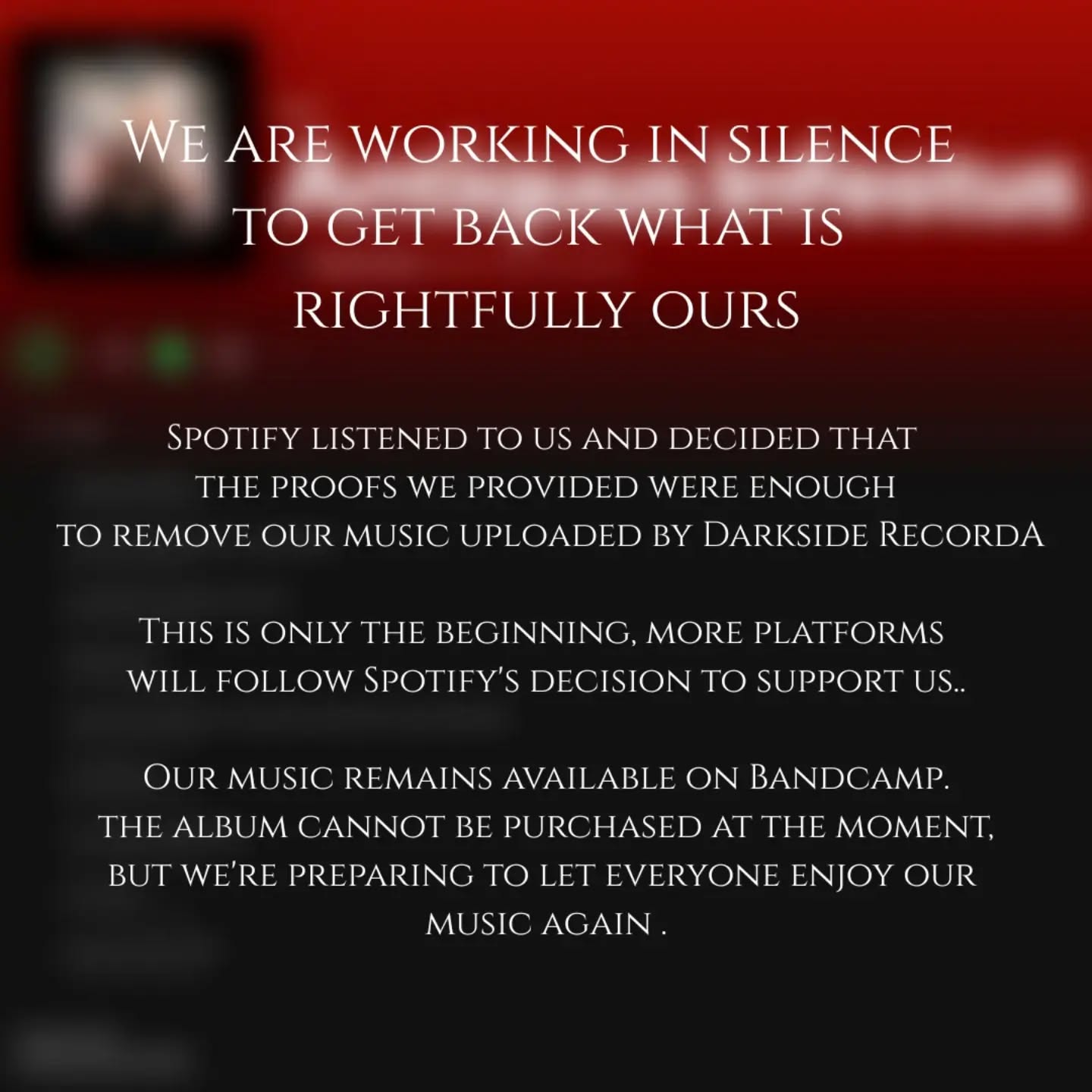
Italian band Antiquus Infestus reached out to Rock Era Magazine with a direct and significant update. After taking matters into their own hands and presenting their case with documented evidence, Spotify has removed their music from the platform — it is no longer searchable and no longer appearing on their artist page. The platform read their message, evaluated their proofs, and acted in their favour.
In their own words to us:
“We managed to have our music removed from Spotify. It would be great if you talked about it, helping us to spread this.”
They added:
“Other bands will follow. We must make sure Saïd Chebacheb and Darkside Records cannot exploit anyone else in the future.”
And finally:
“Thank you guys! I appreciate your support in keeping the attention on the scammers.”
Their official statement, published across their social media platforms, reads:
“We are working in silence to get back what is rightfully ours. Spotify is the first platform to take down our music. The album is no longer searchable nor is it showing on our page. They read our message, heard our reasons, evaluated our proofs and decided to act in our favour. Other platforms will follow. If you want to listen to our music, please visit our Bandcamp page, which has always been managed by us. Thanks to those who are sharing the path with us and their support in gathering all the proofs.”
This is a meaningful step — and a signal to every other affected band that pursuing these claims through platform channels, with documented evidence, can yield results. Other platforms are expected to follow.
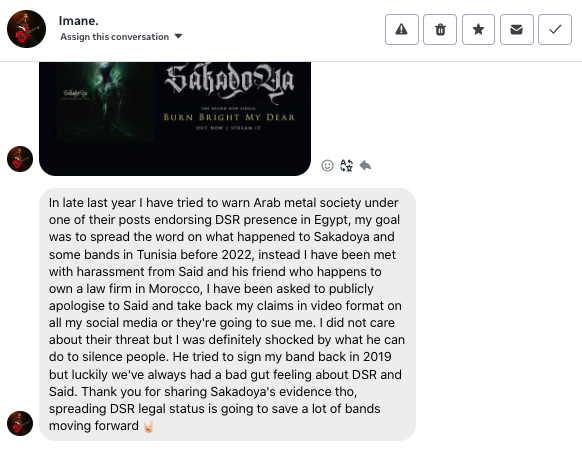
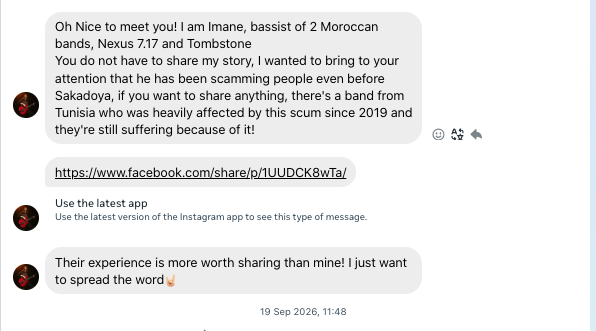
Rock Era Magazine has also heard again from Imane, bassist of Moroccan metal bands Nexus 7.17 and Tombstone, whose account puts the current wave of disclosures into a longer, more troubling context.
Imane attempted to warn the Arab metal community about Darkside Records and Saïd Chebacheb before many of the most recent accounts came to light. The response she received was not gratitude — it was legal intimidation.
In her own words:
“In late last year I tried to warn Arab metal society under one of their posts endorsing DSR’s presence in Egypt. My goal was to spread the word on what happened to Sakadoya and some bands in Tunisia before 2022. Instead, I was met with harassment from Said and his friend, who happens to own a law firm in Morocco. I was asked to publicly apologise to Said and take back my claims in video format on all my social media — or they were going to sue me. I did not care about their threat, but I was definitely shocked by what he can do to silence people.”
She added:
“He tried to sign my band back in 2019, but luckily we’ve always had a bad gut feeling about DSR and Said. Thank you for sharing Sakadoya’s evidence — spreading DSR’s legal status is going to save a lot of bands moving forward.”
Imane also directed our attention to a Tunisian band whose suffering began earlier than almost anyone else in this story — and has lasted longer.
Tunisian metal band CARTHAGODS have been dealing with the consequences of their relationship with Darkside Records since October 2019 — when, by their account, Saïd Chebacheb left Tunisia, blocked all communication channels, and settled in Morocco. Their 2024 statement, which Rock Era Magazine republishes here in full, documents the scale of what was left behind:
“Hi everybody. As many of you have mentioned, ‘The Monster In Me’ album has been taken down from all the platforms. This was after Darkside Records decided that we owe him €100,000 for the recording and the promotion costs of the album.
The Darkside Records chapter was a tough one for the band — not only did it cause us multiple problems as a band and as artists, but also as humans. It literally destroyed many relationships and partnerships around us because of the huge amounts of unpaid money left under our names — recording, mixing, flight tickets, video making, merch — after Darkside Records escaped from Tunisia in October 2019 and blocked all communication.
Today, after almost five long years, during which we worked hard to stay together and go forward with our art and our passion — to connect with the people who always believed in us — we are still dealing with the consequences.
On the other hand, Darkside Records got in contact with us several times asking for another chance. Our position was clear: the dues need to be paid. He even reached out to several of our partners. Some were paid and never worked with him again. Others are still waiting for payment until today.
We would like to express our gratitude for your messages and support. Our current label Flying Dolphins is in search of a solution. We will provide updates as soon as we hear from them.
Stay true. Stay metal.”
An entire album removed. Five years of damage to relationships, finances, and creative momentum. A claim of €100,000 owed — levelled at the very band that was left unpaid. And an ongoing search for resolution that continues to this day.
The picture being assembled here — across Italy, Tunisia, Morocco, and beyond — is consistent, documented, and growing. Bands are reclaiming their music. Platforms are listening. Legal threats are being made against those who speak up. And the timeline of harm stretches back to at least 2019.
Rock Era Magazine will continue to publish every verified account we receive. We stand in complete solidarity with every other artist who has been affected — named in our coverage or not.
To every band still hesitant to come forward: the evidence is working. The platforms are listening. And you are not alone.