As December 8, 2025, ushers in what would have been Jim Morrison’s 82nd birthday, the echoes of his baritone poetry still reverberate through the canyons of rock history. The enigmatic frontman of The Doors, who fused shamanic intensity with psychedelic rebellion, left this world at 27 but ignited a flame that continues to burn in the hearts of misfits, poets, and musicians alike. In this commemorative tribute for Rock Era Magazine, we journey through his nomadic early years, the explosive rise of The Doors, the chaos of his final performance, the shrouded mystery of his death, and the profound legacy that crowns him as one of the most influential musicians of all time.

Born James Douglas Morrison on December 8, 1943, in Melbourne, Florida, to a strict military family, Jim’s childhood was a whirlwind of relocations across the American Southwest. His father, George Stephen Morrison, rose to admiral in the U.S. Navy, commanding forces during the Gulf of Tonkin incident, while his mother, Clara, provided a veneer of domestic stability. The family denied Jim’s rock stardom until his death, prompting him to claim in interviews that his parents were dead—a mythic reinvention that fueled his Lizard King persona.
A pivotal “shamanic” moment came around age four, when Jim witnessed a car crash involving Native Americans on a New Mexico highway, believing their souls “crawled into” him—a haunting image echoed in songs like “Peace Frog.” This event, whether literal or symbolic, instilled a lifelong fascination with death, Native American spirituality, and the occult. By his teens in Alexandria, Virginia, Jim devoured Nietzsche, Rimbaud, Kerouac, and William Blake, blending philosophy with a rebellious streak that saw him expelled from school for truancy.
At Florida State University, Jim dabbled in theater before transferring to UCLA’s film school in 1964, where he met keyboardist Ray Manzarek. Graduating in 1965 with a short film, The Hitchhiker (inspired by a real murder he read about), Jim dropped into Venice Beach’s bohemian scene, sleeping on rooftops and scribbling lyrics like “Moonlight Drive” amid acid trips and LSD-fueled visions. Influences ranged from Elvis and Frank Sinatra’s crooning to bluesmen like Howlin’ Wolf and jazz poet William Burroughs, forging his baritone growl and shamanic stagecraft.
In July 1965, a chance Venice Beach encounter with Manzarek sparked The Doors—named after Aldous Huxley’s The Doors of Perception. Manzarek, impressed by Jim’s poetry, urged him to sing; they recruited guitarist Robby Krieger and drummer John Densmore, forming a no-bass quartet where Manzarek’s keys mimicked bass lines. Signed to Elektra after a Whisky a Go Go residency, their self-titled 1967 debut exploded with “Break On Through (To the Other Side),” “Light My Fire” (No. 1 hit), and “The End”—an Oedipal epic clocking 11 minutes.
Strange Days (1967) delved deeper into psychedelia with circus-like sounds and tracks like “People Are Strange,” while Waiting for the Sun (1968) yielded “Hello, I Love You.” Jim’s lyrics—surreal, shamanic, laced with sex, death, and rebellion—paired with the band’s jazz-blues fusion, made them counterculture prophets. But Jim’s antics escalated: arrested onstage in New Haven (1967) for “lewd behavior,” and infamously in Miami (1969) for allegedly exposing himself, leading to obscenity charges, tour cancellations, and a $50,000 bond.
Albums like The Soft Parade (1969) experimented with orchestration, while Morrison Hotel (1970) returned to blues roots with “Roadhouse Blues.” L.A. Woman (1971), recorded amid Jim’s decline, birthed “Riders on the Storm” and “Love Her Madly.” The Doors sold millions, headlined festivals like Woodstock (where Jim skipped the mud-soaked set), and embodied the ’60s’ dark underbelly—hedonism amid Vietnam’s shadow.
Jim’s life offstage was a vortex of passion and peril. He shared a volatile, open relationship with Pamela Courson, his “cosmic mate” since 1965, whom he called his soulmate despite infidelities. They opened the short-lived Aquarius nightclub in L.A., but drugs—LSD, heroin, cocaine—and whiskey fueled Jim’s blackouts and brawls. Affairs with figures like journalist Patricia Kennealy (a Wiccan handfasting ceremony) and Nico added layers of scandal.
A voracious reader and filmmaker, Jim self-published poetry collections The Lords and the New Creatures (1969) and recorded An American Prayer (released posthumously in 1978). His UCLA thesis on hitchhiking as a metaphor for life’s journey mirrored his nomadic soul. Yet, as the ’60s waned, Jim’s weight ballooned, his voice rasped from abuse, and paranoia gripped him—fearing Nixon’s FBI surveillance. Convicted in Florida for the Miami incident (six months hard labor, $500 fine), he appealed and fled to Paris in March 1971 with Courson, seeking anonymity to write.
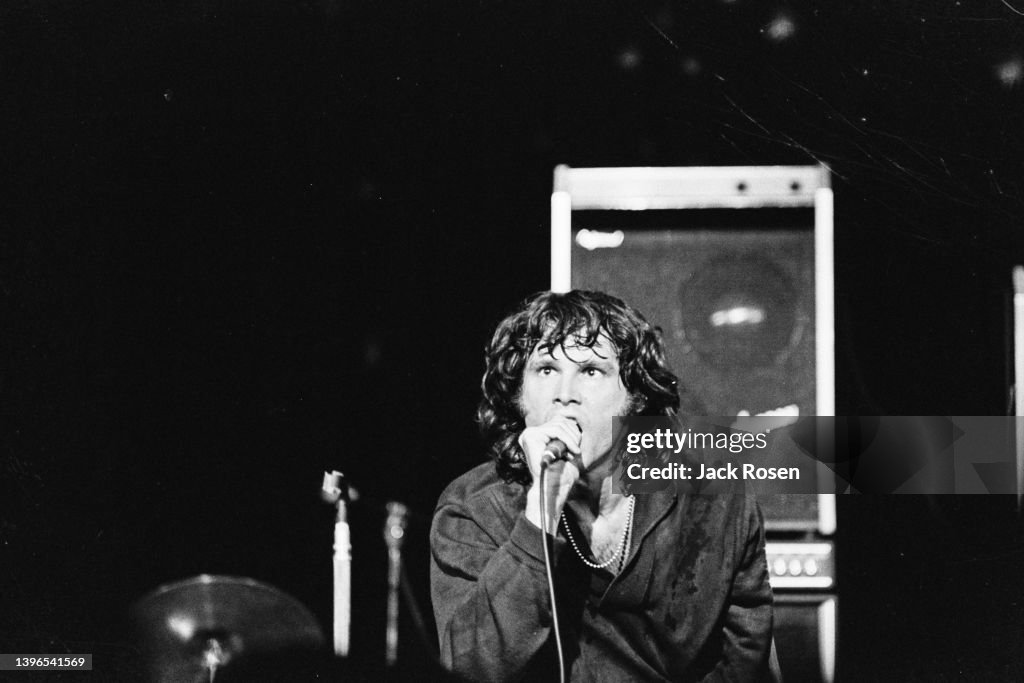
The Doors’ swan song with Jim unfolded on December 12, 1970, at The Warehouse in New Orleans—a gig promoting Morrison Hotel that devolved into pandemonium. Bearded, bloated, and blackout drunk, Jim mumbled incoherently through “Back Door Man” and collapsed mid-set, slurring pleas for the audience to “keep it going.” Enraged, he smashed his mic stand into the stage, splintering the floor, before storming off, ending the show early. Bandmates Ray, Robby, and John, exhausted by his unreliability, agreed it was over—Jim’s spirit, as Manzarek later wrote, had fled his body.
The performance, captured in grainy photos but no full recording, symbolized The Doors’ unraveling: a poet reduced to a “madman,” his Dionysian fire consuming itself. Just four months later, Jim was gone, but the gig’s raw fury—cheered by 1,400 fans who mistook chaos for genius—cemented his mythic exit.
On July 3, 1971—two years after Brian Jones, nine months after Jimi Hendrix and Janis Joplin—Jim Morrison was found dead in a Paris bathtub at Courson’s apartment. At 6 a.m., the 27-year-old was cold, clad only in underwear, with no signs of violence. French law required no autopsy; a doctor ruled heart failure, possibly from respiratory distress or embolism. Courson claimed he’d attended a Marianne Faithfull concert, partied with heroin (which Jim allegedly snorted, mistaking it for cocaine), complained of chest pain, and retired to the bath.
No foul play, no overdose traces—yet theories abound: heroin OD, voodoo curse from a Miami fan, faked death to escape fame (sightings persist), or even CIA hit tied to his father’s Vietnam role. Buried hastily in Père Lachaise Cemetery (now a pilgrimage site with 3 million annual visitors), Jim’s simple tombstone reads “Kata Ton Daimona Eautou”—”True to his own spirit.” Courson, inheriting his estate (estimated $400,000 at death), died of a heroin OD in 1974, buried as “Pamela Susan Morrison.” The absence of closure only amplified his myth, joining the “27 Club” as rock’s ultimate enigma.
Jim Morrison’s influence is seismic, his baritone a prototype for gothic rock’s “deep, heavy alloys,” inspiring Layne Staley (Alice in Chains), Eddie Vedder (Pearl Jam), Scott Weiland (Stone Temple Pilots), Ian Curtis (Joy Division), and Patti Smith. Iggy Pop credits a Doors show for birthing the Stooges; David Bowie and Siouxsie Sioux echoed his theatrical shamanism. The Doors pioneered “rock theater”—blending poetry slams, happenings, and rituals—paving the way for punk, grunge, and alt-rock.
Posthumously, An American Prayer (1978) fused his poetry with band music; inducted into the Rock Hall (1993), The Doors earned a Lifetime Achievement Grammy (2007) and Hollywood Walk star. Oliver Stone’s 1991 biopic, starring Val Kilmer, revived interest, while The Collected Works of Jim Morrison (2021) spans 600+ pages of verse. His estate, managed by Doors royalties, generates millions annually, funding poetry prizes.
Morrison embodied the ’60s’ dark romantic—hedonistic yet philosophical, railing against conformity via Nietzschean duality. As Simon Reynolds noted, his voice birthed goth; his fashion—leather pants, untamed hair—influenced Westwood and Sui. In a conservative age, he remains the radical hero, granting “permission to miscreants” to embrace chaos. Albums like The Doors rank in Rolling Stone‘s 500 Greatest; his grave draws pilgrims seeking the infinite.
Happy birthday in the beyond, Jim.
You broke on through—and left the doors forever ajar.