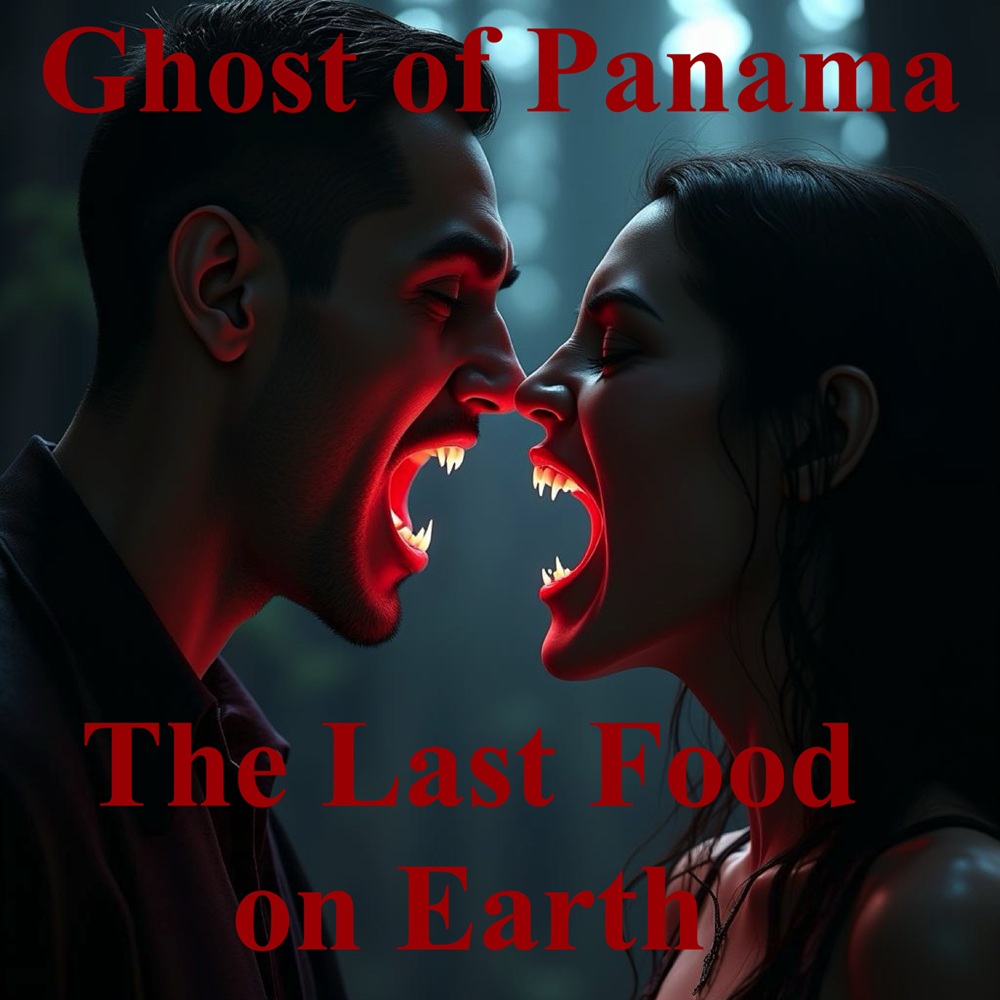
Concept albums often lean so heavily on their central idea that the music becomes secondary. Ghost of Panama avoid that pitfall on The Last Food on Earth, allowing the story to unfold gradually through atmosphere, pacing, and emotional nuance rather than overt storytelling. Each song feels like another fragment of a larger narrative, coming together to form a cohesive portrait of a relationship in all its complexity.
The Last Food on Earth traces the emotional anatomy of a relationship through entrapment, guilt, acceptance, indecision, and ultimately, resolution. The concept never feels imposed. Instead, it emerges naturally through shifting textures, restrained arrangements, and subtle sonic details, rewarding listeners who experience the album from beginning to end.
Recorded primarily in a small project studio in West London, the album embraces inventive production choices that deepen its emotional landscape. Found sounds recorded around the city become part of its musical vocabulary, grounding abstract ideas in tangible environments. Nowhere is that more striking than on “Half-Life,” where breathing and the clicking pulse of a Geiger counter replace conventional drums. It’s a bold creative choice that reinforces the song’s underlying tension rather than distracting from it.
The album continually balances intimacy with scale. “The Lift” opens with bright guitars and driving rhythms that immediately establish momentum, while “Stockholm Syndrome Reversed” pairs elegant piano melodies with pulsing bass and expressive storytelling. Elsewhere, the melodic immediacy of “Ghost of Your Perfume” and “Damage” offers moments of accessibility, while the expansive “Siberia” stretches into cinematic territory, broadening the album’s emotional and sonic scope.
Ghost of Panama embrace subtlety through their writing. Rather than explaining every feeling outright, they rely on evocative imagery and emotional suggestion, inviting listeners to complete the story themselves. That same restraint defines the production, where silence and space often carry as much weight as the instruments, making every sonic decision feel intentional.
After spending much of its runtime immersed in uncertainty and emotional exhaustion, The Last Food on Earth reaches its emotional destination with “North Star.” The closing track gradually introduces hope without dismissing the darkness that came before. The result is an ending that feels earned, one that acknowledges healing as a process rather than a single moment.
With The Last Food on Earth, Ghost of Panama have crafted a debut that succeeds not because of its ambitious concept alone, but because every creative decision serves the emotional journey at its core. Rich in atmosphere, inventive in production, and quietly affecting throughout, the album proves that the most compelling stories are often the ones revealed piece by piece; and that The Last Food on Earth is best experienced as a complete journey rather than a mere collection of individual songs!