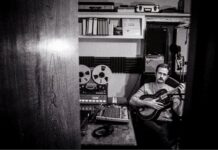
Stephen Moore’s Post Death Soundtrack is a unique presence in contemporary heavy music, blending various genres and personal themes. The upcoming release of GRIST on January 6, 2026, continues this exploration with 30 tracks, merging doom, grunge, industrial sounds, and dreamlike lyrics. Influenced by artists like Swans and PJ Harvey, GRIST addresses themes of trauma, awakening, and survival, inspired by Ram Dass’s philosophy. Moore discusses the evolution of the project, the significance of expansive releases in today’s AI-driven music scene, and future projects.
- Your musical journey with Post Death Soundtrack spans nearly two decades, evolving from collaborative industrial and psychedelic roots to a solo-driven project. How has this transition influenced the creative process and sonic identity evident in GRIST?
The transition to going solo was initially driven by my realization that I had more time for Post Death Soundtrack than anyone else, and things were lingering. Once I started self-producing, I created “IN ALL MY NIGHTMARES I AM ALONE” and it was revelatory for me. I’ve always done whatever I want artistically because I feel that’s the only way art has a purpose. But this project ended up really exploring what that meant in an intuitive way, a chaotic way. I love saying what I want and making calls as to when to add noise, sirens or uncomfortable sounds.
GRIST is a continuation of that approach. However, where IAMNIIA had a very scrapbook feel, I wanted GRIST to be more consistent, more industrial and very unnerving. In fact, I came up with the album cover months before I had even completed much of the music at all. My goal was to make the album sound how the cover looks. The beats are very heavy and often influenced by gangster rap. The music is a mixture of industrial/noise, metal, gothic rock and electronic music.
- “GRIST” serves as the second installment in your new series of 30-song double albums, following IN ALL MY NIGHTMARES I AM ALONE. What motivated this shift toward such expansive, ambitious releases, and how do you approach structuring and sequencing 30 tracks to maintain cohesion and impact?
It was unintentional the first time. I was going through heavy depression and stress, addiction and mourning the loss of an animal. I poured myself into recording and compiling for IAMNIIA, sometimes staying awake for days and recording all night. I believe I initially thought of doing something that was 7 or 8 songs and ended up going and going until it reached 30. Granted, some of the songs are merely interludes to keep things flowing and add intrigue to the themes.
GRIST, funnily enough, I intended for it to be 10-15 tracks. As I got on a creative role and realized these songs were darker and heavier than its predecessor, I continued and decided it would be 30 again. Same thing with this album – I have continued to utilize interludes not as filler but to expand on the manic meaning of the release.
For cohesion and impact, I’m a music obsessive and have pretty much studied track listing and albums my whole life, so I just kind of meditate on it and know where to put each piece for flow. I order it how I’d want to listen.

- The album draws inspiration from Ram Dass’s concept of life experiences as “grist for the mill of awakening,” encompassing themes of philosophy, mental illness, loss, addiction, and spirituality. Could you elaborate on how these elements manifest across specific tracks, such as the rallying imagery in “OMEN” or the personal reflections in “CUB”?
Ram Dass has always inspired me, and in fact I was able to visit him for 5 days in Hawaii. Grist for the mill is such a brutal, yet beautiful quote. I thought shortening this to GRIST, and showing pieces of my experience these past few years, it’s horrifying but beautiful, too. What I’ve gone through is scary. OMEN is a personal rallying cry. It’s a personal, original mantra and an invitation to fearlessness in the face of being scared or being threatened. CUB is an imaginary hunt or revenge tale dedicated to my deceased black cat Bonzai, and it is one of my ways of bringing his spirit with me. It is also intended as a rallying cry for cats and people too!
- “GRIST” incorporates covers from artists like PJ Harvey (“Catherine”), The Beatles (“Helter Skelter”), and The Doors (“The End”). What drew you to these particular songs, and how do they integrate into the album’s overarching narrative of survival, chaos, and awakening?
PJ Harvey is one of my favorite artists – period. “Catherine” has the feeling of deep mourning, and also revenge. It’s so dark lyrically that it is atypical in every way. It’s almost shocking. But you can tell, Polly Jean is hurting, and she wants her get back. That is one of the themes of this album, strange to say. It’s an ‘enough is enough’ mentality, and this is where ‘OH NO!’ and ‘BEAR IS WAKING’ come from. It’s the energy of ‘don’t push me as there’s no more ledge’.
The Beatles are my favorite band alongside Nirvana. I wanted to completely subvert ‘Helter Skelter’ into a vulnerable but menacing version as if it was the end of the world and the bombs were flying.
The Doors ‘The End’ has always been one of my favorite songs, and it’s iconic for how much it embraces chaos. Walking through a Roman wilderness of pain where all the children are insane….that’s a bit like modern life, so reality has caught up with Jim Morrison.
- In an era increasingly shaped by artificial intelligence in music production and distribution, how do you envision AI affecting the future of the music industry—particularly for independent, genre-blending artists like yourself who prioritize raw, human-driven expression?
We’re early into the AI stage, so I think more companies will take the Bandcamp route and ban it. To me it’s clear. I have nothing against AI as a tool. Sampling has been used in masterful art for a very long time now. I approached this album with both real drummer samples and electronic samples, noise samples, sound effects etc. But its my voice, my guitar, my expression and my design. The rest is largely impacts and explosions for effect.
I feel that if someone just types a prompt ‘sunny feeling, bright synth, trip hop beat and lyrics about a day at the beach’ and AI pops out a full song, that’s not creating art. That is having some fun. The artist has to be in it.
- With streaming platforms favoring shorter attention spans and algorithmic promotion, are you concerned that listeners might overlook or undervalue a 30-track album in such a rapid era, or do you see this format as a deliberate challenge to contemporary consumption habits?
Yes. I figure, in a world where 90,000 releases or so come out weekly, THIS is something unique. And nobody is doing it. And to those who think it might be too long, treat it like a book! Put it down. Pick it up. I’m a big Lord of the Rings fan and each film is 4 hours. Nobody complains. People want them to be longer. Also, releasing double albums helps me build the right audience who are fascinated by this work and want to support it.
- The press materials describe GRIST as a “pure offering” to your dedicated supporters—referred to as “baby bees,” “cubs,” “bears,” and “hyenas.” How has the relationship with your audience evolved, and in what ways does this community inform your ongoing work?
I have often lived in quite a bit of isolation and depression, so I write from this perspective. I find it liberating to do so. In doing this, I’ve started to rally energetically in the music in hopes it will spark some inspiration in others who have felt the same way. Others going through mourning can listen to CUB and feel something incredibly deep, possibly cry or stand up in some way. Some people might listen to OMEN or I SWEAR and feel vindicated, feel like their power is back and they won’t accept anything less. The growing community is something I appreciate and find very powerful. I always write from the heart, but I certainly want the community to love it each time.
- Your influences range from Swans and Skinny Puppy to Nick Cave, PJ Harvey, and Tom Waits, blending doom, industrial, gothic, and avant-garde elements. How did these diverse touchstones converge to shape the beat-heavy, noise-driven yet emotionally resonant sound of GRIST?
They all contribute, and my influences seem to go together pretty seamlessly. The benefit of having many influences is it’s a gumbo, and you filter all of them into your own unique sound. Bands who only listen to Pantera sound like Pantera. Have a wide palette, and you’ll sound pretty wild.
- You are currently finalizing HEL’S MOUTH with your collaborative project HE IS ME alongside Casey Braunger. How does this duo’s dynamic—described as featuring dynamic shifts, sludgy metal, industrial grooves, and ambient pieces—differ from your solo work on Post Death Soundtrack, and what can listeners expect from its release?
It has it’s similarities in mood, but HE IS ME is overall more metal-based and has different atmospheres and tones thanks to the music and production of Casey Braunger. He makes all the music and I do the vocals/lyrics, so there is that difference as well to color the sound.
- Looking ahead beyond HEL’S MOUTH, what are your upcoming plans for Post Death Soundtrack, whether in terms of new material, live performances, or further exploration of the double-album series? Do you anticipate any shifts in direction or format?
Well, the 30-song release thing…..it’s intended as a trilogy! Or more haha. We will see. I might just keep doing them. Maybe I’ll do 8 or more. Let’s start with 3 though. I already have the album title for the 3rd one, but will reveal that at a later date. I’m excited to heavily promote GRIST this year and start working on the next album by Summer.