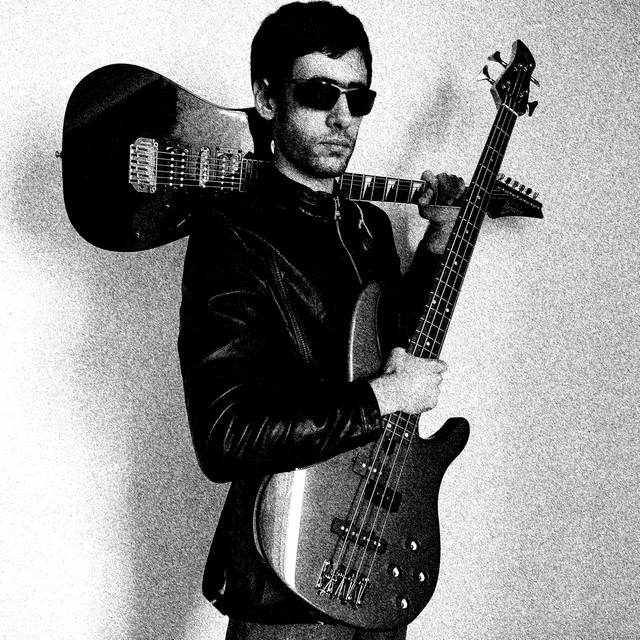
As our thoughts are with the wonderful people of Iran, we had the opportunity to speak with one of the rising Iranian rock artists, Parham Gharavaisi. Take a look at our interview below and discover more about his remarkable journey.
- Firstly, thank you for this opportunity to get to know you more. I can see that you are a multi-disciplined artist, establishing narratives and overworlds in which your artwork lives, writing, recording, and producing your own work, as well as writing literature that supports overarching storylines. So our question is, what kind of artist do you primarily consider yourself to be? A Guitarist, a musician, a writer, or something else entirely?
Thank you for having me. Well, I’ve been writing ever since I was a little kid and won first place in two national writing competitions back in school, so I consider myself a writer first before being a musician. I’ve always been fascinated by sci-fi and dystopian fiction, as well as horror—cosmic horror in particular. But nowadays, I am mostly occupied with music production and, as a solo artist, write, record, produce, mix, and master almost all of my songs myself, so I guess I’m also an audio engineer on top of it all as well.

- How did you approach creating Beyond Devastation? Or maybe if we can make the scope of the question larger, how do you approach writing music in general? Do words come first, or the music, or the imagery or themes? How does a Parham Gharavaisi piece of work come to be, from inception to completion?
When it comes to my creative process, I tend to finish the instrumental completely before even approaching the lyrics. I start by noodling on the classical guitar for hours every day and eventually come across a collection of ideas that I’m quite fond of. Then I organize those ideas—be it a riff, a melody, a chord progression, or otherwise—into sections to be later turned into full songs. I only start recording once I have the big picture down. I begin with recording the guitars, then the bass, then the drums, and finally the synths/orchestra, and once the instrumental is fully finished, I begin thinking about the vocals and writing my lyrics. Beyond Devastation—being a concept album and part of a larger narrative—wasn’t an exception; the process is still the same for almost all of my songs.
- Beyond Devastation is a concept album set in a universe you created in your short story The Words that Ended the World. We would love for you to share a little about this universe, and about the stories that unfold during Beyond Devastation, and its sister album Infect the Clouds. What plans do you have for expanding this universe?
The universe these works are set in is based on a unique anti-teleological ontological philosophy that I came up with and formalized in a yet unpublished document. Basically, the gist of it is that there is a fixed source of meaning that cannot be changed. This source of meaning creates pairs of opposites (e.g., creation & destruction), and everything that exists is constantly pushed away from both sides of these vectors, slowly turning to and from opposites but never reaching them. So, in a sense, everything comes from this endless cycle of moving away but never towards abstract points (and thus never reaching any). The events of my short story, The Words That Ended the World, mark the beginning of a grave societal shift in this world, and the albums Infect the Clouds & Beyond Devastation explore similar themes and ideas to the short story, but each work is self-contained, meaning it’s not required to know the rest in order to understand and enjoy them. So you can just read the short story or only listen to either album without worrying too much about not understanding what’s going on.
- Having been brought up surrounded by Persian culture, has this at all affected your artistic vision? Does Iranian culture seep its way into any parts of your creative process? Does it influence you in ways we can not see or hear?
Actually no, not at all! In fact, I consider English my primary language, and it is almost exclusively the language that I think in—as I’m one of the people who do have an inner monologue—and speak! I don’t know much, if anything, about Persian culture, and I have been living quite an isolated life from it, so any influence that might be perceived in my work has to be either a coincidence or perhaps unconscious. Additionally, I’d like to make it crystal clear that I do not identify with my birthplace, its people, or its culture.
- What part of creating a conceptual narrative as the one you have created here, and owning it from its very beginning to its very end is the most rewarding to you? Is producing your own music a rewarding process? Or is it merely a matter of being the only person fully capable of bringing your vision to life?
I think for the most part, it’s about exploring the same ideas from different angles rather than different perspectives. It’s like looking at the same painting but under different lighting, or how different sunglasses make you see slightly differently. The picture is the same, but the devil is in the details. I find this process of exploration very insightful and, dare I say it, rewarding in and of itself. Having finished multiple concept albums, I think a musical album is one of the most difficult mediums for the purpose of telling a story because of how limiting lyrics can be, but I’d say overcoming that challenge was the most rewarding thing for me.
⇒ DON’T MISS HIS PREVIOUS FEATURES IN ROCK ERA HERE!
- The music in Beyond Devastation showcases a full spectrum of dynamics and emotions, from soft and hushed balladry, to extreme metal mayhem, where on this spectrum do you feel most at home as a guitar player and as a listener, and where is the region that challenges you the most to develop?
This “beauty and the beast” approach to music, so to speak, has always been a core element of my sound and a conscious choice at that. I have always been most fascinated by gothic and doom genres, and perhaps to some extent melodic metalcore, and I find this contrast between soft and heavy sections incredibly alluring. I started my musical journey with a post-rock instrumental debut album, so I’m well-versed in writing tender melodies and creating chilling atmospheres, but at the same time, I’m also very keen on delivering heavy riffs and chunky chugs to headbang to. It would be very difficult for me to pick one over the other, even if it’s just a tiny preference, so I really can’t say. I love both equally!
- Finally, what are your plans for the coming months, what can fans expect from you and where can they find you?
I’m looking forward to collaborating with more talented female singers across the world, and you can expect to hear more such songs from me. My collaborations will be released on my YouTube channel first and then eventually on all streaming platforms as a part of my Greatest Hits compilation albums. I don’t use social media (and I strongly recommend that you do not as well), but if you’re interested in my work, you can follow me on YouTube and streaming platforms. If you’re a female singer looking to collaborate, shoot me an email at: parham6@live.com