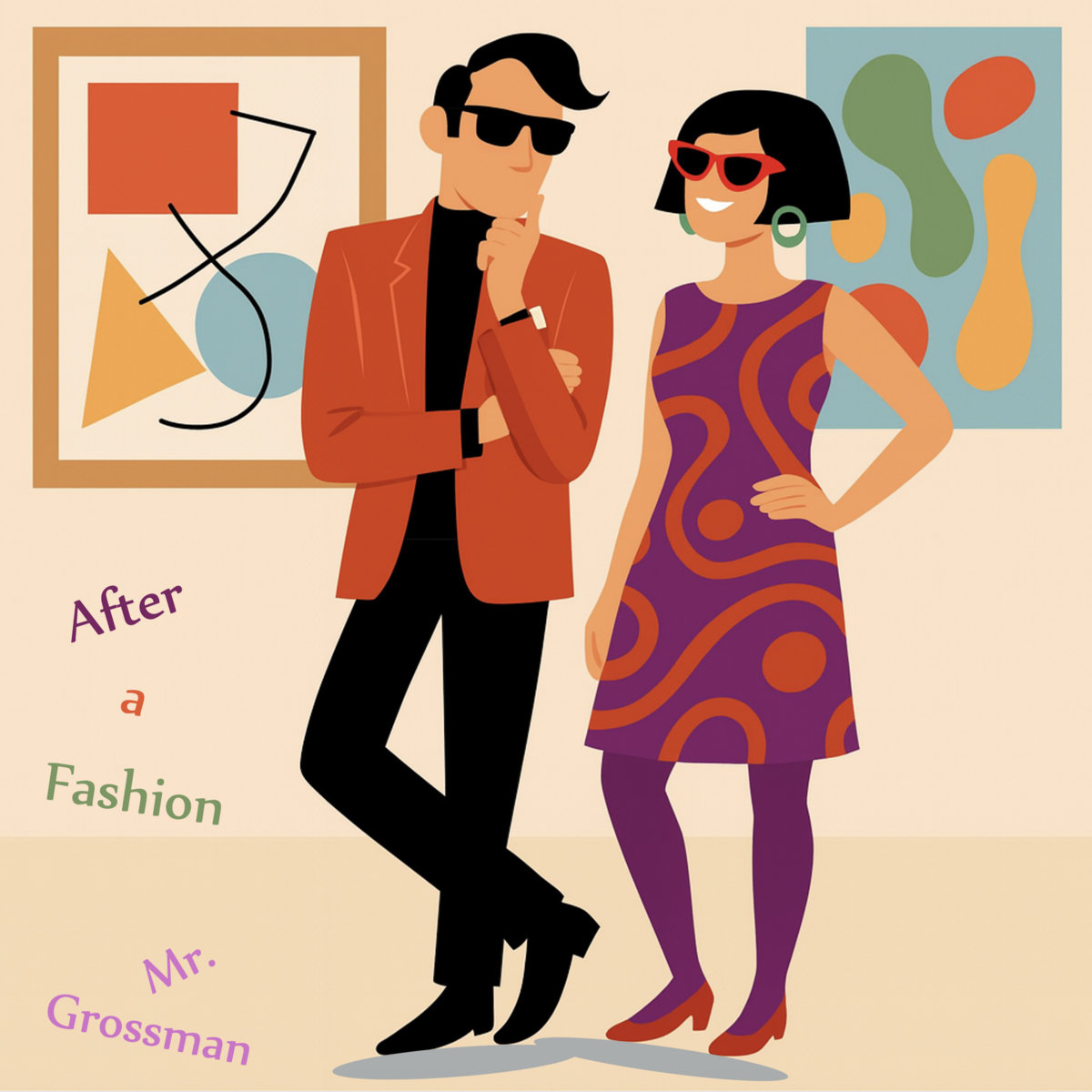
Mr. Grossman, the SF Bay Area-based multi-instrumentalist and composer known to many as Mark S. Grossman, has long navigated the intersection of technology and music, bringing a veteran chip designer’s precision to an untethered creative output that defies categorization. His latest independent full-length album, After a Fashion, released January 30, 2026, via Nondiscordant Music, presents a seamless yet adventurous sonic gumbo of trip hop, dream pop, neo soul, synth pop, and progressive rock. Self-produced and performed primarily by Grossman on vocals, guitar, bass, MIDI drums, and synths—with guest vocals from Nolo (South Africa) and Shruthi Aiyar—the record explores the shadowy edges of romance against the backdrop of a turbulent world. In the conversation below, Grossman reflects on the evolution of his artistic path, the conceptual and sonic architecture of this release, and his plans for the projects ahead.
- Your professional life as a chip designer has run parallel to decades of musical creation, from choral singing—including a performance with Pavarotti—to composing across disparate styles. How has this dual existence informed your ability to move fluidly between genres without feeling constrained by any single tradition?
There’s that whole popular myth about a connection between math and music, but I don’t think that’s what defines me. I grew up with a house full of classical, pop, and jazz, which my parents enjoyed equally, and I was also a clever boy with science. Then there came prog rock and jazz fusion – ELP, Yes, Mahavishnu Orchestra, Return to Forever – and it was for me like, “Aha! You can mix all these together and it works!” In high school I started building my own synth from scratch. So my creative impulses span all that space.
- After a Fashion deliberately draws from influences spanning Ella Fitzgerald, Marvin Gaye, and Toro y Moi, yet coalesces into a cohesive whole. What guided your approach to weaving these disparate references into a unified statement that feels both contemporary and timeless?
Well, thank you for the ups! It was a matter of patience – or maybe impatience. During the second half of 2025 I had a few songs like Put a Scarf and Could Happen in the can, but I waited for other ideas to coalesce to flesh out a full album. I could have done a full dreampop album if I went long enough, but I embraced the mix of idioms that I was working with at the time.
- The album’s thematic core examines the “scary edges of romance” amid a fearful present. In what ways did global events and personal reflection shape the lyrical undercurrents across tracks such as “Man on a Wire” and “Blow Me Away”?
The key idea came from Ella’s Isn’t It Romantic, which I heard in my head not simply as a lovey-dovey ballad, but as being full of doubt, shadows, and strange voices. So I change the setting to use mysterious tone clusters and disjointed percussion and bass. Aside from that, the awfulness blaring from the news recently seeped into my mind and personal relationships big time. Thus “Go Out Tonight” takes what could have been a joyful Motown dance tune and say, hey, yeah, go clubbing, but make sure you know where the exit doors are. My family was actually recently trapped in a theater while police cleared a street action outside! Every song has some element of uncertainty, confusion, or wildly overblown emotions. Man on a Wire is mostly a peppy 80’s style recitation of famous books and movies starting with “Man” or “Woman” but then minor chords and tone clusters appear, and the lyrics turn into discord between a couple. Blow Me Away is about letting someone else dictate my emotions, taking advantage of my lost state.
- As both sole producer and primary instrumentalist—augmented only by select guest vocalists—how did the self-contained recording process allow you to realize the album’s intricate layering of MIDI elements, synth textures, and organic instrumentation in a way that earlier collaborative projects could not?
Again, thanks for noticing! I mostly start with my own beats, guitars, bass, and keyboards, but I also made use of some new plugins I discovered and some drum loops that were more authentic than I could generate. I really try to emulate great producers who can pull off complexity on a track without turning it into mush. But I know my limitations, so that’s where the collaboration comes in – like when I needed kick-ass vocalists for a couple songs.
- Songs like “Could Happen (2025 version)” and “Little Queen (Crown Pleaser version)” suggest a revisiting or refinement of prior material. What prompted these specific reimaginings, and how do they illustrate the album’s broader meditation on style as both approximation and literal expression?
“Could Happen” is one of my Cocteau Twins tribute songs. It’s definitely less dark than the other tracks, but it’s about recovering from a dark place lovers got into. The funk track, Little Queen (no relation to Heart’s!) is super upbeat, but it’s also about the danger of a relationship where there’s a huge power disparity.
- The title After a Fashion carries dual meanings of approximation and personal style. How does this concept encapsulate your refusal to be confined by labels, and in what manner does the record serve as a deliberate statement of artistic freedom at this stage of your career?
The third meaning is the acknowledgement that I’m basically a dilettante! I am just a suburban industry outsider borrowing a lot from original musical idioms. Being self-funded and self-produced means I can just put out what interests me and hope it resonates.
- Collaborations with local artists such as Paul Paternoster, Patrick Ames, and Chana Matthews have been a consistent thread since 2022. In what ways did those experiences prepare the ground for the fully autonomous yet outwardly expansive approach taken on After a Fashion?
Working with these awesome folks, we can be each other’s first audience. There’s peril in sitting alone in my studio with only those walls as the horizon.
- With After a Fashion now released, what new compositional directions or collaborative formats are you pursuing next, and how do you envision these future works continuing to explore the tension between technical precision and untethered musical curiosity?
I’ll be recording a fairly major work for chorus and synth pipe organ in May. Also, a while back I really wanted to develop a new kind of music platform that allowed people to play with artists’ stems and easily create and share their own versions of their songs. Maybe I’ll revisit that for a piece or two, because it is both a technical and compositional challenge.