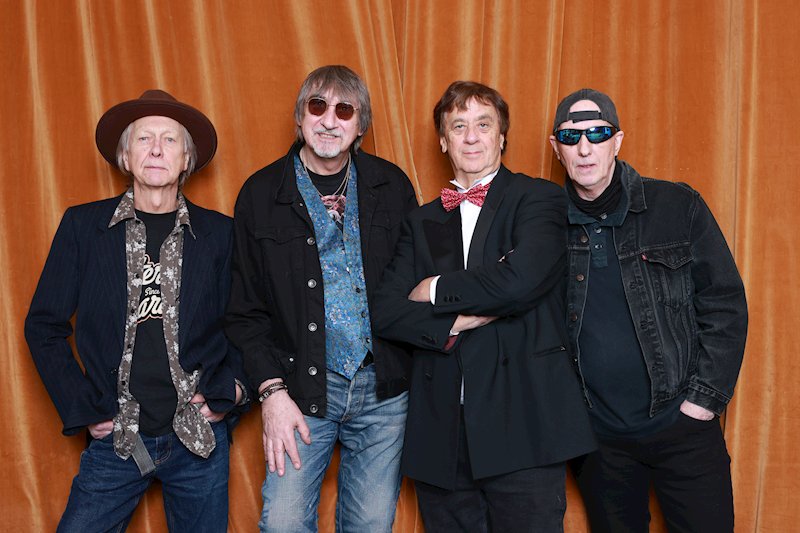
They’ve been playing original music together since the 1970s — and over fifty years later, The Tirith are arguably at the peak of their powers. The UK prog rock outfit return with their most ambitious and wide-ranging album yet: “Quetzalcoatl”, out Friday, July 3rd, preceded by the single “Save The Oak” arriving May 1st. Named after the feathered serpent deity of Mesoamerican mythology, the album spans themes of mysticism, ancient legend, space privateers, vampires, Zen philosophy, and Shakespearean riddles — all wrapped in a sound that moves effortlessly between heavy rock, folk, jazz, country, and prog. With a settled, fully-gelled lineup and a catalogue that stretches back to when Tim Cox and Dick Cory were schoolboys at Loughborough Grammar School, The Tirith are riding a wave of inspiration right now — and “Quetzalcoatl” is the proof. We sat down with the band to talk about the new album, the journey, and the universe they’ve spent decades building.
- The album takes its name from the Mesoamerican feathered serpent deity — a figure representing wind, knowledge, the union of earth and sky. What drew you to Quetzalcoatl as a central image, and how does that mythology thread its way through the album’s themes?
We have been aware of the feathered serpent deity for quite a while. he was central to Aztec, Toltec and Maya cultures. The legend also has it that he appeared as an old man with a long beard, who disappeared over the sea never to return. It is a standalone song, the other songs are about other subjects, but it’s a great track and makes a good title for the album.
There was also a Cretaceous azhdarchid pterosaur called Quetzalcoatlus which was the biggest pterosaur that ever lived. Tim said “when I wrote the music for Quetzalcoatl I was expecting Dick to write about the Dinosaur. But Dick was drawn to all of that Aztec and Mayan stuff.” Dick said “Right I was, it makes a better song, how do you write a song about an extinct flying dinosaur?”
- Yeah! Make sense. Well, “Quetzalcoatl” has been described as your most cohesive and adventurous record yet — heavy rock sitting alongside prog folk, jazz, a vampire waltz, and Zen philosophy. How do you hold all of those wildly different influences together under one roof without the album feeling scattered?
The Tirith in some ways is a unique band, many people find us difficult to directly compare to other bands and artists. Because our influences are so wide that is hardly surprising, and we aren’t trying to be like anybody else. Many current prog bands are heavily influenced by Genesis, we aren’t. Neither do we play what we would refer to as standard prog, lots of thrashing around, complicated time signatures, seemingly just for the sake of it, and doom-laden lyrics strung together in an ad hoc style. We play properly constructed songs, sometimes featuring stories, often with soaring instrumental sections. We are included in the prog rock genre really because there is no other genre that fits. I could give you a list of our influences but it would take up a whole page and you don’t really want that.

- The space narrative that began on “Tales from the Tower” and continued through “Return of the Lydia” gets a new chapter here with “Back to Space” — a stranded spaceman in New York, unable to adapt to city life, deciding the only way forward is back to the stars. How did that storyline develop over three albums, and was it always planned as an ongoing saga?
There was no plan, but it is a fascination. It all started really with a song called “The Tower” when we were very young, about a tower on a distant planet surrounded by methane snow. Tim was inspired by Ray Bradbury to write that song. Most of the development of the theme though has been written by Dick. Dick says “the space theme and our ongoing story is always in the back of my mind when writing songs for a new album. Where to go with it next? The song Return of the Lydia, the title track of the last album, seemed a logical move to bring the space ship back to earth but it also afforded an opportunity to fill in more details about the adventures along the way. And so we come to Back to Space on the latest album.” “I’ve been thinking about that angle for a while, the nightmare of city life with surreal lyrics, and then the big chorus of Back to Space.” Has the adventure finished? Not sure, but also not sure at this point where it might go. But you know its all a bit tongue in cheek.
- “No Mind (Mushin)” originated as an improvisation and explores the Japanese Zen concept of empty, thought-free flow — total presence and effortless action. How does that philosophy of improvisation and instinct inform the way The Tirith approaches music-making more broadly?
OMG, it doesn’t, we are not a band that does a lot of improvisation, but occasionally we do and then develop a tune from there. But in real life we are inspired by this approach. Tim first came across these ideas when practicing martial arts, it is basically a form of meditation, which has been adopted by both of us
- Tim Cox’s history includes being part of the production team behind Rozalla’s “Everybody’s Free (to Feel Good)” — still a dancefloor anthem today — before returning to his prog rock roots. Tim, how does that commercial pop and dance world experience shape the way you approach songwriting and production for The Tirith?
Working with drums machines, sequencers and samplers in the late 80s it became possible to create an entire arrangement of a song before recording it to tape and mixing it. This was a big step from mapping out a song on say, acoustic guitar or piano, and then rehearsing and arranging a band before recording and mixing.
This has had a huge influence on the way we can work nowadays. With modern Digital Audio Workstations (DAWs) we can map out an entire song, before rehearsing and recording the individual members of the band, who can put their own style and interpretation on the song. In dance music, most of the music remains programmed and sequenced, apart from the vocals. In our songs, pretty much everything is replaced by the musicians in the band playing in their own way.
- The band’s origins go back to Loughborough Grammar School in the 1970s — two boys sitting opposite each other with acoustic guitars, playing only original material from the very start. Over fifty years later, what is it about the Tim Cox and Dick Cory creative partnership that has kept it alive and relevant through everything?
It’s a special thing and we still like to do that, but it doesn’t really reflect the way we work together today. We work together and separately to create the songs and we both have our own particular strengths. For Tim’s songs of which there are 3 on the Quetzalcoatl album, “Quetzalcoatl”, “Back to Space” and “Dancing With Vampires”, Tim will map out the whole arrangement of the song but without vocals, lyrics or topline. Dick then works up a topline melody, writes the lyrics and makes it into a song sometimes suggesting changes to the arrangements along the way. Dick’s songs (of which there are 5 on Quetzalcoatl, “Rabbit Ings”, Spirit of the Volcano”, “Masters of Highways”, “Save The Oak” and “The Riddles”) are usually presented in a rougher form as simple often chaotic complete songs with topline and lyrics, but then Tim sorts them out, changing the arrangements, adding instrumental sections and turning them into the finished article. “Moon King” is an Ant song but with extensive work on the arrangement and topline by Dick. “The Slide” is a band collaboration, starting with a section from Tim, with a section by Ant in the middle. Dick wrote lyrics and topline for both sections. “No Mind (Mushin)” started life as a band improvisation which grew and evolved into its final form. That’s the creative process, we love playing live and hope to translate that into live energy.
- Keyboardist Anthony Hill joined in 2022 and the band has spoken about how the lineup has genuinely gelled since then. What did Ant’s arrival unlock in the sound — and how has the dynamic between all four members shaped what “Quetzalcoatl” became?
Before I talk about Ant I would like to tell you about our drummer Paul Williams who can get overlooked. Paul was our main drummer in the 70s before we went our separate ways. He was the one who brought us back together after the in 2010. Unfortunately he had to leave us again in 2012 due to heavy commitments with other bands. But he rejoined us in 2020 and has been with us ever since. The Tirith always feels right with Paul sitting behind us on that drum stool. He has an effortless bouncy technique which we love, having Paul on drums has made it possible for us to play our more difficult songs with relative ease. We are trying to keep him going for as long as possible (he does suffer from rheumatism now in his hands), so fingers crossed.
When Ant joined in 2022 it completed the circle. We had wanted a keyboard player for a while that fitted with us, and we had tried a few. Keyboards up until that point were played by both Tim and Dick on record, but that was hard to replicate on stage. As a 3 piece we would bring keyboards on stage but our hands were mostly playing guitars, although Dick did also play keyboard pedals which were effective to some degree. We had been aware of Anthony Hill for a few years and had spoken to him before, but at that time he was busy with his own band. By 2022 he was fed up with them and contacted us asking to join The Tirith. For Ant its been a steep learning curve, he has had to learn all our previous albums and the way we work technically, and has now started to contribute to the process, eg Moon King.
- The album closes with “The Riddles” — lyrics full of classic riddles, and at its heart M.O.A.I., Malvolio’s riddle from Shakespeare’s Twelfth Night, for which there is no solution. Why end the album on an unsolvable riddle — and is that a deliberate philosophical statement about the nature of prog itself?
We didn’t purposely intend to, its just when we ordered the album The Riddles ended up in that position, honest ! But seriously we like little quirks and mysteries, we did let you into the secret though. Maybe we shouldn’t have and you would now be asking us, ”what is M.O.A.I. ?”
- The Tirith have performed at the Cambridge Rock Festival, HRH Prog, Sonic Rock Solstice, and venues across the UK and Europe. With “Quetzalcoatl” arriving in July, what does the live picture look like — and are there festival appearances or tour dates in the works to support the album?
Our next 3 gigs are all small festivals, Steel City Prog at Network Sheffield in Sept, our own festival Prog Rhino 3 at Greystones Sheffield in Oct, and Spriggan Fest in Reading in January 27.
- The band began as Minas Tirith in the 70s — named after a place in Middle-earth — and has always sat at that intersection of prog rock and dark fantasy. Looking back across fifty-plus years and forward into whatever comes after “Quetzalcoatl”, what does this band still have left to say?
Although we did originate all those years ago there were no recordings from that era. So it’s a lifetime compressed really starting in 2015 with the release of “Tales from the Tower” the songs of our youth. Followed by “A Leap into the Dark” in 2019 and “Return of the Lydia” 2022, both with newer songs. But I think our latest Quetzalcoatl is surpasses all of them.
I think with Quetzalcoatl you have to immerse yourself in the whole album to really get it. The tracks are all so different, they pull you this way and that, the moods change, but always with that underlying rock sensibility. The album is more keyboard based than our earlier albums, but the guitar solos are still there, just shorter than previously. We have tried to cut repetition down and there is a whole load of music in there. Just dive in and immerse yourself in it!
And we still have a lot to say!