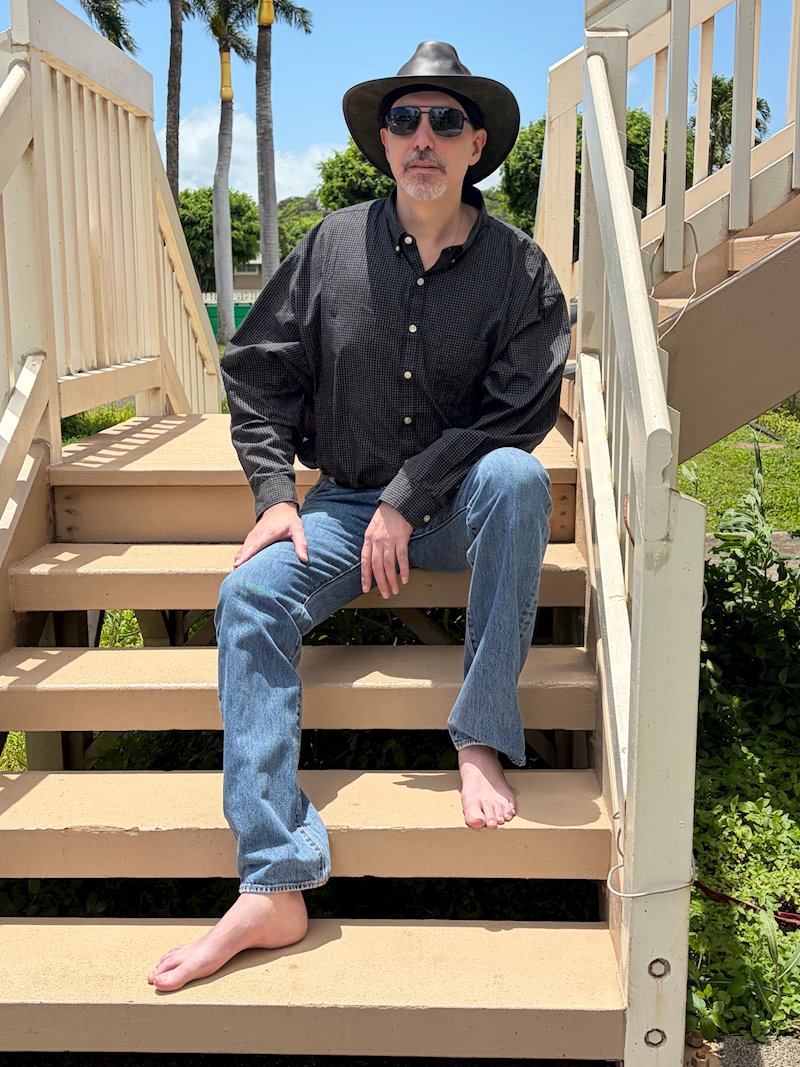
Some albums are made. Others are survived. “Acoustic Mourning”, the debut release from Lonesome Cat — the moniker of Maui-based artist Monty Oliver Anderson — is the latter. A deeply personal collection of rock and blues songwriter compositions rooted in grief, isolation, and the raw reality of mortality, the album was born from one of the most devastating stretches a person can endure: the loss of friends, family, a marriage, a career, and finally, his beloved cat of sixteen years, Batty. That Monty made this album at all is remarkable. That he made it while being blind, self-taught in music theory, and working ten hours a day seven days a week to bring it to life — is extraordinary. Out now via his own Unsound Creations label, “Acoustic Mourning” is one of the most honest records you’ll hear this year. We sat down with Monty to talk about the music, the grief, and the resilience behind it all.
- The album is dedicated to Batty and to all the beloved pets and friends you’ve lost. Can you tell us a little about who Batty was to you — and how her passing became the moment that crystallized everything this record needed to say?
Batty was a little black cat who had been with me for sixteen years. She was different somehow than my other furry friends. I adored them all, but somehow Batty and I developed a special relationship. Maybe it was because she was so dainty and delicate, I felt I had an elevated responsibility to protect her. She would follow me everywhere and sleep on my arm at night.
She came down with a respiratory condition that the vets couldn’t heal. When I made the decision to end her suffering, it hurt me deeply. It was only then that I realized how much I depended on her. She was my anchor to hope and optimism. No matter how bad things were getting in my life, as long as she was with me, I could find the desire to keep going. When she departed, it literally felt as though something had been torn out of my heart. I felt empty and alone. While deep in my grief, I had a powerful waking vision of being alone forever. Everyone knows intellectually that death and loss are a part of life, but this was beyond mere awareness. I was experiencing emotionally the unavoidable fact that everything I love, and will ever love, will one day leave.
At one point I decided to put my grief down in words. I knew that other people were certainly going through the same experience, and I wanted to do whatever I could with the abilities that I have to try and let people know that they are not alone in their grief. Since music had always been a powerful therapy for me, I turned my words into lyrics and tried to capture various shades of grief, which eventually turned into Acoustic Mourning.
- You describe that period as a Jenga collapse — friends, family, pets, your job, your marriage — all falling away. How did music become the place you turned to, and at what point did you realize that what you were creating was becoming an album rather than just a way of coping?
Making an album at some point in my life had been a goal for many years, but it was something I had to keep pushing into the future due to various responsibilities. About a year after Batty passed, I was still unemployed and depressed, and I decided that it was now or never. I began treating the album as a job, starting early in the morning and continuing on until the evening.
- You’re blind and entirely self-taught in music theory, guitar, and vocal performance — committing seriously to music only from 2012 onward. What did that journey of learning look like, and what methods and approaches did you develop that others might never have needed to find?
I knew I would have to do everything myself, so I embarked upon a journey of learning the craft of music along with recording, mixing, and mastering. I searched for all the training materials I could find, which had to be in an audio format due to my lack of eyesight. The practical application was the most difficult. I had to find and obtain the right computer with the right screen reading software and the right recording and editing software that would all work together and permit me to perform all of the necessary tasks with a computer keyboard only, no mouse.
Most of the software, including virtual instruments and plugins, were totally inaccessible. I had even contacted various gear manufacturers to encourage them to make their products more accessible, without much success. The only company that I’m aware of at the moment that has made such an effort is Native Instruments. A few years ago they released a music keyboard with a feature that would announce selections and parameter changes, which opened up their vast library of virtual instruments to blind persons.
When I did have a job, I spent obscene amounts of money searching for the right gear. It was an obsession.

- The album was built by treating music like a full-time job — ten hours a day, seven days a week in early 2026. What does that kind of focused, solitary creative process feel like from the inside — and how do you know when a song is finished?
When I sit down to write, I really don’t have any starting ideas. I begin by looking inside myself, at different memories from my life, searching for the emotional resonance. When I find something, I start typing out lines that attempt to capture what I am feeling. The goal at this point is to find a single idea to develop the song around. Once I have that idea, I try to find phrases and images that add flesh to the skeleton of the idea, and then begin sorting these elements into verse and chorus sections.
I can usually feel when a song is complete. After combing through the lyrics multiple times, I step away for a few hours and then come back to it with a more relaxed mindset for another review.
- The tracklist carries titles like Beautiful Oblivion, In the End, Going Home, No One Gets Out Alive, and Table for One — there’s a clear emotional and philosophical arc here. Did you sequence the album deliberately as a journey, and is there a track you’d point a new listener to first?
Yes, the tracklist was chosen specifically to take listeners on a journey through grief and loss. I didn’t want to just drop a bundle of sorrow onto people and potentially leave them feeling miserable. Tracks like Through the Night, Thinking of You, and Ride Your Wave were created to provide an emotional balance.
The one track I would point someone to as a way of capturing the essence of the album is probably the final track, Mercy. The song is about someone who is so broken by the tragedies of life that he is yearning to be taken from this world to the next realm of existence.
- Any music videos planned to bring some of these songs to life visually?
Yes. A video for Beautiful Oblivion is currently underway.
- In such an AI-driven era, how do you see the future of indie artists in particular — and the music industry in general?
This is such an important question right now. I actually have a series on my YouTube channel discussing this very topic. AI is just the next step in the evolution of digital music production technology. Songwriters in particular now have a method of expression for their lyrical creations that they may not have had access to before. AI generated music will certainly provide a greater level of competition for listeners. A recent article stated that nearly 100,000 new tracks are uploaded to streaming services each days. That can be overwhelming for new artists trying to capture someone’s attention.
I believe Indie artists will eventually embrace AI as yet another production tool, the same way they embraced MIDI, electronic music, and AI driven production tools. Songwriters can now manifest their lyrics without depending upon another group of people to interpret their vision, and traditional musicians will likely use AI to help find lyrical and melodic ideas.
- Thank you for your time and music.
Thanks Mena for the time and the excellent questions!