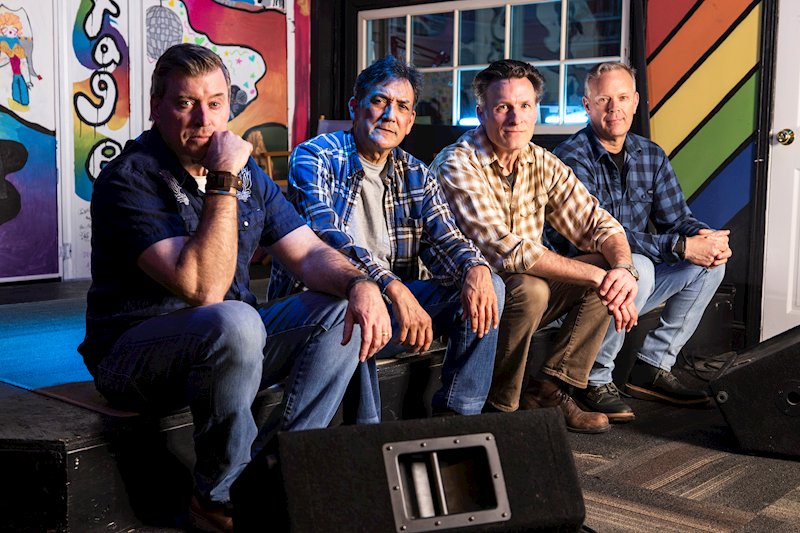
Two decades of road-worn Americana wisdom, three acclaimed albums with The Molenes, and a debut record that Dave Hunter himself calls his best yet — Dave Hunter and the Seven Hundred arrive with “Tamp That Fever Down”, out July 7th, 2026 via Happy Little Records. Rooted in the haunted back roads, dark alleys, and forgotten corners of American life, this eleven-track debut fuses roots rock, alt-country, and Americana into something that feels both deeply familiar and entirely fresh — virtuosic guitar work, a defiant croon, and a rhythm section tight as a constrictor knot. Formed in 2025 from the Seacoast region of Maine and New Hampshire, the band carries forward a lineage that once reached the Top 40 of the AMA radio chart and earned praise from Boston to the UK. The fever, it seems, was never going to stay tamped down for long. We sat down with Dave to talk about the new record, the journey behind it, and what it means to start a new chapter after twenty years of making music that matters.
- “Tamp That Fever Down” is being described as your best album yet — more mature in the songwriting and reaching new levels of musicality in the playing and production. After two decades of music making, what does it feel like to genuinely believe that your best work is right now?
It feels great, thanks! I was away from the roots-rock/alt-country songwriting for a while — doing more rock and indie-based work for a few years — but have always felt it came pretty naturally to me. It’s been fun to discover that the muscle still works, and that I feel I have something more to say with this style of music.
- The Molenes built a serious reputation — year’s best lists, AMA and FAR chart success, songs in film and TV, coverage across more than a dozen countries. When that chapter closed, what did it take to step back into the spotlight under a new name and with a new band — and what made 2025 the right moment to do it?
It always felt like this was “home base” for me artistically, and this kind of music comes pretty organically — even though it’s always still work to do it right and produce good material — so it was just kind of an intuitive move to slip back into it. I knew my bandmates from The Molenes wouldn’t be available, or not available to play as much as I wanted to when firing this thing up again, but Chris, Steve, and Joe are all good friends of many years and they have embraced the adventure wholeheartedly.

- The album title “Tamp That Fever Down” has a very particular atmosphere to it — something simmering just below the surface, a calm before the storm. Where did that phrase come from, and how does it capture the spirit of what’s on this record?
The phrase comes from one of the lyric lines in the song “Leaving Westbrook,” and the story told in that encapsulates notion of just sitting by for far too long and watching things go to hell in a place — whether a small town or an entire country — until you reach a point where you have to do something about it. And it seemed to us that the same feeling represented the mood of the entire album. In the song, it’s implied that the “have to do something about it” point the protagonist hits is perhaps pretty explosive or damaging, so it’s also subtly implied that we might want to work with those feelings – or rather, those genuine observations of evil at work in a place – and start combatting it sooner than later, rather than tamping it down indefinitely. Which is to say, the line in the song before the one that forms the album title is “And man, it’s only so long… that you can tamp that fever down.”
- Dave Hunter and the Seven Hundred carries forward The Molenes’ live catalogue alongside new original material. How do you balance honoring that older body of work — which clearly still resonates deeply with audiences — while making sure the new songs feel like a genuine step forward rather than a continuation?
Including some old Molenes material in the live sets was kind of a necessity at first, just to have enough material to start gigging without having to fully develop enough brand-new material first, even though we did add in several new songs from the start. That’s largely because we were eager to get out there and play, ha ha — I’ve always been a little impatient that way! But I think that between the time that has passed between the last full Molenes shows and the start of this new band, which is a good ten years, there’s been a natural maturation and evolution of the way I write and perform that makes it pretty clear this is something new and a little different, without being a million miles away from the spirit of what I was doing previously. Put another way, if The Molenes had kept going past 2015 and eventually made this album, there would have been at least a couple others in between then and now to bridge the gap – so that “bridging” just kind of happened behind the scenes in this case.
- Chris Kelly, Steve Barlock, and Joe Welsh round out the band — and the rhythm section has been described as tight as a constrictor knot. How did this particular lineup come together, and what does each member bring to the sound that shapes what “Tamp That Fever Down” became?
In addition to being good and long-time friends of mine whom I’ve known for between 15 and 20 years or so, Chris, Steve, and Joe played in a local band together for several years, and I used to sit in with them now and then for fun. So, they have been working as a unit for a good while, but we’ve also got the friendship between us that adds an extra dimension to the band and simply makes it a lot of fun to play together. Joe and Steve have a real symbiosis as the rhythm section, and Chris is great at laying on color and nuance that I can’t tackle while singing.
- The music has always conjured the back roads, dark alleys, and forgotten corners of American life — both yesterday and today. In 2026, with the state of the country as it is, does that lyrical territory feel more urgent or more personal than it did when you started out?
It definitely does. And part of that is because I think a lot of people in those so-called “back roads, dark alleys, and forgotten corners” have had certain things thrust upon them that they’re just expected to accept and live with, and in some cases conform to. And I feel they deserve to be given the grace and the respect to know what’s really driving so many things in the country today and to be able to make clear choices without the major curtain of trumped-up BS clouding their judgment — to understand what the real forces at play are and to have a chance to assess who’s got their backs, and who really doesn’t but likes to pretend to just to win them over for the sake of maximizing their own wealth and power.
- The album was self-produced and mastered by Justin Perkins at Mystery Room Mastering, released on your own Happy Little Records imprint. What does that level of ownership and creative control mean to you at this point in your career — and has the experience of doing it yourself taught you anything about the music that surprised you?
I suppose if there’s an element of surprise to doing it all ourselves it’s how much work it is, ha ha. But it’s also very rewarding to have creative control of so many aspects of what we’re doing. Part of it, of course, is out of necessity, too; I have a lot of respect for the great and supportive independent labels still doing their best out there, and have been fortunate to have worked with some of them in the past, but musicians have been stripped of so much of the financial reward of the recording and record-releasing side of the craft that it’s barely something you can expect to figure in the “plus” column on the financial spread sheet anymore, although everyone still feels the creative drive to put out new music. So, for a lot of bands having control of that production and release component helps to get the music out there without too much of a financial burden, which I feel is really important to many artists, as it is to us. As a sidebar to that, though, I’ve always enjoyed the studio-based part of this — the engineering, producing and mixing — and it’s also fun to maintain control of that as another aspect of the creative process as a whole.
- In such an AI-driven era, how do you see the future of indie artists in particular — and the music industry in general?
I’d like to think that indie artists might be some of the saviors of genuinely creative and original human-made music going forward. This whole AI onslaught depresses me no end, but the best way to combat that is to resolutely refuse to allow it into your own creative process, and call it out for what it is when you see it. I had intended to put a note on the album’s back cover to say “DH700 is an entirely AI-free zone,” but I forgot to have it added to the cover design. Next time! Regardless, I refuse to let any aspect of what we do be touched by the Soma-fication of the AI boom, whether it’s the music, or any visuals or video creation, or what have you. I know a lot of indie artists feel very much the same, and hopefully we can offer each other the support needed to keep it that way. Why even get involved in any aspect of a creative and artistic pursuit — one of the most rewarding of human endeavors — if you’re going to turn that over to a machine?
- “Tamp That Fever Down” is the debut, but the biography mentions the band is already recording toward a new full-length release. How much creative momentum is the band carrying right now — and what direction is the next chapter heading in?
I think that was a holdover from an old press release from when we first started playing live about a year ago, and that was talking about THIS album that’s coming out now. But, I do have about an album’s worth of new material to present to the band and we’ll likely start putting that together once we’ve gotten past this run of live shows promoting “Tamp That Fever Down”.