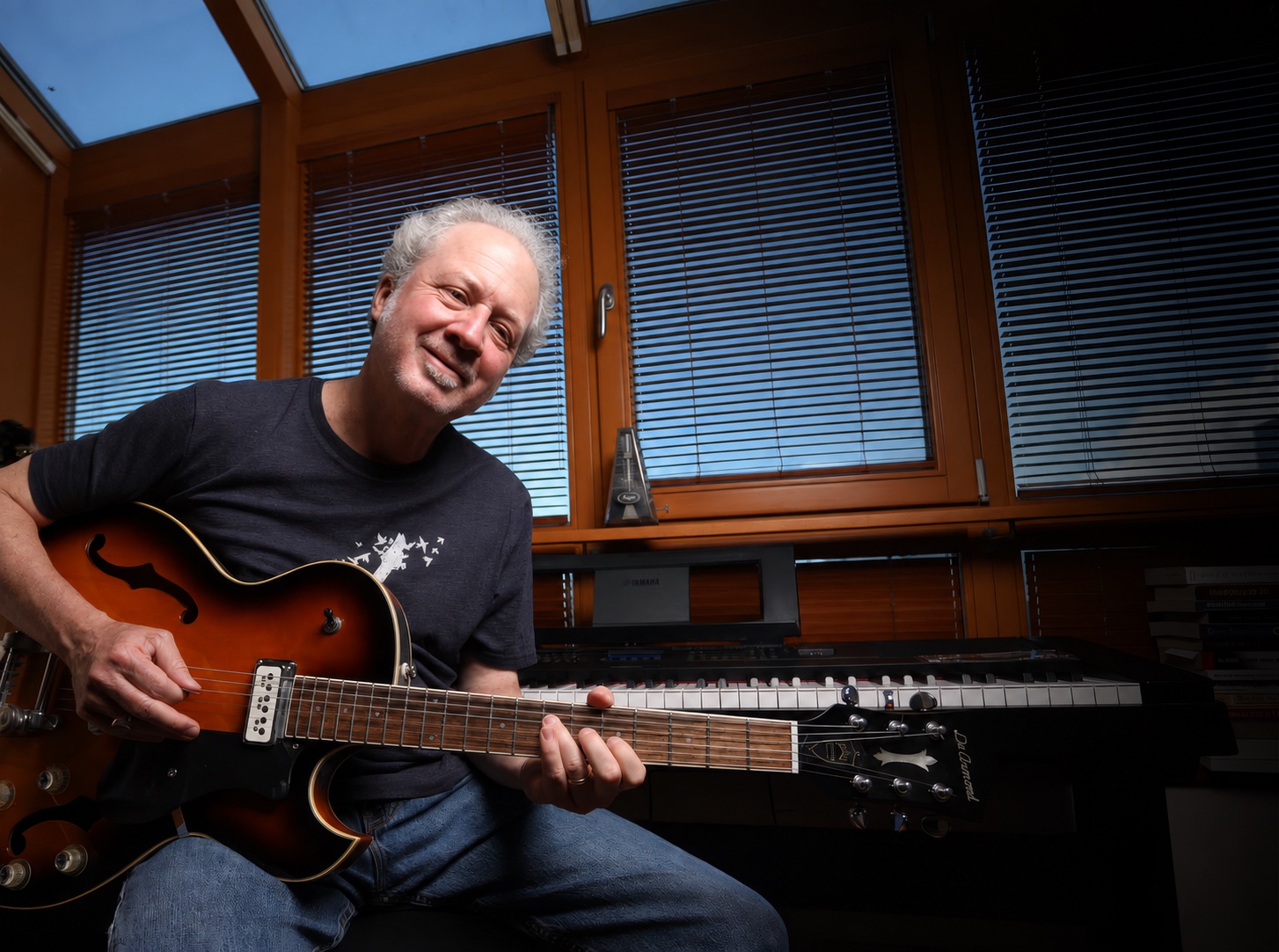
For George Collins, the path back to music began with a guitar, an old songbook and a Fourth of July performance in Prague. After decades working in international finance, Collins had not played a live show since leaving the United States, but by 2013 he was ready to reconnect with the creative side of himself that had never really disappeared.
That performance proved to be the beginning of something much bigger. Since then, Collins has returned to songwriting, released new music and expanded his creative work into fiction and screenwriting. His latest single, “Safe Harbor,” is particularly personal, having originated during his student days and been rediscovered decades later while he was working on his album New Ways of Getting Old. Revisiting the song allowed him to bring the experience of the years in between to a piece of music that had remained with him.
Collins’s story is also one of remarkable musical connections. In his younger years, he played alongside Carter Beauford and the late LeRoi Moore, long before their work with Dave Matthews Band brought them international recognition. Those early experiences, combined with a lifetime of influences ranging from The Beatles and Bob Dylan to Bruce Springsteen and Tom Petty, continue to inform his approach to songwriting today.
Alongside his music, Collins has also turned to fiction with his debut novel PLAYING THE CHANGES, exploring many of the same themes that run through his songs: love, loss, change and the possibility of becoming someone new.
Here, Collins talks about rediscovering his musical identity, the story behind “Safe Harbor,” the lessons that come with growing older as an artist, and why creativity may become even more rewarding with time.
- You spent decades working in international finance before returning to music, and you’ve described an impromptu Fourth of July performance as the moment that reignited your creative life. What happened that day, and did you realise at the time that it might mark the beginning of an entirely new chapter?
I remember the Fourth of July 2013 very well. One of my best friends in Prague owned one of the most popular pubs in the city, with a big beer garden in the back. He would host a Fourth of July BBQ every year for over a hundred guests, featuring live entertainment. So I approached him in the autumn of 2012 and asked if he would book me for the following Fourth of July party, and he agreed. At this point, I had not played a live gig since moving over to Prague 20 years earlier. However, I was already in the process of wrapping up my finance career and was writing the first drafts of my novel PLAYING THE CHANGES, and I was feeling my creative juices flowing again. I thought it would be fun to get back into music as well, and I wanted to set myself a challenge, so I tuned up my guitar and dusted off my old songbooks and spent months re-learning all the songs I used to play as a solo acoustic act when I was a student. The Fourth of July show went well – people were stunned, because very few of my friends and colleagues from the world of finance knew that I’d been a professional musician in my younger days. I remember sitting in the beer garden after the audience had left and I’d packed up my gear, sipping a whiskey and reminiscing about all the shows I’d played back in the 1980s and early 1990s – it was quite emotional, and extremely satisfying, and I knew at that moment that music would have to become a big part of my life again.

- You were bandmates with Carter Beauford and the late LeRoi Moore before they became known through Dave Matthews Band. What do you remember about those early days playing music together, and could you sense the extraordinary musicians they would become?
Common Knowledge was an 11-piece Earth, Wind & Fire-esque band that played a mix of funk, jazz, soul, Pop, and R&B – everything from Michael Jackson to Steely Dan to Chaka Kahn to The Crusaders to Stevie Wonder. I was the only white guy in the band – my bandmates dubbed me an “honorary brother” and nicknamed me “Bootsy” Collins.
Although the band dissolved amicably after a couple years before making any records, I knew from our first session that I was playing with some world-class musicians and that I’d have to up my game! Carter Beauford was already an extraordinary drummer, and LeRoi Moore (leader of the five-man horn section) was a superb saxophonist. The band also featured keyboardist Raleigh Neal II, who has had a long and successful career playing alongside legends such as Herbie Hancock, Carlos Santana, Nile Rogers, and others. As I headed off to grad school, I knew that Carter, LeRoi, Raleigh and some of the others would hit it big in the world of music – they were simply too good not to make it. No question, Common Knowledge featured some amazing talent – Charlottesville has always had a thriving music scene, and I was fortunate enough to play with some of the Best.
- Your new single, “Safe Harbor,” began as a song you wrote in your student days, when Bruce Springsteen’s Born in the U.S.A. was dominating the charts. What was it about Springsteen’s songwriting that influenced you, and what did you discover when you returned to the song decades later?
I grew up in New Jersey and have been a Springsteen fan ever since he burst on the scene with “Born to Run.” Whether it’s his stirring, anthemic rockers, or his more soulful and sensitive ballads, I have always loved the power and passion of his songwriting, his insight into human nature, and the energy of his live performances. I have had many influences over the course of my musical life – The Beatles, the Stones, Bob Dylan, Tom Petty, Van Morrison, Billy Joel, and too many others to mention – but Springsteen will always hold a special place in my heart. Maybe it’s that New Jersey connection. So when I found an old demo of “Safe Harbor,” while I was working on my new album, it took me back to a very formative time in my songwriting journey and I thought to myself, “Hey, this is something I can work with.”
- Revisiting old material can be an uncomfortable experience, particularly when you look back at the person you were when you wrote it. You’ve said that much of your early songwriting didn’t stand the test of time, but “Safe Harbor” did. How did you decide what to preserve, what to change and how to make the song feel relevant to the person and musician you are today?
Yes, most of the songs I wrote in my student days are cringe-worthy, the product of musical and emotional immaturity. Some of my songs from that era have stood the test of time however – for example, I wrote “Toward the Light” (which appeared on my first EP, It’s Been a Long Time) when I was 22, and it’s an extremely sophisticated song, both musically and lyrically. Today I find it hard to believe I wrote such a mature song at such a young age – and at a time when most of my other songs were pure drivel. Unlike “Toward the Light” (which I recorded exactly as I wrote it almost forty years earlier), when I listened to the old demo of “Safe Harbor” I knew I would have to make a few changes. The energy was there, and the message and meaning of the song were clear, but chord progression and melody in the verses were static and repetitive, and some of the lyrics no longer made sense to me or struck me as cliches. I tried out a few different variations – a new chord sequence here, a few melodic twists, a more creative lyric there – with some of my songwriting mentors, and their input was invaluable in helping me shape the final version.
- Your album New Ways of Getting Old explores the idea of reinvention, while your songs often deal with love, uncertainty and the complexities of being human. Has getting older changed the way you write about these subjects, and do you think you understand yourself differently as a songwriter now than you did in your twenties?
Of course. Also, being a parent has informed my songwriting enormously, as well as the passing of time and the process of aging. While I still love fist-pumping rockers (and I hope I always will), I’m writing now from a much more mature perspective than when I was in my twenties. Although I was a better guitarist back in those days, today I’m a much better songwriter with a better grasp of melody, harmony, rhythm and structure. I’m also a better singer now than I was back then. But most importantly, the themes I address now reflect where I’m at in my life and my lyrics are written from a more mature perspective with, hopefully, a more universal appeal than the self-absorbed, intensely personal songs I wrote in my youth.
- Alongside your music career, you’ve written your debut novel, PLAYING THE CHANGES, which explores love, loss and the possibility of becoming someone new. What can fiction allow you to express that songwriting cannot, and do you find that the two creative disciplines influence one another?
Fiction allows me to dive deeper and examine a subject (or subjects) from a variety of angles, which is difficult to pull off in a three-minute song. Also, the narrative structure of fiction enables me to tell longer stories and vary the pacing of the exposition. The words themselves must be rhythmical and create the music necessary to summon up an imaginary world for the reader to experience.
On the other hand, the structural constraints imposed on a song require far more compression and precision – repetition is a good thing in pop or rock but is considered anathema in fiction. And of course, there is a direct link between music and emotions, how a certain lyrical phrase or melodic line or guitar riff can embolden us or cause us to break down in tears. In my case, the two disciplines certainly inform each other and force me to continually improve in both. At the end of the day, in whatever format, it’s all about capturing emotion and sharing it with a reader or listener so they can experience it too.
- Your journey challenges the idea that creative ambition belongs primarily to youth. Having returned to music and expanded into fiction and screenwriting, do you feel more creatively fulfilled now than you did earlier in life, and what ambitions are still waiting to be realised?
Yes, definitely. I was frustrated back in my twenties because I knew I wasn’t yet writing the songs that I believed I was capable of writing. While I am a firm believer in the concept of kaizen, or continuous improvement, and I hope I continue to improve as an artist, I can say that at the moment I am pleased with my development over the past few years and proud of what I’ve been creating – both in fiction as well as music. Of course, the challenge is to sustain that creativity, but for the foreseeable future that shouldn’t be a problem for me – I’m currently writing songs for my fifth album, and my second novel (working title: POISONTOWN) has already been through several drafts, so the next few years are already spoken for. I just hope these new songs and my next novel will be as good as or better than what I have already written, and that readers and listeners will appreciate them – only time will tell.