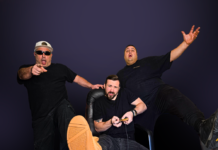
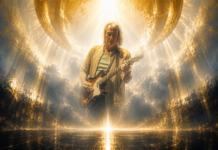
Brooklyn’s most gloriously unhinged rock and roll agitator is back — and he’s not asking for permission. Lord Sonny The Unifier, the artistic brainchild of multi-instrumentalist, vocalist, painter, biker, and self-described nuisance to the uninspired status quo Greg Jiritano, returns with “The Escape Plan Handbook“ — out September 25th, 2026 on digital platforms, with lead single “Ain’t Nobody Listening” already out and “Who’s Rules?” arriving August 28th. All analog, tube amps, early 70s synths, and zero compromise — this is psych-tinged biker punk rock that captures the collective frustration of a world that has forgotten what freedom actually feels like. Praised as “an anthemic sonic voyage that serves as a soundtrack for a new rebellion,” Lord Sonny The Unifier is exactly the kind of artist this moment demands. We sat down with Greg to talk about the album, the escape plan, and the tribe of iconoclasts who inspired it all.
- “The Escape Plan Handbook” was built around the idea of a vanishing America — the 60s and 70s freedom of being truly unreachable, of cheap rent, open roads, and no way to track you down. When did you first feel the loss of that world personally, and what made it the right obsession to build an entire album around?
Yes, I was trying to capture what it was like in the 60’s and 70’s in America. According to some economists and historians, the year that America had the highest standard of living was 1969. The exact year can be debated but this is as close as many come. If we look at the 10 years prior to that and the ten after we get a rough idea of a certain lifestyle for many. I am sorry to offend people of color and minorities and the very poor who were always dealt a difficult and much different version of America. This thinking is a means to understand the overall general population at that time. It was a time when rents were so cheap and minimum wage was so great that it scared the daylights out of conservative politics – because too many people had too much time on their hands and stood up and yelled and caused a ruckus when the government did things that were against the decency of humanity such as the Vietnam War. This freedom and lifestyle had to stop because it allowed for a lot of Artists to thrive as a result of this very high standard of living. The minimum wage was $1.60 an hour. A worker in a factory such as General Motors made $4.00 an hour. $4.00 in 1969 money is equivalent to $37.00 today. That’s for a person working a factory floor. So, for example The Grateful Dead rented an entire Victorian house in, it’s safe to say, a nice street in a really cool city for $250 a month. It had 4 floors, God knows how many bedrooms, so with 5 people sleeping there and each paying $50 a month, the rent was covered. That means one person had to work A DAY AND A HALF in a factory to cover their rent FOR THE MONTH. Gas was 30 cents a gallon, a hamburger, fries and milkshake at a dinner in 1969 was between 85 cents and $1. So one had to work a half an a hour to get a full meal at a diner if they were making the very minimum wage of $1.60. McDonalds Burger was 15 cents in 1969. A 50 cent hamburger has the same purchasing power of a $4.25 hamburger today. Imagine buying a Hamburger for $4.25 today? We’re fucked. My point is people had freedom, freedom to live as they decided. For so many it was easy. Life was wide open. And what does that mean? For one, the arts thrived. Peoples minds weren’t trapped in a hellscape of working. People didn’t even think about the cost of rent as they must today. People soared and roared and created shit. Those picture of the 60’s and 70’s are real. We could talk about this for hours. We could talk about why and how this ended as well. Was it purposely ended by governmental policies? They certainly don’t want a free society who has the wherewithal to rise up every time they entered a war or commit any other indecent act and have to deal with street revolts by the people etc. I don’t want to get into politics any more here but look into the changes that took place in 1980 and where they lead to and see who was behind them…and vote accordingly.

- You’ve described writing these songs from two perspectives — being IN that world and looking AT it from the outside. How did those two vantage points produce different kinds of songs, and can you point to specific tracks on the album that live in each of those spaces?
Sometimes both perspectives meld into one song as well. The bird’s eye view makes a landing at the camp sight. It’s like a cloak I carry around with both perspectives always on the lookout and inevitably it ends up in a song or in this case many songs. I’ll find myself in certain situations with unabashed freedom, surrounded by the coolest freaks and think, yeah this is it, this was how it must have been in the late 60’s but they had it 24/7 or 24/6 This will write a song like We Applaud All The Freaks- a direct result of getting together with a bunch of great people and walking around the city with the same playlist in all of our headphones, tripping over ourselves . I thought man, look at all these beautiful freaks…and then I’ll get back to the reality of today where people don’t have the time to listen to ONE song let alone sit around a turntable with their friends to check out a new album, the entire thing…just sitting there listening because that was a great thing to do and we’d freak out doing it. Nostalgia is a strange thing when things have gotten worse. This devestating reality will write a song like What’s Your Message because it’s asking what are you going to leave everyone with this new lifestyle? What are you doing now that we will remember you by, that is so important it will be written in stone later on? I was imagining this scenario sitting in a kitchen at someones house in 2026, the modern frenetic nothing and comparing that to what went on in The Grateful Dead’s house in 67, or any other house on that block.
- The recording philosophy here was clear from the start: keep it dirty and real, all analog, tube amps, wild early 70s synths. In an era of infinite digital polish and endless plugin options, what does committing to that analog approach actually demand of you as a producer — and what does it give the music that nothing else can?
Analog helps shape the Spirit of the songs because analog instruments have their own Spirit. It’s like having another great player with you. If a keyboard player is playing it on an old synth, that synth is bringing its’ added Spirit with it. Each player brings their signature to a performance and that signature can be so deep it transcends the simplicity of the part and so does analog gear, it has it’s own signature. There’s also the scientific element that digital recording does not think the distortion is important enough for converters to capture. It doesn’t capture all the harmonics of the wave, just bits of it. It transfers the fundamental tone and not the distorted outer waves of the tone (also something one might not ‘hear’) but all those lost distorted tones of that wave creates a body, a depth, a mystery. This is evident when you put on vinyl from the 70’s. They have a Spirit, almost as if the tape machines that recorded those songs also recorded the essence of the Earth itself. The magnetic tape absorbed the ghosts that were present and it got sucked onto the tape. This takes a conscious listen and a very awake listener to hear of course. As a producer there’s no compromising for me. In the studio every instrument was played by a person, there are no programmed parts played out by computer. Do listeners know this? Maybe. Maybe there’s a deeper part of knowing that is not conscious. But it’s an honoring of the past and what made me love music…honor the drummer and use a drummer, honor the Hammond B-3 and use a real one, honor the amps and microphones and use the real ones. Why? Because Hendrix, Marley, Morrison, Lennon , they’re all listening. Don’t let them down. They played for real. Their magnificent souls went into this thing called music. Ring their bells. A small part of me was reacting against AI generated music as well – which is as vile as eating vomit. So I was keeping in elements of humanity during the recording, even in small degrees and details, like the scraping of fingers on the strings between chords that in times past a producer would have stopped, or the slight squeal of the guitar amp before or after the chord is hit for example. That’s one aspect of keeping it dirty, but mostly it’s the sounds themselves that deliver the dirt. Keeping it dirty and real is a way to combat AI. We also have to get weird. So weird and honest that it sounds unlike anything AI could conjure. Not for weirdness’ sake but for the sake of digging deeper and bring forth our uniquenesses, our souls, our take on our time here as only we can say it and without an ounce of compromise. Ai does not and will never have a soul so we’ve got to bring forth ours.
- Your story includes recording an entire album in the Massachusetts mountains using only modified analog effects and 40 overdubbed guitars — music that was never released — and then losing a full studio to fire before your debut. Most people would have walked away. What kept you going through that, and how much of that resilience shows up in the DNA of “The Escape Plan Handbook”?
It’s all an evolution, nothing is directed or forced or even thought about consciously, we just become and what we become is evident in our output at that time. I usually write a lot of songs for each album and pick the 11 or so that strike me as the better ones and so by writing a lot and not being trapped into any song with the thinking that this one particular song I am working on must be put on the album, this forces me to pull in everything Ive got at the moment, creating a lot of work and not fine tuning or focusing too much on the details, at first, nor stopping to be conscious of a specific statement to make. It’s all just an outpouring of being at that moment in time. An overwhelming capturing of what’s in the net. I never stopped this fishing expedition except for the time I was rebuilding my studio and re-thinking a few things. None of my heroes stopped. Nobody stops who ever really began. If you began for reasons other than creating as great a work you can and for that reason only, you won’t stop. That’s what keeps so many of us going after making 0.0036 cents per listen.
- Greg, you started playing guitar at 8, was in a band at 12, and playing NYC bars at 16 — yet at 18 you made the deliberate choice to step away from the lucrative live musician path and focus entirely on writing and recording your own music. How has that foundational decision shaped everything Lord Sonny The Unifier has become?
Everything we do, everything, builds onto our soul, piles on. We’re walking wooly mammoths lumbering into the streets, the bars, your friends place for a BBQ, the Supermarket. We’re MASSIVE. Wearing massive coats of history and memories, secrets, plans, fantasies, losses, wins, everything is there, piled on a clear, somewhat weightless overcoat. When we create our art we’re moving the brush and choosing the paint with this behemoth soul, this life’s overcoat on. Hopefully it’s light as a feather and a wise guide for us and not a burden. That’s the point of this human experience. Stay light. When I begin to write a song I tell myself, I’ve got one objective to get a good one, to get it “right” and that is to have fun. I don’t know what I am going to do but I am going to do it and have fun doing it. Nobody knows how to write a great song, nobody. There’s no knowing, there’s only doing and hoping for some magic. Magic comes to the free. This will open up a lot more avenues for creation, a lot more roads reveal themselves when you’re lighter, for one, you’re flying higher and can see more options. You don’t see clearly down in the mud. I chose the most creative path, that is writing, sometimes at the expense of playing live but so be it.
- The album has been compared to Viagra Boys, Tom Waits, Motorhead, David Bowie, The Lennon Claypool Delirium, and Jack White — a wild and eclectic range. Which of those comparisons feels most accurate to you, and which one surprises you most?
It’s so difficult to say exactly how we are influenced by the artists we love. Hopefully I wasn’t too influenced by any of the above mentioned great artists. I certainly don’t want to be. I want to make music that, from the first note, people will say, that’s Lord Sonny The Unifier, like we do when we hear the songs and artists we love. Think of the greatest guitar players, you only need to hear 2 seconds of a note and you can say, Oh that’s Carlos Santana, that’s Richie Blackmore. 2 seconds. That’s the ultimate achievement for a writer. Probably the artists from when I was much much younger directly influenced me. The songs I heard at 2 or 3 years old. Those rhythms and beats told me, hey, this is the music of your era, in your birthplace. This is it …and it sunk in, and those roots grew to many branches and leaves and some of those leaves died and some of those branches grew larger some smaller but the roots stayed and got fatter and deeper. If I were born in Jamaica and heard those rhythms as a 3 year old I would be playing reggae. I can’t now, it’s not me. Do I love it? yes. Do I freak out when the beat is on the 3? Yes and I write music with the beat on the 3 sometimes because I love it so much but it’s not reggae. If someone says, you sound like so and so- your career is doomed. You won’t shake the pages of a music history book that’s for sure . Kandinsky the great painter who some say created the first abstract painting in the early 20th century (tho that’s up for debate) said that if you create a work that is based on someone else’s work or use theirs as a starting point in your work then your work will be stillborn. He would know.
- Alternative Nation called LTSU a band with “not an ounce of compromise” and The Farsighted noted something “distinct that will never be accused of being derivative.” In a Brooklyn music scene that can sometimes reward a certain kind of cool, what does it actually cost to be that uncompromising — and has it ever cost you something you regret?
Well, the ultimate cool is never being accused of being derivative or not having an ounce of compromise. So we fit right in, HA! I think that’s what’s so great about the Brooklyn Music scene- that those descriptors can apply to so many of the bands there. It is the melting pot of Freaks. It’s changing a bit for the worse as the rents are incomprehensible and creating a restricted area for most artists. It will soon change like Manhattan did and as soon as everyone’s lease is up or lost somehow, it will be gone and moved elsewhere- if the music scene continues with a BAND being the central core, as this is evolving as well. The only thing I regret as a musician is working too much at things not musical.
- Lead single “Ain’t Nobody Listening” — what is that song about, and why was it the right first signal to send from this album into the world?
In that song, Ain’t Nobody Listening, I sing, ‘ I pulled the alarm cause my head is on fire/ the men in charge are serial liars/ thought I’d let you know/ it’s gonna blow’ There’s a maniacal urgency when there is maniacal, incomprehensible behavior by our so called leaders. It’s absolutely out of control that this behavior has been normalized and so it began the LP. It’s an overt blaring of emergency and the effects of people shouting in the streets and nothing much changing, if anything. This goes back to your first question and how the young fighters in this country are trapped in their jobs and have so little time and energy to take over the streets like they did in the 60’s. They’re not listening to us and we dont believe a word they say- that’s pretty much the loop we’re in. At this point it feels as if the only change that will emerge is from an Alien intervention of the extraterrestrial kind.
- Vinyl is coming shortly after the digital release, and the album is available to pre-order on BandCamp now. Where does Lord Sonny The Unifier go from here — and is there already a next escape plan forming on the horizon?
I was going to call the next album The Escape Plan Handbook Part 2 but thought because of our short attention spans nobody would notice the part 2 part in the title and it would get brushed aside, but yes there is another album that I am in the studio recording now. It’s more of a where we go when we get out of the bunker album. I’d love to play more shows live as well. I’ve got a 7 piece band so it’s a bit of an ordeal to pull them all together for gigs without a guarantee. Hopefully we’ll get there this year.