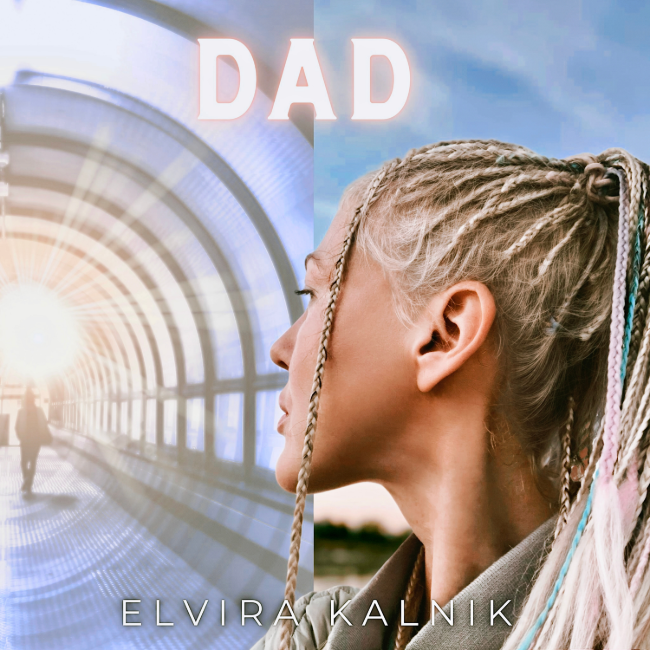
When Elvira Kalnik’s father taught her guitar and sang her lullabies, he gave her more than an introduction to music. He gave her a place where she felt safe and free to create. After his passing, Kalnik wrote “Dad,” a deeply personal tribute that took six months to bring into the studio. Ahead of the song’s October 9th release, she reflects on the advice that helped her record it, the emotion she chose to leave in the final take, and the ways her father remains part of her life.
Your father introduced you to music by teaching you guitar and singing you lullabies. What is your earliest musical memory with him?
To me, the music world looked like a safe, wonderful place. We learned children’s songs together, and those moments were always filled with positivity, laughter, and joy. I will cherish them forever.
You’ve said “Dad” came to you soon after his passing, but it took six months to record. What helped you finally step into the studio?
I kept trying to find a way to get myself back to music. I tried various emotional techniques and cognitive exercises, but they didn’t work. You simply can’t talk yourself out of grief. I was just about to give up when, all of a sudden, I remembered what my dad used to tell me in difficult situations: “You’re smart, courageous, and strong. You can handle it. Don’t let any circumstance discourage you.” His advice was what finally helped me. Even though he’s gone, he continues to guide and help me.
You kept the sighs, caught breaths, and other imperfections in the final recording. What did those moments express that a polished take couldn’t?
How do you explain a scent, the wind, a touch, or a sound? You can only feel it. Raw emotion is deeply profound. It belongs to a single moment, and moments never repeat. Polished things often lose their life, just like refined sugar loses its real taste. Removing the true emotions from this song would strip away the authentic, real-time moments that come with a breath. Breathing is the very essence of life. Sometimes, a subtle sigh can speak much louder than a technically perfect, steady vocal performance.
Your father trusted you to solve problems on your own while always being there when you needed him. How has that shaped the way you approach your life and art?
It taught me to trust my intuition, build confidence, take risks, go the extra mile, and live without a fear of making mistakes. I learned that failure doesn’t exist in reality; it only lives in our minds when we think we’ve failed. Life is a process, and like any task, it is alive in that process. The biggest mistake we can make is to always wait for results. Outcomes will come no matter what, but when we focus entirely on them, we can’t truly live in the moment or enjoy the journey. What’s the point then? So, I made it my goal to focus on the process and enjoy it as much as possible. My dad used to say: “Will be what will be, and will be what is supposed to be. Just do it. Try again. You can do better. It’s just a matter of time. As long as you keep going, it means you didn’t fail.”
You remember him as an avid reader with a remarkable library. Is there a book, story, or idea he shared that has stayed with you?
My dad was truly a walking well of wisdom. He was a man of few words, with a very calm and powerful personality. His grounding, yet innocent, childlike energy could light up an entire room. He carried a healing presence; just by being there, he could calm everyone around him. Because of that, I learned from him mostly through nonverbal language—through his inner freedom, natural wisdom, and a deep soul connection. We could understand each other without words. There is a kind of wisdom that can’t be taught because it goes beyond logic; it’s about the emotional intelligence and unconditional love that a parent passes to a child. He was someone who would never betray you. I trusted him more than myself because his sense of fairness and emotional intelligence were unmatched, and he taught me that simply by his example.
You’ve worked across music, fashion, and performance. Did your experience in those fields influence how you created the lyric video for “Dad”?
I feel like this project marks a completely new chapter in my creativity. I intuitively turned off my internal “judge”—the part of me that thinks it knows how things “should” look based on past experience—and just let the video unfold on its own. My dad had a rare gift of never trying to be perfect, because he knew perfectionism is meaningless. In fact, true perfection doesn’t exist. Ironically, we think that polishing everything makes it better, but the opposite is true. When you take a whole grain and remove its germ to polish it, you actually make it incomplete. Everything is perfect as it is. You will never find a perfectly straight line in nature, or a forest growing in neat rows. Nature has its own complex order, full of different frequencies, colors, and endless sounds. I feel like I am just starting to rediscover myself as an artist.
What was the hardest part of sharing such a personal tribute with other people, and what do you hope they take from it?
Interestingly, it was much harder to keep this song to myself than it was to share it with the world. Every person has a story worthy of a book or a movie. I truly believe my father deserves this tribute. He was incredibly humble, selfless, and generous, always helping his friends, and even strangers, without a second thought. He was also deeply talented in music, acting, and art, and he used to create amazing art pieces out of wood. He was rich inside and out, with a beautiful soul, and I feel incredibly lucky to have had him as my father.
I wish I had spent more time with him, because now I feel like there are so many questions that I didn’t ask him, so many things that I didn’t tell him, and now it’s too late, as every question is met with loud silence. It’s an unexplainable feeling that I’ve never experienced before. It feels like infinite stillness, like another dimension that can’t be perceived by the logical mind. As I sing in the song, my phone is silent because he can no longer call, and I cry out to him across that distance. All I can tell people is to take time from your busy schedules and spend it with your parents while you still have the chance.
Has making “Dad” changed your relationship with music or the way you feel your father’s presence in it today?
There is a line in the song: “Because I am a part of you, and a part of me is gone with you.” I feel my father’s presence not just in my music, but in everything. I’ve realized so clearly how much of him lives on in me—the way I think, the way I perceive this world, and the way I create are all deeply influenced by him. He saw beauty in everything and truly loved life, even though he left this world far too soon. So yes, I absolutely feel his presence. He lives in my heart and my memories forever.
In “Dad,” Kalnik shares a loss that remains difficult to put into words, along with the love and guidance that have endured beyond it. Her message to listeners is simple: make time for the people you love while you can.
“Dad” is set for release on October 9th, 2026.