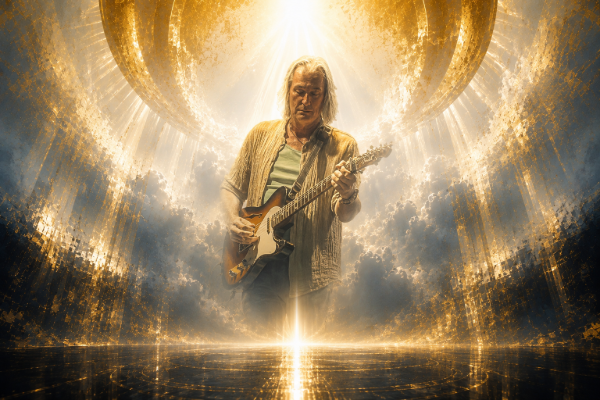
For Eddy Mann, songwriting begins with listening: to scripture, to the people gathered in worship and to where he feels God is leading him. His song “We Are” brings jazz harmony and an uncommon rhythm into a message of unity, while his album The Unveiling draws hope and compassion from the Book of Revelation. In this conversation, Mann reflects on the songs that have connected with listeners, how he measures their impact and the ideas taking shape for his next project.
“We Are” approaches worship from an unusual musical direction, particularly with its jazz influence and natural 5/4 time signature. Now that the song has been out for a while, what reactions from listeners have surprised or meant the most to you?
I’ve found that the song has been very easy for people to engage with. My hope was that, by allowing the Spirit to work through both the writing and recording process, the song would flow naturally. I never wanted the uncommon rhythm or extended harmony to become a distraction—or a hindrance—to the act of worship.
The Unveiling finds hope and compassion in the Book of Revelation, a text often associated with fear and judgment. Has creating this album permanently changed the way you personally read or understand Revelation?
It was actually just the opposite. The study I journeyed through inspired both the writing and the composing. It truly became an unveiling for me, and the song was simply my response to the truths that were opening up before me.
You’ve described “We Are” as a reminder that “we, together, are what God intended.” In a culture that often seems increasingly divided, what role do you believe musicians—and especially Christian artists—can play in encouraging unity without becoming preachy?
Well, it’s God’s Word that encourages us to live in harmony. As a singer-songwriter, I’m simply digesting that message, allowing it to reverberate within me, and then offering my personal understanding through my own voice. Whether something feels “preachy” is ultimately determined by the listener. I can be faithful to what I’m expressing, but I have little control over how someone chooses to receive it.
After more than three decades of songwriting and ministry, how has your definition of a “successful” song changed? Are charts, streams and radio play still meaningful, or do you measure a song’s impact differently today?
Success for me is measured by whether I’ve fulfilled God’s purpose for me. If I’m called to create, produce, and offer a worship song as a vehicle for leading God’s people into a place of worship, then ultimately only God knows whether I’ve succeeded. My prayer is simply that each song reaches those whom God intends it to reach.
https://open.spotify.com/track/754wadFOdJCBQTcDagp9Cg?si=0e958aeb1e894975
“I Will Never Know the Desert Again” and “We Are” reveal very different musical sides of The Unveiling, yet both ultimately point toward hope. When you look at the album as a complete work now, which songs feel most personal to you and why?
Both of the songs you mentioned, along with “Hallelujah” and “I’m Coming,” immediately come to mind. All four have been experienced in live worship and have proven their ability to engage people, which is always the ultimate goal. Interestingly, I’ve only just noticed how evenly they’re spread throughout the album from beginning to end. That wasn’t intentional, but in hindsight, I think they serve as the glue that holds the album together as a whole.
Your music draws from worship, folk, jazz and the classic singer-songwriter tradition rather than staying inside one clearly defined genre. Which artists or records had the greatest influence on the way you learned to tell a story through a song?
I was brought up listening to all kinds of music. Nothing was really off the table—traditional, historical, or popular music from cultures around the world. So it was only natural that, over time, those influences would find their way into my writing, recording, and performing.
You’ve often encouraged younger Christian musicians to discover their own voices instead of becoming replicas of successful artists. Was there a particular moment in your own career when you stopped worrying about what you were “supposed” to sound like and became comfortable simply sounding like Eddy Mann?
Sure, though it wasn’t so much a particular person as it was a particular moment—one in which I heard God’s voice very clearly, guiding me and transforming me into who He intended me to be. It was quite an epiphany, and at the same time, a deeply comforting revelation.
You’ve mentioned that your next project, Dreaming with God, is being developed with an eye toward a yearlong release in 2027. What can you tell us about the concept, sound and songwriting behind the project, and how will it take listeners somewhere different from The Unveiling?
My vision, which continues to evolve each day, prayerfully embraces a lifelong journey with God accompanying me through it all—present in both the highs and the lows. I don’t want to simply dream of God; I want to dream with Him, exploring the possibilities together.
From the shared invitation of “We Are” to the personal vision behind Dreaming with God, Mann’s songs return to the same hope: that music can help people feel God’s presence in their lives and in one another. As he looks toward 2027, he remains open to where that journey—and the songs it inspires—will lead.