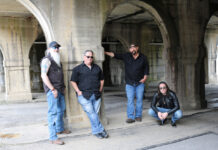
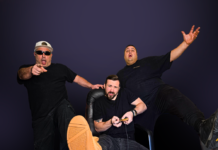
JustFolk, a folk-rock trio led by Todd Kolod, has spent thirteen years creating emotionally resonant songs focused on love, hope, and mortality. Formed in 2012 in Saint Paul, Minnesota, the band draws from classic influences while emphasizing vocal authenticity and melody. With four albums and numerous singles recorded remotely, they developed a devoted catalog of introspective rock. Their farewell compilation, Best of JustFolk 2012-2025, offers a retrospective of their work. In a recent conversation, Kolod reflects on the band’s origins, songwriting power, and what closure means after decades of music.
- JustFolk began in 2012 as a studio project in Saint Paul, Minnesota, with you as the primary songwriter and vocalist, supported by professional collaborators Steven Gores and Manolo Díaz. How did this remote, transatlantic recording process—spanning Minnesota, Helena, Montana, and Ibiza, Spain—shape the band’s sound and creative dynamic over the thirteen years?
I started collaborating with producer and keyboard player Steven Gores in 2012. We both lived in the same city: Saint Paul, Minnesota. We would have meetings at a local coffee shop or work things out on the fly in the studio. But then in 2015 I moved 4,600 miles away to Ibiza, Spain and this changed everything. It required letting each musician, some I would never meet personally, to give their best shot with almost no input from me. It required that I let go to a higher power. This dynamic change offered many dividends in terms of artistic creativity and independence.
- Your influences are clearly rooted in the classic rock lineage of The Beatles, Neil Young, Jeff Lynne, and Tom Petty. In what ways did these artists guide your approach to melody, vocal delivery, and lyrical honesty, particularly in balancing emotional vulnerability with accessible hooks?
I cut my musical teeth with the Beatles, live on the Ed Sullivan Show. The most obvious Beatles’ references in my music are the major to minor chord changes. And the double tracking of my voice can sound Lennon-esque at times in my dreams. Neil Young’s release of “After the Gold Rush” (1970) was such a seminal and coming of age album for me. I was literally 15 years old with all the longing and desire. My tune “Protest to Survive” has Young’s muffling of the acoustic guitar strings with my strumming hand. Jeff Lynne’s compositions with ELO and with his solo record “Armchair Theater” are every songwriter’s guide to song structure with melodic hooks. I live for hooks. The more the merrier and repeat them if possible. The Traveling Wilburys with Tom Petty, George Harrison, Bob Dylan and Roy Orbison were the perfect delivery device for Lynne’s genius. I hav always strived to emulate his wall of sound.

- The compilation Best of JustFolk 2012-2025 presents a chronological selection of essential tracks from your four albums and singles. What criteria did you use to choose these thirteen songs, and how does sequencing them in order reflect the evolution of your songwriting and thematic concerns—from love and life to mortality and hope?
It wasn’t rocket science. I picked my favorite songs. They were usually the first and second tracks of each album but not always. The first two albums were more stripped down with my acoustic guitar. These early albums featured the electric guitar of my friend Dean Branshaw, a studio musician in Las Vegas who had worked with Pure Prairie League. The second two albums were recorded in Ibiza, Spain and these featured the Santana-esque playing of longtime family friend Manolo Díaz. Taking a snapshot of the 4 records, I see an unfiltered idealism that bent toward a more sober realism. In the fall of 2009, I had reunited with my high school sweetheart in Ibiza after 36 years of absolutely zero contact. Barbe Lix caused a tsunami in my life. It was the ultimate accident and pushed my music in new and never imagined directions.
- Your previous album, Grounded, was a concept record centered on death and dying, described as hopeful. How does this final compilation serve as a capstone to that exploration, and in what sense does it offer a broader retrospective of the universal human experiences you’ve addressed across the catalog?
Since I was a young boy, I was cognizant of the quick passage of time. There was a specific chair in the living room of our family’s rambler in Smithtown, Long Island where I pondered how quickly my life had unfolded. Lo and behold, I grew up to become a ‘dweller’ about all things, including death and dying. This final compilation brings together a lifetime of expecting too much from others and coming to terms with what the Spanish say, “Es lo que hay.” While recording “Grounded” our bass player had a heart attack at an airport and was dead for 20 minutes. His first song after he completed rehab was “Don’t Turn the Lights Out.” Can’t make this up.
- You have described yourself as the “amateur” in the group, with the rest being seasoned professionals, and noted your John Lennon-inspired double-tracked vocals and pursuit of unpolished authenticity. How did this contrast in experience contribute to the band’s distinctive spirit and chemistry?
I was absolutely the thin-voiced amateur in the band. I knew only the most basic rhythm guitar chords and staying on tempo was not my forté. This meant that the pros brought the songs to life. And they did. The sum was always greater than the individual parts. I loved this part of the process.
- After releasing four albums and several singles over thirteen years, JustFolk has now officially retired with this compilation. What prompted the decision to conclude the project at this point, and how do you feel this body of work stands as a complete statement?
I had run out of gas, though I prefer to say I ran out of battery. It’s less polluting. I felt like I had exhausted my best chords and lyrics. It was clearly time to give it a rest and spend the rest of my days enjoying the music of others. I have now revisited vinyl records and am loving it.
- The press materials express pride in what JustFolk accomplished, while acknowledging that the music reached only a limited audience. In assembling Best of JustFolk 2012-2025, what motivated you to provide “the world a second chance” to discover these songs, and what response have you hoped to elicit from new listeners?
I always believed that I had a good body of work, even some hits. I decided on giving one last push in the hopes of finding someone with a much bigger following than me to cover my songs.
- Having written seventy songs across seven decades—including your earlier work with the Daddy-Doo Band—this compilation marks the end of JustFolk’s chapter. Looking ahead, do you anticipate continuing to write or record in any form, perhaps solo or in new collaborations, or does this feel like a definitive close to your recorded output?
I am very proud of the work of my first band: Daddy-Doo Band. It also has a compilation record living in complete obscurity: “Daddy-Done: 2003-2009.” Who knows, maybe I’ll try one day to find a promoter for this one too. As for JustFolk, this is the end of a wonderful ride. The last stop. I am so grateful to all who have worked with me, especially to Steven Gores who always encouraged me. Steven did it all.