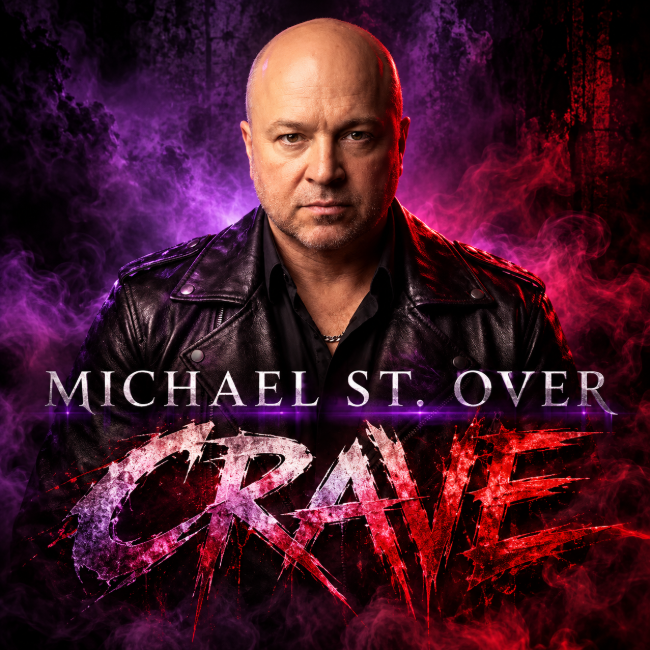
Michael St. Over doesn’t ease into “Crave.” He hits the gas, locks the doors, and lets the song take you wherever it’s going.
Built around lust, obsession, dependency, and that familiar rock-and-roll feeling of knowing something might be bad for you and wanting it anyway, “Crave” is unapologetically direct. There’s no coyness here, no tortured attempt to disguise desire as something more sophisticated. This is a hard-rock song about wanting somebody so badly that reason starts losing the argument.
And that’s exactly why it works.
From the opening lyric, “I was born to love you baby / You were born to drive me crazy,” St. Over makes it clear that subtlety has left the building. The song is written in the language of classic hard rock: oversized emotion, physical attraction, danger, temptation, and guitars that are meant to be played loud.
The central idea is simple—love as addiction—but St. Over pushes the metaphor hard enough to give it genuine momentum. He isn’t merely attracted to the subject of the song. He is consumed. The craving becomes emotional, physical, and almost chemical, and the repeated imagery of dependency gives the track an edge that separates it from a standard love song.
Musically, “Crave” sits comfortably in the space where classic hard-rock attitude meets modern production. The guitars are thick and aggressive without swallowing the melody, and the rhythm keeps things moving with the kind of steady punch that makes the song feel built for a stage. There’s muscle in the arrangement, but there’s also discipline. Every part is there to support the hook.
And make no mistake: St. Over understands the importance of a hook.
The chorus hits quickly and stays with you. That may sound obvious, but plenty of modern rock songs spend so much time chasing atmosphere that they forget listeners need something they can actually remember. “Crave” avoids that problem. Its title becomes the focal point, and the repetition feels appropriate because obsession, by definition, doesn’t know when to stop.
St. Over’s vocal performance gives the song much of its personality. He doesn’t sound detached or overly polished. There’s a roughness and urgency in the delivery that fits the subject. You believe that the narrator is genuinely caught in the grip of what he’s describing.
That intensity also keeps the song from drifting into parody.
Let’s face it: hard rock has built an entire history around sex, temptation, excess, and unhealthy relationships. The line between swagger and cliché can be dangerously thin. “Crave” survives because St. Over doesn’t treat the song like a joke. He commits to it completely.
The accompanying visual concept fits that mood perfectly. A dark, nocturnal world of shadows, neon, fleeting images, and a woman who seems perpetually just out of reach reinforces the sense that the real subject isn’t romance at all—it’s obsession. She becomes less a character than an idea, the object of a fixation that grows more consuming as the song moves forward.
That darker psychological edge gives “Crave” more depth than its initial hard-rock swagger might suggest.
Underneath all the bravado is a song about losing control.
That’s always been fertile territory for rock music.
Michael St. Over isn’t trying to rewrite the rulebook with “Crave.” He’s doing something arguably more important: remembering why those rules existed in the first place. Big guitars. Strong vocals. A memorable chorus. A little danger. A little sex. A feeling that somebody might regret all of this tomorrow.
That combination has worked for decades.
On “Crave,” it still does.
Turn it up, close the blinds, and make your own bad decisions.