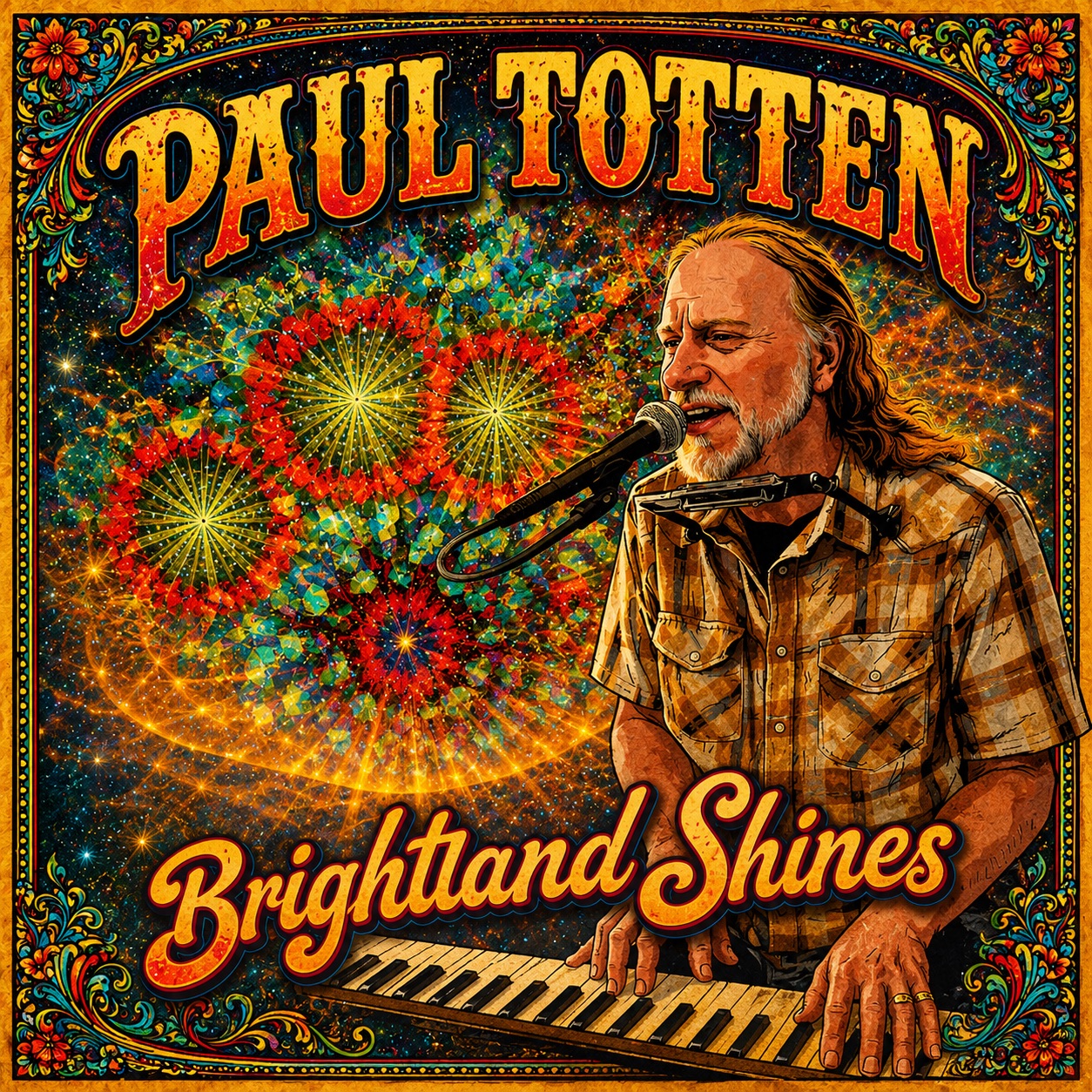
An artist’s first album inevitably raises a question that has little to do with genre: who is this person when the influences, expectations, and previous versions of themselves fall away? In Brightland Shines, Paul Totten seems less concerned with answering that question definitively than with exploring it. His background as a percussionist, his rediscovery of the piano, and his emergence as a singer and songwriter all converge across these ten tracks, creating an album that feels caught between inheritance and reinvention. The familiar contours of roots rock, folk, jazz, and classic songwriting are present, but beneath them is something more personal: an artist negotiating what it means to finally claim his own voice.
Perhaps the real question Brightland Shines leaves behind is not whether an artist can reinvent himself, but whether reinvention is ever really what happens. Maybe what we call reinvention is simply recognition arriving late: the moment scattered influences, unfinished instincts, old experiences, and new circumstances suddenly begin to make sense together. Paul Totten’s Brightland Shines feels like such a moment. It does not present a finished identity so much as reveal one taking shape.
That sense of discovery is particularly relevant to the album’s origins. Totten spent years immersed in music as a percussionist, drummer, and steel-drum player, performing with various ensembles and local bands. The pandemic disrupted that established rhythm, but it also redirected his attention toward piano, voice, and songwriting. What emerged from that period was not simply a new set of skills, but another mode of expression. Brightland Shines consequently carries the feeling of an artist turning inward after years of primarily contributing to a larger musical whole, asking what happens when the instrument becomes a vehicle for his own stories.

Those stories are united by recurring ideas of loss, love, change, uncertainty, redemption, and hope. “Hundred Year Flood” establishes this emotional landscape particularly well, using catastrophe as a metaphor for the experiences that leave us altered. Its central tension, being broken while simultaneously being washed clean, becomes almost a thesis for the album. Destruction and renewal are not opposing forces here; they are often inseparable.
The album’s emotional world is rarely hurried. “Eloise”, for instance, carries a slow, reflective quality, allowing its images of memory, love, mystery, and transformation to unfold gradually. Its references to wheels, vessels, cards, and fire give the song an almost dreamlike symbolism, while its repeated invocation of Eloise feels less like a straightforward narrative than an attempt to reconnect with something, or someone, that exists somewhere between memory and imagination. Elsewhere, “Expensive to Get” combines humor with a quietly vulnerable meditation on ambition, artistic worth, and refusing to count oneself out. “Sing Again” turns toward mortality and remembrance, imagining reunion while making a broader plea for love to replace competition and self-interest.
That emotional continuity is one of the album’s strongest qualities. “When You Run” approaches love through patience rather than possession, leaving space for someone to leave and still offering a way back. “September Wind” transforms seasonal change into a meditation on departure and renewal, while “Blessings and Curses” embraces the uncomfortable possibility that hardship and grace can coexist. Even “Half Dead,” with its more sensual and intimate perspective, contributes to the album’s larger fascination with choosing to be fully present rather than simply moving through life halfway.
Totten wears his influences openly. The echoes of Neil Young, Paul Simon, James Taylor, Lucinda Williams, the Grateful Dead, Talking Heads, and Little Feat are part of the album’s vocabulary, alongside the broader traditions of folk, jazz, and roots rock. Yet Brightland Shines is not particularly interested in hiding these influences in pursuit of novelty. Instead, Totten uses a familiar musical language to articulate experiences that are distinctly his own. At times, that directness can make the songwriting feel more earnest than elusive, but it also gives the record its warmth. There is little sense of an artist constructing an impenetrable persona; the appeal lies in the willingness to remain emotionally accessible.
The title track gathers these ideas into the album’s final movement. Its imagery of darkness, wandering, struggle, liberation, and light turns “Brightland Shines” into something larger than a destination. It becomes an imagined state of possibility; somewhere beyond the confusion, where what has been lost might still be recovered in another form. The brightness matters precisely because the darkness has been acknowledged first.
And perhaps that is what makes Paul Totten’s Brightland Shines worth hearing as more than a debut. It captures an artist realizing that finding a voice may not require abandoning the voices that came before him. Sometimes, it means understanding them well enough to discover what you have to add. Paul Totten’s Brightland Shines does not offer a finished identity so much as document one emerging, making the album feel less like a conclusion than the beginning of a more personal conversation between influence, experience, and most importantly expression!