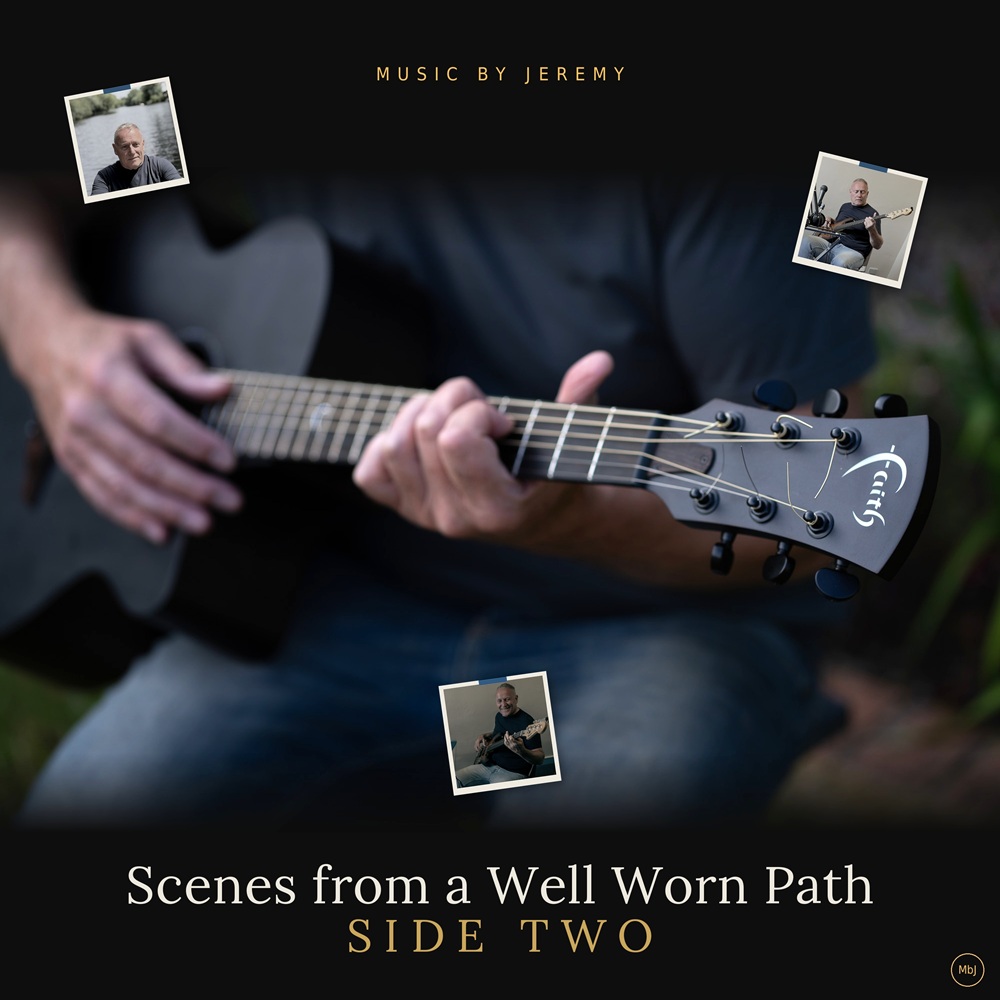
An acoustic guitar can be many things in a song: an instrument, a rhythm section, a memory, even a kind of confession. On Music by Jeremy’s Scenes from a Well Worn Path – Side Two, it becomes the thread connecting six songs that otherwise refuse to stay in one emotional or sonic place. Warm guitar work anchors Jeremy’s vocals while atmospheric production, rhythmic shifts, and layered harmonies gradually expand the world around them. The result is a collection less concerned with arriving somewhere than with examining what it means to keep on moving.
“Do Birds Sing the News” establishes that intimacy immediately. Built around acoustic guitar, the track gives considerable space to Jeremy’s emotionally expressive vocal performance. There is something conversational in the delivery, as though the song is thinking aloud rather than presenting a neatly resolved conclusion. That quality becomes central to the record: feelings are not simply presented, but questioned and examined.
“So Cold” takes that acoustic foundation somewhere more atmospheric. The guitar remains central, but surrounding textures introduce suspense and a slightly dramatic edge. Still, the darkness never fully takes over. There is a sense of hope and forward momentum underneath it, creating an effective tension between uncertainty and the possibility of change.
That tension becomes particularly clear on “Moving On – Side Two.” More upbeat and melodic, with warm vocal harmonies adding lift, the track initially suggests a straightforward step forward. Its lyrics complicate that impression:
“I’m out of place, I’m out of time,
tell myself it will be fine.
Don’t wanna go, I just can’t stay.
I can’t live in yesterday.”
There is something compelling in that contradiction. Moving forward does not necessarily mean feeling ready. Sometimes it simply means recognising that staying has become impossible.
“4 O’clock Train” gives that idea a more physical sense of departure. Clapping establishes the rhythm before upbeat guitar, pads and vocals enter, creating a more mysterious and rhythmically driven atmosphere. The vocal harmonies reinforce the feeling of movement, while the production gives the song a distinct identity within the sequence. It feels like a journey whose destination remains deliberately unclear.
“No 9” shifts again, introducing a classic-rock character and a stronger melodic presence. Its most interesting quality, however, is its movement between emotional states. An uplifting brightness suddenly gives way to something darker, dreamier, and more mysterious before returning to the light. The transition feels almost like a musical reflection of the record’s larger concerns: optimism and uncertainty do not necessarily cancel each other out.
Closing with “Ideonella Sakaiensis,” the record returns to a more laid-back warmth and the simplicity of acoustic guitar. After the atmospheric and rhythmic detours, that return feels grounding. Rather than ending with grand resolution, the album circles back to its most familiar element.
That simplicity becomes particularly interesting considering Jeremy’s unusual creative process. The music and lyrics originate with him, often beginning on an old Faith acoustic guitar, while AI tools function as a creative prosthetic for building out arrangements and performances. Yet the technology remains secondary to the songwriting. What survives is the distinctly human impulse behind these songs: questioning connection, confronting the past and wondering what comes next.
Music by Jeremy’s Scenes from a Well Worn Path – Side Two therefore feels appropriately titled. These songs travel through grief, uncertainty, hope, and renewal without pretending any of them can be cleanly left behind. Music by Jeremy’s Scenes from a Well Worn Path – Side Two ultimately finds its meaning in that movement itself: the uneasy, sometimes hopeful act of leaving one place emotionally while carrying pieces of it toward somewhere else..