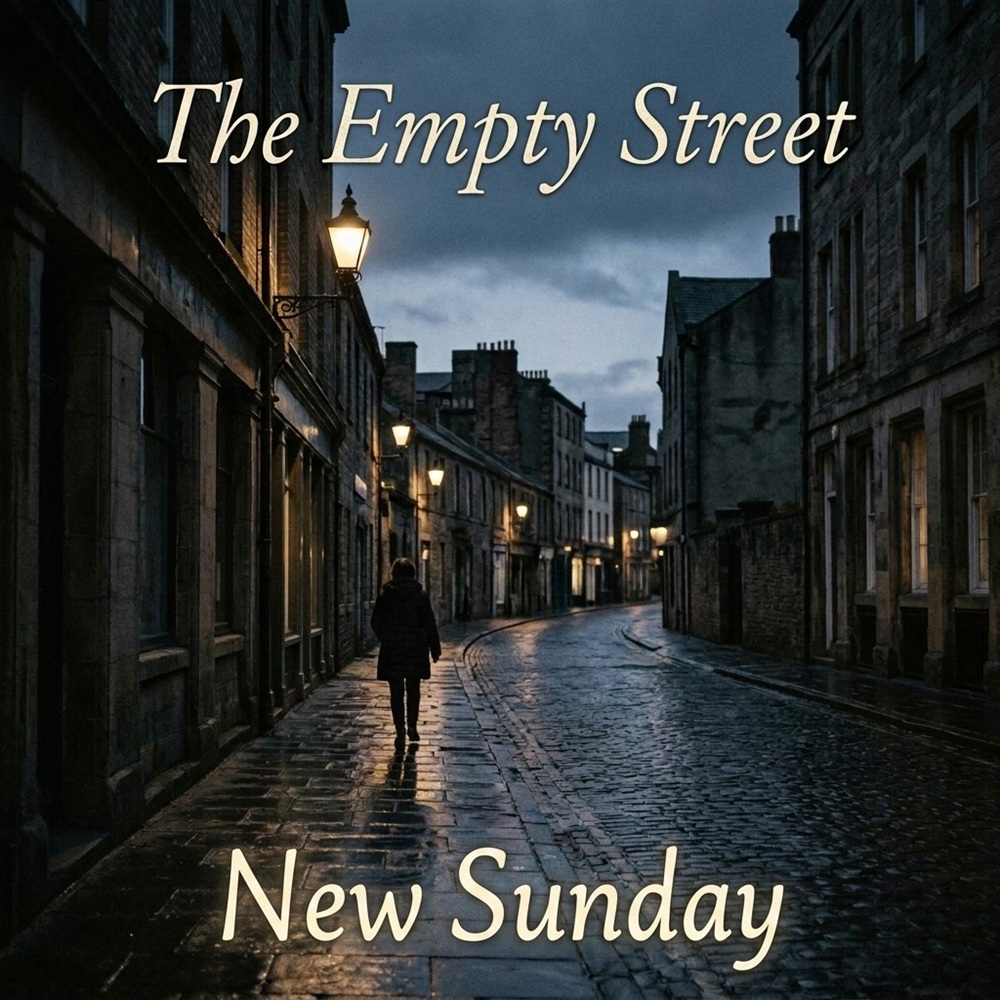
Some streets are physical places. Others exist only in memory. On “The Empty Street,” New Sunday explores the latter, transforming a quiet walk into a poignant reflection on loss, longing, and the slow process of finding peace. Blending folk rock with touches of classic rock and country, the Icelandic outfit crafts a song that feels deeply personal while remaining universally relatable.
Built around a modest four-chord progression, the track demonstrates that memorable songwriting isn’t measured by complexity. Warm strings, restrained percussion, and layered harmonies create a rich yet understated backdrop, allowing every musical choice to serve the song’s message rather than compete for attention.
The artist delivers a heartfelt vocal performance that captures both fragility and resilience. From the opening line, “I’m walking in an empty street, there’s no one there to meet,” listeners are immediately immersed in a landscape shaped by absence. As the song unfolds with “I can feel the crawling fear, my anxiety still doesn’t care,” the empty street evolves into a metaphor for isolation, where memories linger, and healing feels just out of reach.
The lyrics continue to paint vivid emotional images without slipping into excess. Lines like “The devil took my true love” and “You were my one, and only, now I walk and feel lonely” convey heartbreak with striking honesty, while the repeated plea, “I need a help from a friend,” introduces a quiet glimmer of hope beneath the sorrow.
That sense of authenticity is echoed in the production. Executive producer and mixer Simon Jones keeps the arrangement spacious and organic, preserving the intimacy at the heart of the performance. Songwriter Einar Askelsson’s thoughtful composition shines through, proving that honest expression often resonates more deeply than technical flourish.
New Sunday‘s “The Empty Street” invites listeners to sit with uncertainty, memory, and hope in equal measure. It’s a beautifully restrained piece that reminds us some journeys are measured not by where they lead, but by what they leave behind..