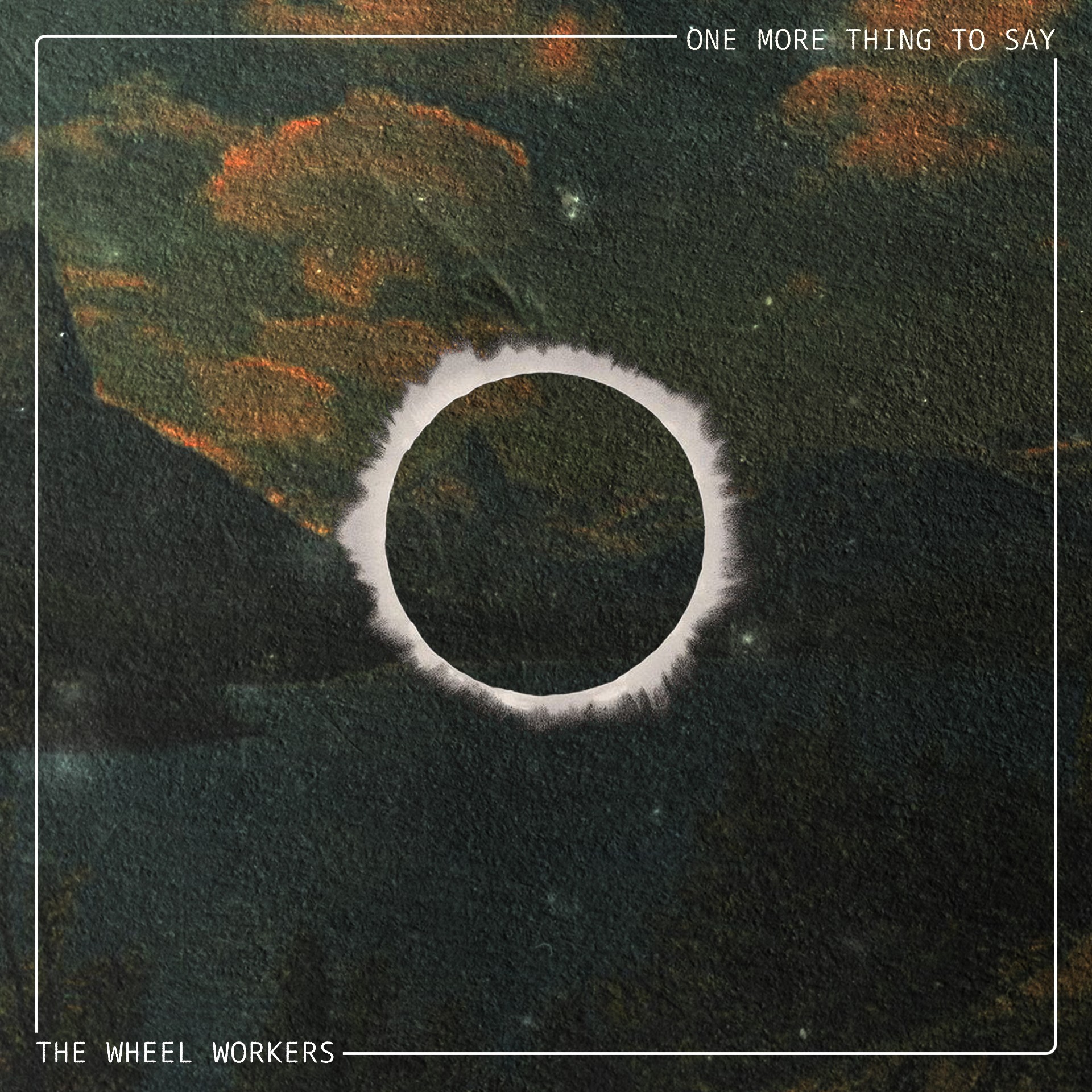
Political disillusionment has a way of outliving the moment that inspires it. On One More Thing To Say, The Wheel Workers revisit songs written in the early 2000s, when war and political power shaped much of their songwriting. Released two decades after the original sessions were abandoned, the album brings those concerns into the present, revealing how questions about violence, complacency, and collective responsibility can remain painfully relevant long after the headlines change.
Originally intended as the band’s sophomore release, the record was left behind when The Wheel Workers broke up around 2005–2006. Rediscovered and completed roughly twenty years later by Steven Higginbotham, it now arrives as the collective’s eighth album, bringing together original recordings and new performances. What could have been little more than an archival curiosity instead feels like an unfinished conversation finding its way back into the world.

Across its sixteen tracks, the album moves between alternative rock, grunge, psychedelia, and art-rock, drawing on the restless energy of acts like Sonic Youth, Pixies, Jane’s Addiction, and Fugazi. Yet its shifting sounds serve a broader purpose: these are songs concerned not only with the world as it is, but with our willingness to question it.
On “So Wrong,” the repeated line “We’ve been so wrong, for so long” becomes both an admission and a challenge. The song calls for an awakening from familiar nightmares, taking aim at a culture distracted by screens and increasingly disconnected from the people around it. Beneath its urgency lies a simple proposition: meaningful change requires people to look up, reconnect, and act together.
The title track, “One More Thing To Say,” takes a similarly direct approach to the ways violence becomes normalized and justified. Its images of innocents engulfed in flames and abstract equations used to rationalize cruelty point to the distance between political rhetoric and human suffering. The question “Why can’t we rise and try to find a little love?” cuts through the noise, offering neither an easy answer nor a neat resolution, but a reminder of what gets lost when hatred and fear become organizing principles.
⇒ Support the band & purchase the album via BandCamp.
“One Must Speak” begins with an acoustic song by Chris Maness before the collective reshapes it into something more expansive and psychedelic. “Distractions” and “Seaside” take a more impressionistic, cinematic approach, allowing the atmosphere to carry what words cannot always express. These shifts keep the album from becoming a single sustained protest, making room for ambiguity, reflection, and the chemistry of musicians responding to one another.
That chemistry is central to the record’s appeal. The album’s journey from abandoned early-2000s sessions to its eventual completion gives it an unusual sense of continuity, with Higginbotham even harmonizing with his younger self. Mixed by Grammy-winning engineer Steve Christensen, the finished work brings together performances separated by years without entirely smoothing over the passage of time.
The closing track, “In the Breeze,” captures that spirit particularly well. Beginning as a quiet, lullaby-like waltz, it gradually opens into a soaring anthem. Its growth feels less like a carefully imposed conclusion than a collective discovery, allowing the record to end on a note of possibility rather than certainty.
Beneath its political frustration and restless musical shifts, One More Thing To Say returns to a deeply human concern: how we live with one another, and what it takes to find common ground. The Wheel Workers‘ recovered songs may have originated in a different time, but their call to look beyond fear and distraction still resonates. Perhaps the most enduring message here is also the simplest: we have to find our way back to each other..