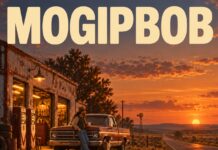
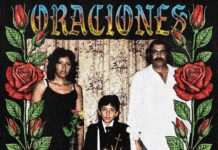
Wildcard Campfire‘s debut album explores a civilization shaped by rebellion, faith, war, and eventual destruction. But three standalone singles reveal that the story begins before some of the album’s most personal moments and continues thousands of years beyond its apocalyptic finale.
Released on September 18, 2026, Where God Grew Tired is a ten-track concept album from Wildcard Campfire, the faceless metal project created by guitarist and songwriter Rom Burla.
Blending melodic metalcore, djent, deathcore, progressive metal, and cinematic orchestration, the album tells the story of a fictional civilization whose history stretches across thousands of years.
At the center of that history is The Ashen Gospel, a three-part narrative exploring the rise of a mysterious False Prophet, the rebellions that follow his promises of peace and salvation, and the generations of warfare that eventually lead humanity to destroy its own world.
Rather than following a linear chronology, the album moves between different characters, historical periods, and personal experiences, gradually revealing how their stories connect.
However, the album’s ten tracks are not the entire story.
Three standalone singles released before the album — The Lowest Point, Make It Pop, and A Hymn for the Unburied — are also part of the same fictional universe.
Together, they reveal previously unseen chapters of its history, extending the narrative in three very different directions.
The Lowest Point – The Story Before the Ghosts
One of the most personal and emotionally intense tracks on Where God Grew Tired is The Ghosts of My Past, a song exploring trauma, painful memories, and the difficulty of escaping the psychological consequences of earlier experiences.
But the character’s story actually begins in The Lowest Point, a standalone single that serves as its direct narrative prequel.
The Lowest Point follows a prisoner whose identity, freedom, and sense of self have been gradually stripped away. Confined within a small room, he struggles with isolation, despair, and the feeling that his life has already been decided for him.
Yet even in that situation, something within him refuses to disappear completely.
While the song explores confinement and the struggle to survive, The Ghosts of My Past takes place after the character’s imprisonment has ended.
⇒ Check our thoughts on the album and read here.
The prison doors may have opened, but the emotional consequences remain.
He is physically free, yet the experiences of his past continue to follow him, affecting the way he understands himself and the world around him.
Musically, the two songs share a progressive and atmospheric character, using changes in dynamics, heavier passages, and emotional melodies to explore different stages of the character’s experience.
Together, they reveal a more intimate side of Wildcard Campfire’s fictional universe, where the consequences of violence are not limited to battles, kingdoms, or collapsing civilizations.
Sometimes, those consequences continue living inside a single person long after the events themselves are over.
Make It Pop – Creative Chaos After the Apocalypse
While The Lowest Point explores a personal story within the old civilization, Make It Pop takes place after the catastrophic events of The Ashen Gospel – III. Where God Grew Tired.
By this point, humanity has retreated into underground shelters, escaping a devastated surface that can no longer support ordinary human life.
But the world above has not become completely lifeless.
Other creatures have adapted to the poisonous environment, developing their own societies among the ruins of the civilization that came before them.
One of these societies is ruled by the Skull King and his council.
These creatures are not descendants of the False Prophet, nor are they responsible for the beliefs preserved by humanity underground. They represent another branch of life that emerged after the world’s destruction.

And yet, despite their differences, they have developed some remarkably familiar habits.
In Make It Pop, a creator working under the Skull King’s authority is repeatedly ordered to revise a piece of work.
What begins as an original creative vision gradually becomes trapped in an endless cycle of contradictory demands.
The work must become bigger, cleaner, darker, more entertaining, less aggressive – while somehow maintaining all the qualities the council simultaneously wants removed.
Each revision takes the creation further away from its original identity, until very little of the initial vision remains.
And even when the final version is approved, the council immediately demands another option.
Partly inspired by Burla’s experiences working as a developer and programmer, the song turns the familiar frustration of endless revisions and creative compromise into a grotesque satire of bureaucracy, control, and the destruction of artistic identity.
⇒ Check our thoughts on the album and read here.
Musically, Make It Pop reflects that absurdity through an especially aggressive combination of cinematic deathcore, djent-inspired riffs, and chaotic breakdowns.
Its exaggerated brutality contrasts with the ridiculous nature of the situation being described.
The song also introduces an unexpected idea within the fictional universe: even after civilization destroys itself, some of its most frustrating and absurd behaviors manage to survive in entirely new forms.
Apparently, even the apocalypse cannot put an end to unnecessary meetings and revisions.
A Hymn for the Unburied – The First Single That Was Actually the Final Chapter
Perhaps the most surprising connection lies in A Hymn for the Unburied, the very first single released by Wildcard Campfire.
On its surface, the song is one of the project’s most hopeful and melodic releases.
It describes humanity finally emerging from underground shelters after thousands of years, returning to a world that has gradually recovered from the devastation that forced their ancestors beneath the earth.
For countless generations, humanity has lived without seeing the sky.
When the shelters finally open, the descendants of the original survivors step into sunlight for the first time, celebrating what appears to be the beginning of a new era.
But within the fictional world’s chronology, A Hymn for the Unburied is actually the final chapter of the entire first era.
And its triumphant atmosphere hides a disturbing revelation.
During humanity’s long existence underground, the memory of the original civilization has become increasingly distorted.
The new generations have never experienced the world that existed before the destruction. Everything they know about it comes from images, records, symbols, and beliefs preserved by their ancestors.
Among those surviving fragments, one figure has become particularly important: the False Prophet.
The same man whose promises of peace and salvation helped set the original civilization on its destructive path has become part of the cultural identity inherited by the people living underground.
His original actions, crimes, and true intentions have disappeared from their collective memory.
To these later generations, his image is simply part of what they understand to be human history.
⇒ Check our thoughts on the album and read here.
When humanity finally returns to the surface, its people unknowingly carry his image, beliefs, and promises into their supposedly new beginning.
They are not deliberately deceiving anyone. They genuinely believe in the future they are celebrating.
But in doing so, they have collectively become a new generation of False Prophets, without even knowing what that identity once represented.
There is no longer one individual standing above the crowd, promising humanity salvation.
The entire returning civilization has inherited the pattern.
This revelation connects directly to the closing words of The Ashen Gospel – III:
“The old lie kept breathing.”
Suddenly, the hopeful atmosphere of A Hymn for the Unburied takes on an entirely different meaning.
The song’s celebration is genuine, but so is the disturbing history concealed beneath it.
Has humanity finally achieved the peaceful future the original False Prophet promised?
Or has his vision survived the destruction of civilization itself, returning in the form of an entire population that no longer knows where its beliefs came from?
And if humanity has become united under a shared inherited identity, is that genuine peace — or has the world simply traded disagreement, individuality, and freedom of thought for the comfort of a common illusion?
The story deliberately leaves these questions open.
Rather than presenting a simple victory or defeat, A Hymn for the Unburied brings the fictional world’s first era full circle.
The original promise survived everything, including the people who first believed in it.
Thirteen Songs, One Connected World
Although Where God Grew Tired contains ten tracks, its three standalone singles expand the first Wildcard Campfire era into thirteen interconnected songs.
Each contributes something different to the wider narrative.
The Lowest Point reveals the events preceding one of the album’s most personal stories, providing new emotional context for The Ghosts of My Past.
Make It Pop explores the bizarre societies that emerge above the ruins after humanity’s destruction, using absurd humor to examine the persistence of power, bureaucracy, and creative control.
And A Hymn for the Unburied reveals what happens thousands of years later, when humanity finally returns to the surface carrying the distorted legacy of the very figure whose ideas helped destroy its original civilization.
None of these connections requires the songs to be heard in chronological order.
Instead, the fictional universe is designed to reward listeners who return to the music, explore the lyrics, and discover how seemingly separate stories influence one another.
A song that initially appears hopeful may become unsettling once its historical context is understood. A personal story may reveal its origins in another release. And even an absurd deathcore satire can become another chapter in a much larger story about power and human behavior.
⇒ Check our thoughts on the album and read here.
Together, these thirteen songs tell a story that reaches beyond the destruction of civilization.
They explore how memories change, how institutions and ideas outlive their creators, and how the consequences of earlier generations can shape the lives of people who never knew them.
Perhaps the central question is not simply whether humanity survives.
It is whether humanity ever truly learns from the world it destroyed.
Listen to Wildcard Campfire on all platforms here.