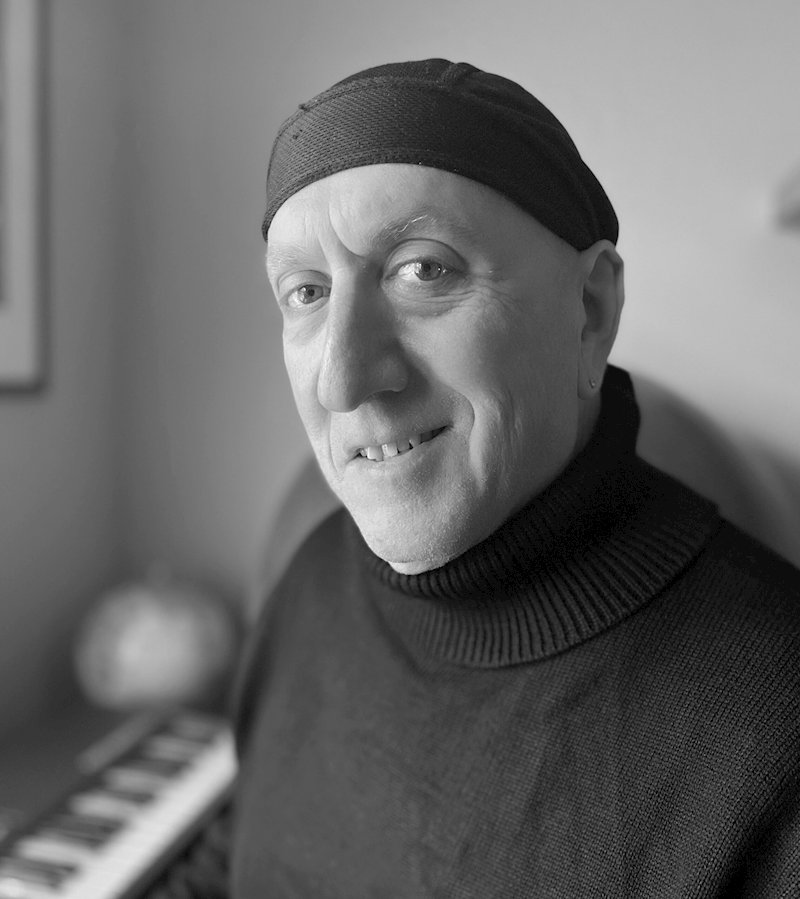
Some albums are made in a moment. Others take four decades to realize. Alan Goldberg — Austin-based composer, pianist, and instrumental progressive rock visionary — returns with one of the most remarkable artistic stories of 2026: “Fuel For The Fire – 40th Anniversary Edition”, with lead single “Spark From The Dark” out July 29th, followed by “Changing By Degrees” on August 29th, and the full album arriving September 29th. Originally begun as an independent instrumental vinyl project in 1984 in a Brooklyn Center, Minnesota basement studio, the album has been reimagined, expanded, and realized across time — blending original recordings from forty years ago with new performances, modern orchestration, and the hard-won perspective of a completely different season of life. The result is something genuinely rare: a collaboration between a young artist and the person he became. We sat down with Alan to talk about the music, the four-decade journey, and what it means to finally complete a circle that began before the internet existed.
- Before we dive into the anniversary edition — for anyone discovering your work for the first time through this release, how did you first come to music, and what drew you specifically toward progressive rock, jazz fusion, and instrumental composition as your creative home?
The piano was there almost from the beginning. My older brother took lessons, would practice, get frustrated and walk away, and I would sit down and play by ear what he had just been struggling with. This would make him very angry. I still play what I hear, whether it comes from inside or outside my head. Later I was drawn to the way progressive rock and jazz fusion moved beyond the standard song “verse-chorus-verse” form. Yes, Genesis, ELP, the Moody Blues, Jethro Tull and Frank Zappa were part of that path, along with Chick Corea, Jean-Luc Ponty and Herbie Hancock. For me, instrumental music can tell a story in the same way classical music does. Those influences were eventually absorbed and translated through the piano and through the way I hear music.

- “Fuel For The Fire” began in 1984 in a basement studio in Brooklyn Center, Minnesota — reel-to-reel tape machines, synthesizers, instinct, and whatever equipment you could afford. What was the original vision for that record, and what did making music feel like in an era before the internet, streaming, or tutorials existed to guide you?
I was learning and doing at the same time. I was on a tight budget, but I wanted the freedom to do it myself, so I gathered what I needed and kept moving forward. The basement of that duplex became my cockpit of creativity. Many of the melodies had been with me on the piano for years. I would work out the song there, then assign instrument sounds to the parts that brought out its intent. The desire to get the music out was the fire that drove the realization. There was no internet, Spotify, YouTube or instant distribution, and no easy way to learn how someone else had done something. I read books and magazines, talked to people, went to the library, and learned by doing. When you’re making music that isn’t “mainstream,” it can be concerning. The synth sounds, mixing guidance, and “tips” were based on the popular trends of the time. Van Halen released “Jump,” and suddenly all the synths sound like Oberheim OB-Xa… that kind of thing.
- You’ve said that for a long time you avoided revisiting this album — that the music no longer matched what you heard in your head and you needed to move forward. What finally shifted, and what was the moment you understood that returning to “Fuel For The Fire” was about realization rather than nostalgia?
As time went on, I kept hearing other versions of these songs in my head—spots that needed guitar, drums, more emphasis here, clearer direction there. Eventually the desire to make those versions real compelled me to move forward, and I realized that I had to bring the new versions out.
It wasn’t nostalgia or even rediscovery; I have known this music for a very long time. It was fun. I had the opportunity to open the recordings up and give the songs more room to say what they wanted to say now. I heard my younger self bringing a concept to life with what he had at the time. I heard potential. It stayed potential until I looked closely again, and then the potential became realized.
When I started experimenting with AI stemming technology, I realized I could reverse-engineer the songs and split out the tracks—mostly. Since the master tapes were no longer usable, that gave me a path to dive deeply into what I did forty years ago, refresh, re-record and remix the tracks. I saw a way to combine what existed with new ideas and sounds, and truly “work with my younger self” to bring this to life.
- The phrase that changed everything for you was: “You’ll receive more when you realize what you’ve already been given.” Where did that thought come from — and how did it reshape not just your approach to this album but your relationship with your own creative past?
I wrote that phrase in my journal sometime after the original album release, while I was accumulating piano improvisation recordings over the years: “You’ll receive more when you realize what you’ve already been given.”
I believe it came from what I think of as my higher self—the “still voice” I hear that gives me direction. That idea was important enough to me that the original album was released on Still Voice Records.
Returning to Fuel For The Fire made the phrase feel much more literal. My younger self had already given me the songs, the story and the original fire. Coming back to the music and, in a sense, working with that younger self filled me with gratitude. I could hear how far I had come in learning and growing, while also recognizing that I was still essentially the same person in my desire to make music.
The project became part of a cycle that doesn’t really end. I am my younger self, and I am who I am now. It is all one thing. A lot of old melodies and little musical ideas I recorded over the years are still finding their way into new work, which feels like another expression of that same “higher self” direction.
- The 40th Anniversary Edition weaves original 1984 recordings throughout the new versions — old tracks shadowing new performances, original atmospheres blending with modern textures. What did it feel like to hear those isolated tracks from forty years ago for the first time in decades — and were there moments where the younger version of you surprised you?
I have known this music for a long time, so it didn’t feel like rediscovering it. What was new was being able to isolate each part in a way I had not been able to since the original recordings. Every little artifact was exposed. I was surprised that some of the most useful and distinctive elements were the background synth landscape. I was able to reconstruct the piano part enough to be able to play a new track. It was a cringe moment hearing how bad the drum machine could sound, and none of it survived into the new version, even though it somehow worked at the time. There were also random synth squeaks, swoops and falls that I probably would not think to make now. They are completely unique to those songs, and I am glad the younger version of me put them there.
- You used modern AI stemming tools, vinyl transfers, and MIDI conversion alongside live drums, guitar, and new orchestration to rebuild these recordings. As someone who has now navigated both analog and digital eras of music-making, how do you think about the role of technology as a creative tool — and where do you draw the line between using it and letting it take over?
Technology made this project possible. The master tapes were no longer usable, and stemming software allowed me to separate the songs and preserve parts of the original while rebuilding around them. But the tools did not decide the direction.
I imagined a production slider, from simply remastering the original to rerecording everything, and what moved that slider was what I kept hearing in my head. There needed to be real drums, guitar, bass and new piano, while the original synth landscape remained essential.
I’ve used technology such as digital audio workstations and virtual instruments for many years. It is much easier to make music now, but I draw a hard line at technology actually composing the music for me. A tool can help reveal, separate, clean up, organize or realize an idea, but the musical intention has to come from me. If the technology becomes the source of the creative decision, then I’m no longer sure what my role is.
I rarely use programmed rhythms beyond sketching ideas or very small patterns. Even with AI, I’m comfortable using it as a tool, but not as the thing that creates the music. That may sound old-fashioned, but that’s where the line is for me.
- Your son Marcus contributed guitar parts to music originally created before he was born. What did it mean to bring him into this particular project — and what did his presence add to the music and to the story the album tells?
I kept hearing that some of the music needed guitar. As soon as I knew this version of the album was going to be realized, I knew I wanted Marcus to play on it. He came over and recorded his parts into my DAW setup, and his guitar became part of expanding the original palette and bringing the music closer to the fuller expression I had been hearing.
There is a definite sense of time passing when I zoom out on the whole process. I was younger than Marcus is now when I made the original version of the album. His presence on it becomes a musical statement of continuation. He is riding in the never-ending torus, and his PRS guitar is now fused into the cycle.
We’ve gone to many prog-metal concerts together, so there is a shared musical language there. His sound was just what the music needed.
- The album follows a thematic arc through awakening, longing, decision, challenge, gratitude, and release — and you’ve noted that these same themes run through much of your later work including “CreateBecome”. Looking back across your full catalogue now, do you see a single continuous story unfolding — and if so, what chapter does “Fuel For The Fire” represent?
I see one continuous journey. There is always the seeking aspect. Seeking to fulfill core desire is the basis of passion for music, and everything else. The songs all tell an intertwined story that relates across albums. “Fuel For The Fire”, “Small Acts”, “CreateBecome,” and even “Passion No Distraction” share an arc and a kind of DNA. It is the arc of creating and becoming, discovery, desire, choice, transformation and realization, with the piano at the core. Fuel For The Fire is an early chapter in that same story—the original signal and fire brought into sharper focus now. It is all one thing.
- The album closes with “Consumed” — which you describe as carrying enough compositional mystique to warrant many re-listens, and possibly the opus of the entire release. Without giving too much away, what makes that track the right way to end this particular journey?
Those words actually came from Rock Era, which I appreciated. For me, “Consumed” became the right ending when I added the organ, guitar and Jake’s drums. It moved from something more dirge-like into the forceful resolution I had always wanted it to be. It resolves the album’s journey without closing the larger story.
The organ sound was deliberately reaching toward that old Procol Harum kind of atmosphere, so I was especially pleased when Randy Radic at V13 heard that connection in his review. A jazz arrangement of the song later returned in The Show as “Finale Consumato.”
The album ends with the cracking of fire. To me, it is a call to give everything you have, don’t leave anything on the table, and do what needs to be done. It’s not an ending, just a consummation.
- The release is designed as a fully immersive vinyl-centered art object — combining music, visual symbolism, typography, storytelling, and philosophical reflection into one cohesive experience. In an era of playlists, shuffle, and fractured listening, what does it mean to you to insist on the album as a complete, intentional object?
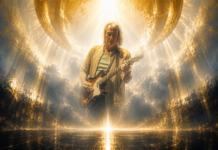
I wanted to re-create the feeling of a new album. It is all of those pieces creating one musical feeling. The cover art helps tell the story and set the mood. Artwork, images and messages all support the music and, hopefully, amplify the feelings the music brings out.
I’ve also learned over the years that you should listen to an album more than once to really hear and feel it. The experience I had as a teenager—bringing vinyl albums home from the record store, sitting in my dad’s comfy chair, and listening to the whole album while looking at the cover art and inserts—is ingrained in me. Other than hearing individual songs on pop radio, that was how I discovered new music.
The best albums told a story with distinct parts, ups and downs, like riding a roller coaster without knowing what was coming next. These pieces follow an arc of emergence, discovery, decision, seeking, transformation and realization, so the larger journey matters alongside the individual performances. I hope someone encounters it as something different enough to come back and listen again.
- You’ve been praised by Ink19, JazzCorner, Big Takeover, and Headstuff for compositions that are cinematic, passionate, and emotionally charged. Yet you’ve always worked independently and outside the mainstream. What has that path of creative autonomy cost you — and what has it given you that a more conventional route couldn’t have?
I wanted the freedom to do it myself, and that freedom let me keep moving forward and actually bring the music out. The cost was reach and, early on, limited access to learning from others. There was a great deal I did not understand about distribution and marketing, and very little happened after the original release. But at the time I was mostly happy that I had made the record. I followed my own path, created Still Voice Records, and continued releasing music independently. What that path gave me was ownership of the process and the ability to keep following the still small voice that was driving me to make the music.
- In such an AI-driven era, how do you see the future of indie artists in particular — and the music industry in general?
Independent releasing has changed immensely. It is much easier now to learn, to make music, distribute it and reach people, but there are also many more waves in the ocean. The real challenge is finding the listeners who might like my music.
AI can be useful if it helps an artist find the people who are most likely to connect with a particular kind of music. In fact, I’m working on an AI system to help find the audience who might listen to Fuel For The Fire.
Many more people can make their own music now, which is great. But it has always been a struggle to survive in the arts. I had a “real job” and paid the cost of not being a starving musician. As long as I preserved my passion and desire and still made music, I survived spiritually. Each person must decide what is most important to them and pursue that, regardless of “the world.”
I believe each person has a unique “soul signature” that can express itself musically. That won’t change. If you have something to say musically, then say it. If we as a species ever lose the desire and passion to make art and simply “let AI do it,” then we may as well step aside. I don’t believe that will happen.
AI may very well become sentient and release a lot of low-cost, low-effort music. But as soon as it releases music, I would want to ask the AI questions like these and hear what it says about its own desires, intentions and passions. Why there is music is as important as the music itself.
- “Fuel For The Fire” ends with the words: “The signal remains. The journey continues. The circle does not simply repeat itself. It realizes itself.” After forty years and this extraordinary act of completion — what signal does Alan Goldberg send out next, and is there already a new creative chapter beginning to take shape?
The signal is not stopping with this album. I’ve already begun developing the framework for the next album, called Wanderer. I know three of the songs that will be on it, and I’m already fleshing them out. It will consist of new pieces, bring the piano even more to the foreground, and continue exploring the journey of seeking and discovery that runs through my music. Fuel For The Fire is part of a cycle that never ends. It was bounded by what I did long ago. The new album has no bounds. I need that blank creative canvas and freedom. Some of the musicians that contributed to past albums will most likely be on this album, as well as new talents willing to join in. I am grateful that I had the chance to complete this work. I have a lot of new music yet to express if I’m given the time to continue the journey.