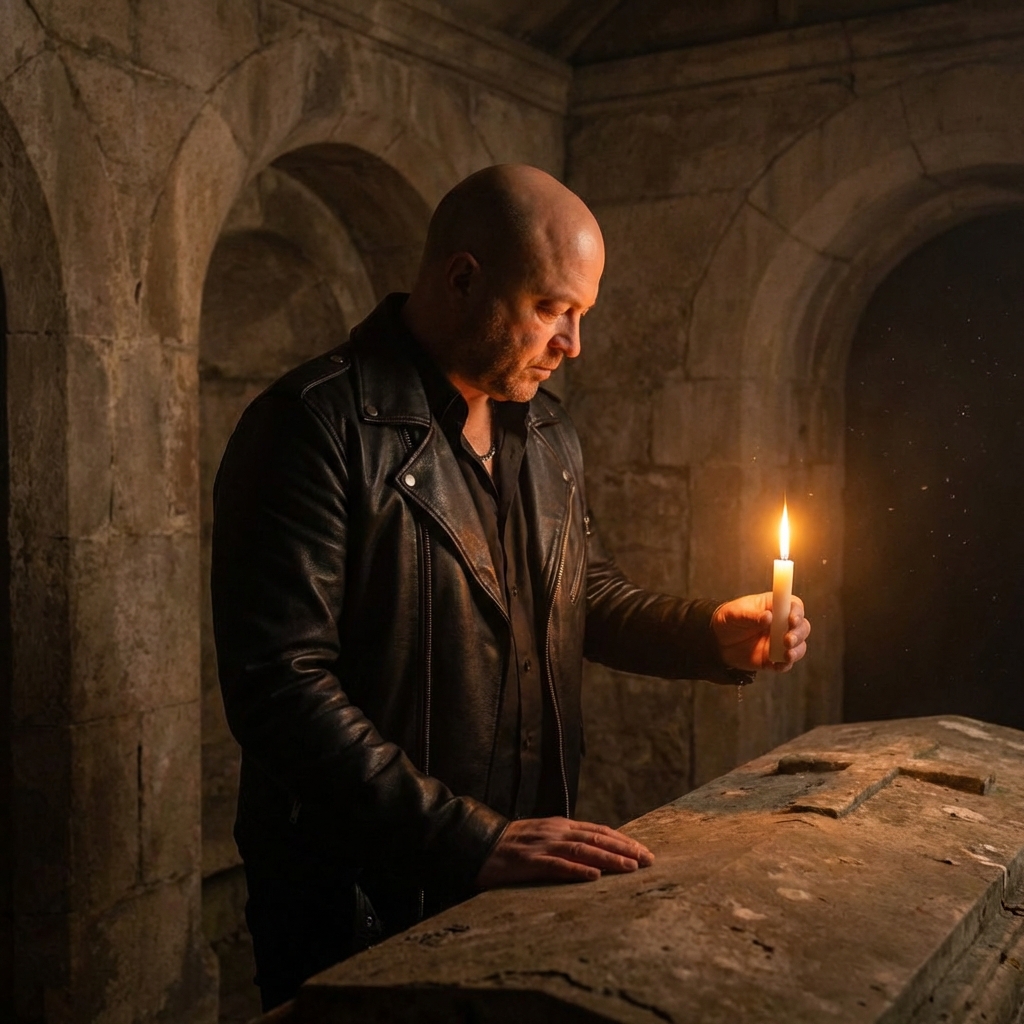
For more than a decade, Michael Stover has worked behind the scenes as the founder of MTS Records and MTS Management Group, helping independent artists find audiences around the world. Now, recording as Michael St. Over, the songwriter and producer has stepped behind the microphone himself. His debut single, “Ride Sweet Angel,” confronts child abuse, addiction, trauma, faith and redemption through the story of a young woman named April—a character whose origins stretch back decades to a teenage girl Stover encountered when he was only about 20 years old. Stover has also connected the release to a larger purpose, pledging his proceeds from sales and streaming to the Tim Tebow Foundation. We spoke with St. Over about the young woman who inspired the song, writing about such difficult subjects, becoming the voice of his own material, the role faith plays in his music, and where this new chapter may lead.
- “Ride Sweet Angel” centers on a young woman named April. You’ve said that the character was inspired by someone you encountered when you were about 20 years old. What do you remember about her?
Michael St. Over: I was about 20 years old and working at a place where this teenage girl would come in from time to time. I didn’t really know her story, and I don’t want to pretend that I did. But there was something about her that stayed with me. She had this incredibly sad look in her eyes. There was a heaviness there that seemed out of place for someone so young. I remember wondering what had happened in her life and what she might be carrying around that nobody else could see.
Years later, when I began developing this song, that memory came back to me. I created the character of “April” around the feeling I remembered seeing in that girl. The events in the song are fictionalized—I don’t know whether she experienced abuse or addiction—but the emotion that started the song was very real. In some ways, April became my attempt to imagine the story behind those eyes.
- Why did that memory stay with you for so many years, and how did it eventually become a song about abuse, addiction and redemption?
Michael St. Over: I think it stayed with me because I never knew what happened to her. When you’re 20, you don’t necessarily have the maturity or perspective to understand what somebody else might be going through. Looking back as an adult, I started thinking about how many young people walk around carrying trauma that the rest of us never see.
That’s where the story grew. I began imagining what could put that kind of sadness into someone’s eyes, and April’s story developed from there. Child abuse leads her toward addiction because she’s desperately trying to numb something she doesn’t know how to process. I wanted listeners to look beyond the addiction and ask, “What happened to her?” rather than simply, “What’s wrong with her?” That’s an important distinction.
- You wrote and produced the song and also sing lead vocals. After spending so much of your career developing other artists, why was this a song you needed to perform yourself?
Michael St. Over: I’ve written songs for years, and I’ve always been comfortable behind the scenes. But “Ride Sweet Angel” had been living somewhere inside me for such a long time that handing it to another singer didn’t feel right. The seed of the song goes all the way back to that girl I remembered from when I was 20. I knew exactly how I wanted the words delivered because I knew the emotion behind them.
I’m not trying to be the world’s most technically perfect singer. I want people to believe me. With a song like this, honesty matters much more than perfection.
- The train is such a powerful recurring image. Why did you choose it as the central metaphor?
Michael St. Over: A train works on several levels. Once it’s moving, there’s this feeling of momentum and inevitability. April thinks she’s escaping her pain, but she’s really traveling deeper into addiction. That’s why she’s initially riding a “nowhere train.”
The most important moment comes at the end when it becomes “salvation’s train.” The tracks haven’t disappeared. Her past hasn’t been erased. But her destination has changed. That’s really the message I wanted to leave people with: what happened to you can always be part of your story, but it doesn’t have to determine where that story ends.
- Why was it important to connect “Ride Sweet Angel” with the Tim Tebow Foundation?
Michael St. Over: Once the song was finished, I kept thinking that I didn’t want the message to end when the music stopped. I wanted it to actually do something. The Tim Tebow Foundation’s work with vulnerable people, including children facing abuse, exploitation and other terrible circumstances, connected naturally with what “Ride Sweet Angel” was trying to say.
That’s why I’ve pledged my proceeds from sales and streaming. There’s something powerful about taking a memory of a sad young girl from decades ago, turning that memory into a song and then allowing that song to potentially help vulnerable people today. It brings everything full circle for me.
- Faith and redemption are central to the final section of the song. How does your faith influence Michael St. Over as an artist?
Michael St. Over: Faith is part of who I am, so naturally it’s going to come through in what I create. But I don’t want to write songs that simply preach at people. I’d rather tell the truth about darkness and then show that darkness doesn’t have to win.
Redemption means more when you’ve acknowledged what somebody actually needs redemption from. “Ride Sweet Angel” goes into some very ugly places, but that’s exactly why the hope at the end matters. I believe God can take circumstances that appear completely destroyed and create something new from them.
- After spending so many years as a label executive, publicist, songwriter and producer, what has it been like becoming the artist yourself?
Michael St. Over: It’s definitely strange! I’ve spent years telling artists, “Do the interview, make the video, promote yourself, tell your story,” and now I’m the guy who has to follow my own advice.
There’s a different vulnerability involved when it’s your voice, your song and your story out there. At the same time, it’s incredibly freeing. I’m not chasing whatever happens to be fashionable. I can make the music I want to make and talk about subjects I believe deserve attention. With Michael St. Over, I want the guitars to be heavy, but I also want the songs to have something meaningful underneath them.
- Now that “Ride Sweet Angel” has introduced Michael St. Over to listeners, where do you want to take the project next?
Michael St. Over: “Ride Sweet Angel” established the foundation for what I want Michael St. Over to represent. I want to continue making hard rock that isn’t afraid of difficult subjects, faith or genuine emotion. I’m interested in struggle, recovery, relationships, spiritual battles and the things people carry around without necessarily talking about them.
I don’t want Michael St. Over to become a character I’m playing. I want it to remain honest. If somebody turns up one of my songs because the guitars sound great, that’s fantastic. But if that same song reaches somebody who’s hurting and makes them feel seen—or reminds them that their story isn’t finished—that means infinitely more to me.
Decades after a teenage girl with sadness in her eyes unknowingly left an impression on a 20-year-old Michael Stover, that fleeting encounter has found an unexpected second life. The girl herself remains a mystery, and Stover is careful not to assign his fictional narrative to her real life. Instead, the feeling she left behind became the emotional seed for April and “Ride Sweet Angel.” By transforming that memory into a song—and the song into support for the Tim Tebow Foundation—Michael St. Over has turned a question he carried for years into something tangible: a call to notice the people whose pain isn’t always visible, to respond with compassion instead of judgment, and to believe that even the darkest journey can still change direction.