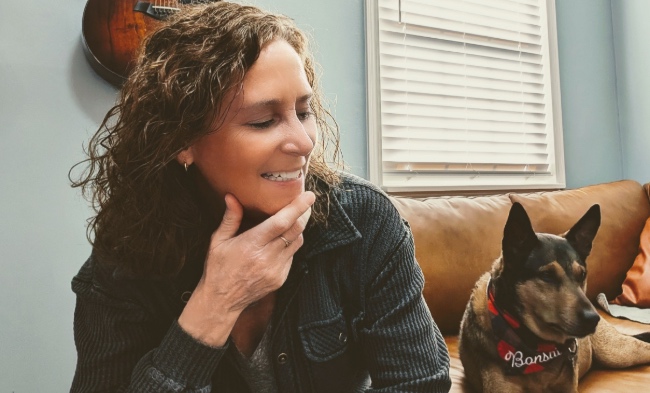
Pam Ross follows a spark wherever it leads. On her latest single, “Lost in Heaven,” a few chords grew into a moonlit story, carried by a haunting slide guitar and an unexpected fiddle solo. We spoke with Ross about how the song came together, the musical influences she grew up with, and her plans for the album Wait For It.
- Your latest single, “Lost in Heaven,” blends romantic desire with spiritual imagery. What inspired the song, and how did its central idea first take shape?
I started playing the chords, and the lyrics just came to me. The window in my music room overlooks our backyard and the woods behind it, so that’s where the idea for the setting came from.
- The lyrics move from the excitement of a moonlit Saturday night to the tenderness of Sunday morning. How important was that emotional progression to the story you wanted to tell?
I wasn’t thinking of that line as being important to the story. I was thinking more about it lyrically. The title is “Lost in Heaven,” and they’re out there on a Saturday night doing things that make angels blush. I thought the idea of Sunday morning sounded cool.
- “Lost in Heaven” brings together country, Americana, and Southern rock. How did you approach the arrangement and production to balance those different influences?
I played around with it a lot. The guitar hook at the beginning is Yvan playing slide with a ton of reverb. I wanted a haunting, swampy sound. Originally, Yvan played guitar on the solo, and it didn’t sound right to me. I tried a fiddle, and it fit perfectly. I really like the way everything fused together.
- You were named Female Multi-Genre Artist of the Year at the 2024 Josie Music Awards. How has embracing multiple genres helped you develop your identity as an artist?
It’s just who I am. It’s not something I strive for. I write whatever comes out and produce it in a direction that sounds best to me.
- You are based in Fuquay-Varina and remain connected to North Carolina’s music community. In what ways has the state influenced your songwriting, sound, and career?
Not very much. I’ve only been in North Carolina a short time. My songwriting style had already developed. My mom always listened to classic country, and my older siblings loved rock. I mainly listened to rock growing up, although my mom always had Dolly, Johnny Cash, and other artists on the radio. I got into country music when I moved to Houston. All of those different styles just meshed together inside me.
- You have performed throughout North Carolina, in Nashville, and at South by Southwest in Austin. Which live-performance experiences have had the greatest impact on you, and what have they taught you about connecting with an audience?
I love playing in Nashville. It’s a songwriting town, so come on. Every songwriter loves it when people sit and listen. Those are the performances where you get to talk about your songs, which really helps you connect with an audience.
- Your songs are often emotionally direct and personal. When writing, how do you decide which real-life feelings or experiences you are ready to share publicly?
I usually don’t decide. It just comes out. I play a song publicly when I think it’s a good song. I don’t share that it’s personal unless I want to. Not all of my songs are about real-life experiences. “Lost in Heaven” isn’t. The music made me start seeing images in my head, and I made a story about it. Other songs are personal, like “I’m The One.” That song comes out next year, and it was mainly written about a family member with an addiction.
- What does “Lost in Heaven” represent in the next chapter of your career, and what can listeners expect from your upcoming music and performances?
I’m not sure what “Lost in Heaven” represents for my career. Hopefully, it means my songwriting is getting better. The album I’m releasing is called Wait For It. It has ten songs, and I’ve released three so far, so you can expect new music throughout 2027.
For Ross, a song can begin with a view through the window, an image sparked by a melody, or a feeling close to home. “Lost in Heaven” shows what happens when she lets those ideas unfold on their own terms. With more songs from Wait For It ahead, listeners will have plenty of chances to hear where her instincts take her next.