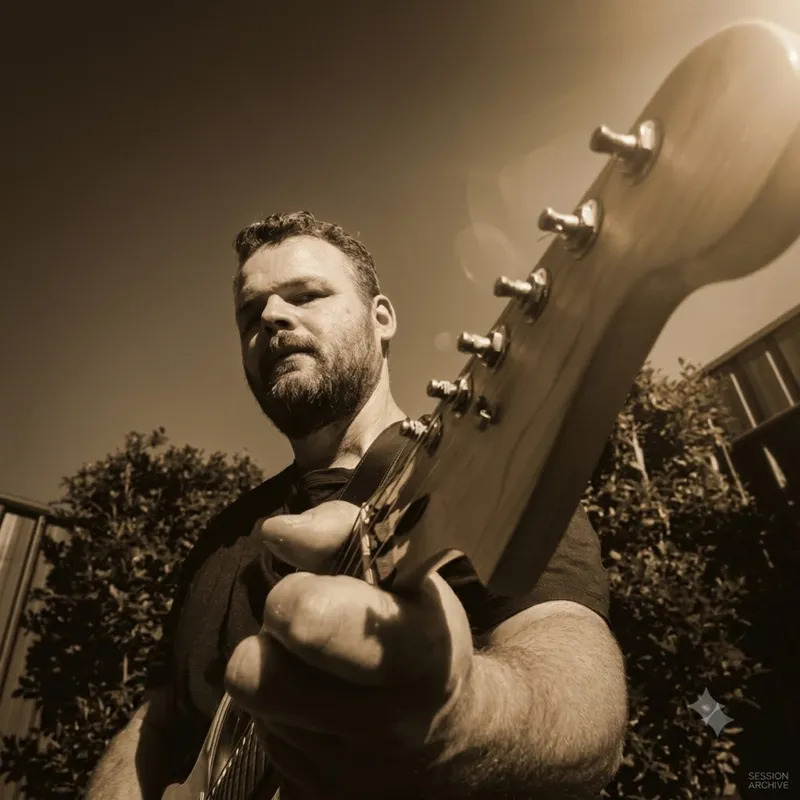
Dan Higgins picked up a guitar as a teenager in Monmouth, Wales, playing in bands and recording on tape before eventually settling in Adelaide, where songwriting stayed a hobby for years. That changed in 2024, when, inspired by his wife and infant daughter, he set himself the challenge of writing and recording at least one song a month for a full year. Twenty Twenty Six, his debut album, out August 1st, grew directly out of that streak, seven tracks recorded entirely solo, writing, performing, and recording all handled by Higgins himself out of his living room, running a Behringer interface into a well-worn 2012 MacBook Pro on GarageBand. Lead single “Commuting” set the tone for the record, built around an idea Higgins landed on almost by accident while trying to record vocals with no finished lyrics yet: the small, unclaimed pocket of time between leaving work and arriving home, and what it’s like to actually sit with your own thoughts in that gap.
This album feels like a movie with how tonally coherent the whole thing is. Every song is a separate chapter in the story, but overall they pass from one to the next smoothly, because many of them even share the same key, and the ones that are in a different key are still very much of a similar bright and whimsical harmony and tonality. Which makes sense, because this is really Dan Higgins’ strong suit; he really knows how to write beautiful chord progressions that don’t sound cheesy but instead sound hopeful and very emotive.
That coherence is even more impressive given how the record was actually built. Higgins ran backing and gang vocals through guitar amp simulators across several tracks simply because he liked the texture, and leaned on a tape cassette plugin during mastering to add warmth and saturation, a nod, by his own account, back to the tape recorder he used as a teenager. Those are small, almost accidental choices rather than a fully mapped-out sonic concept, but they add up to a consistent character across the album that many solo bedroom-recorded debuts struggle to pull off.
Pulling from Britpop and 2000s indie and alt-rock touchstones like Oasis, Idlewild and Feeder, with a newer folk influence from artists like Frank Turner threaded in, Twenty Twenty Six wears its influences honestly without leaning on any single one too hard. Higgins doesn’t perform these songs live, by his own admission a matter of family and time rather than confidence, which makes the album feel less like a calling card for a touring act and more like a genuinely personal document, a full year of writing discipline finally given a proper home.
Twenty Twenty Six is a strong first outing for a songwriter who’s spent a long time treating this as a hobby before finally giving himself the room to make something this complete. Whatever comes next, the coherence and warmth on display here suggest Higgins has found a sound worth sticking with.