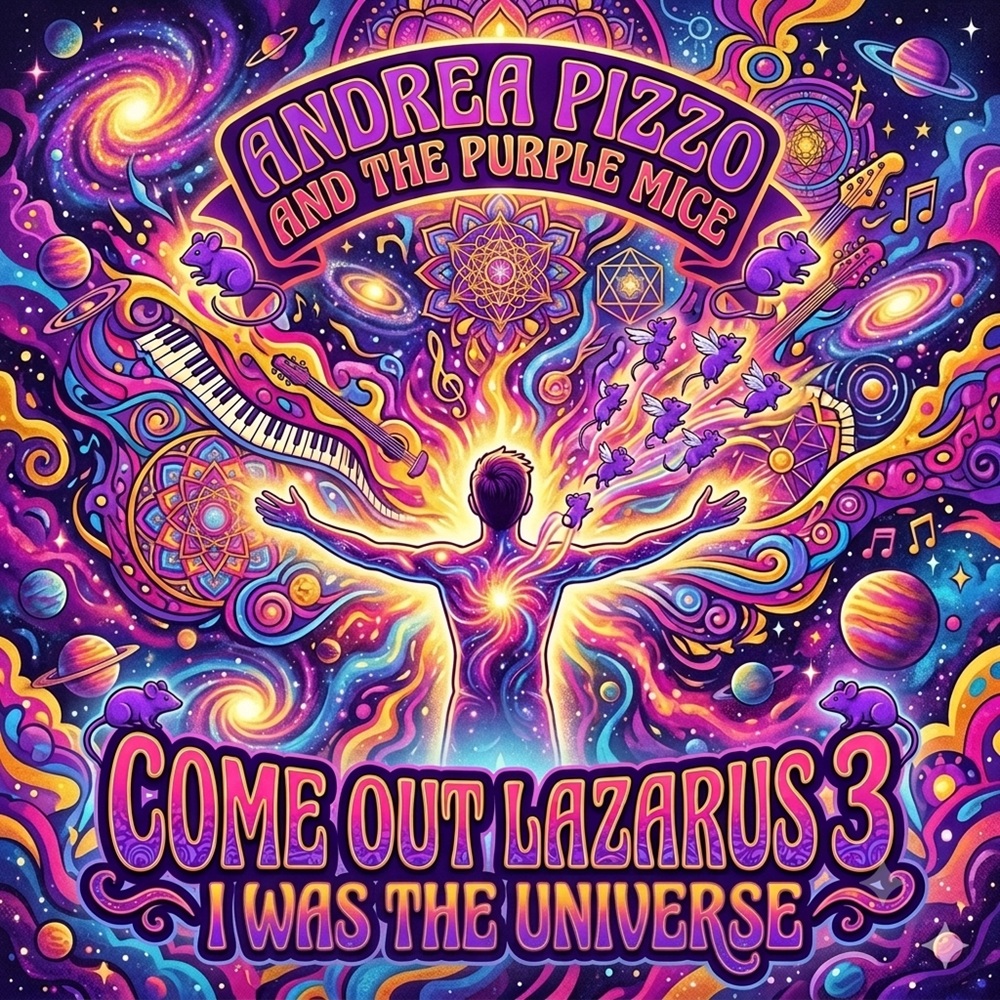
Genova’s Andrea Pizzo and The Purple Mice close out their Come Out Lazarus trilogy with “Come Out Lazarus 3 – I Was The Universe” out July 19th, and it completes an arc I’ve been tracking since April’s “Ineffability.” Where the first chapter watched a fatal accident and organ donation from the outside and the second pulled the listener inside the near-death experience itself, this third chapter is the return, someone coming back and trying to describe an experience nobody around him will believe, bringing back not fear but a strange sense of peace: the memory of having briefly been one with everything.
Musically, this is a real shift from where the cycle started. “Ineffability” leaned on an interior, downtempo space built on Pink Floyd and Massive Attack influences, with sparse elements and an unhurried atmosphere. “I Was The Universe” opens up considerably, borrowing gospel’s architecture, the collective chorus, the slow build toward release, and pointing it toward transcendence rather than anything explicitly sacred. Beatles-like melodies run through a modern filter, with a melancholy undertow that recalls Mike Oldfield, and the arrangement floats rather than pushes, fitting for a song built around a dream nobody around the narrator will accept as real.
The closing stretch belongs entirely to arranger and multi-instrumentalist Roberto Tiranti, who’s handled the instrumentation across all three chapters of this cycle. Here he steps out from behind the arrangement into an extreme, Prince-style falsetto, high and piercing with a gospel singer’s clarity, functioning as the song’s emotional peak, the voice essentially becoming the very experience of consciousness leaving the body that the lyrics describe. It’s a striking way to close out a trilogy that’s spent two prior chapters staying close and interior; letting the final release come through pure vocal performance rather than instrumental buildup gives the ending real weight.
Taken as a whole, the Come Out Lazarus cycle has moved from external observation to internal experience to, now, an attempt at communicating something fundamentally incommunicable, and each chapter has shifted its sonic approach to match that narrative step. “I Was The Universe” is the most immediate and accessible of the three, and closing an ambitious concept trilogy on a track this luminous, rather than something colder or more clinical, feels like the right way to send someone back from the other side.