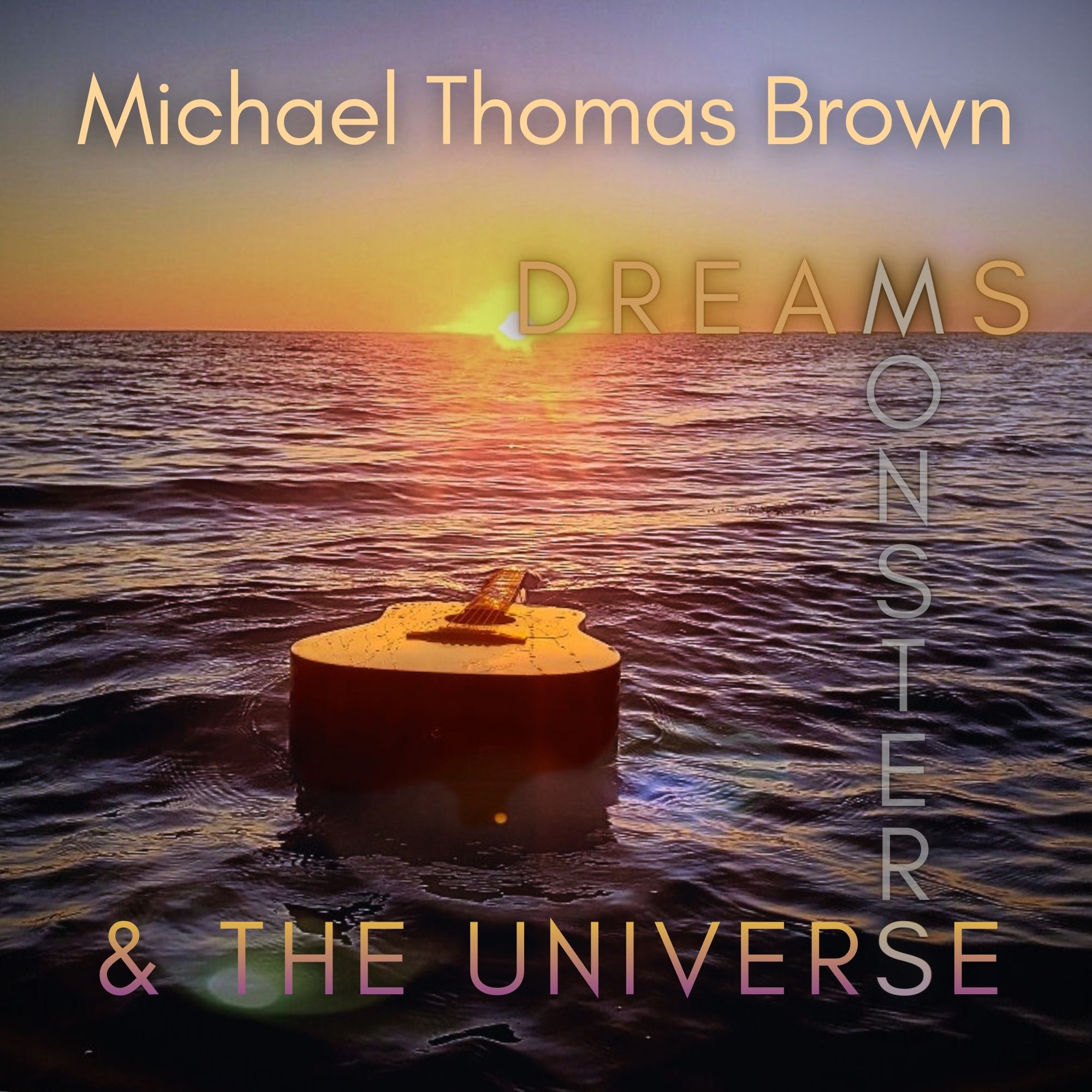
There’s a version of this story that could easily tip into sentimentality. A musician, living in Crystal River, Florida, receives a Stage IV cancer diagnosis and retreats to his bedroom studio to record an album. That’s the kind of press note that practically writes its own emotional arc. But Dreams, Monsters, and the Universe, released on February 13th through Michael Thomas Brown‘s own Amalgam Recordings imprint, doesn’t lean on that backstory as a crutch. It just sounds like a guy who needed to make something, and did.
Michael Thomas Brown has been around music for a long time. He studied Recording Production and Technology at Middle Tennessee State University, spent years teaching guitar outside Nashville, and eventually moved into orchestral composition, with instrumental works landing in TV productions internationally. This is his first traditional solo album, the first time he’s recorded his own voice, and he handled all of it himself – writing, producing, engineering, mastering, and playing nearly everything. Guitars, bass, percussion, synths, piano, and an assortment of sampled objects from around his house and yard: flower pots, soda bottles, a lawnmower, a fence. David Adkins contributes hand drums on one track, and John Shade plays the drum kit on another. Otherwise, this is entirely Michael Thomas Brown’s record.
The album sounds like its cover art, an acoustic guitar floating on a serene ocean, witnessing the sun rise. It’s like Michael Thomas Brown is impersonating the warmth of the guitar in his own vocals. The album blends musically because of that. It stays relatively warm and simple in its arrangements the whole way through, but each song becomes distinct because of its unique thematic impact. There is some really great songwriting here. Let’s go through some highlights.
“You’re Like the Sun” is a wholesome love song. The sun is the biggest star we interact with daily, and its rising every day is an intrinsically positive event because it signals the start of a new day. It makes perfect sense to draw a comparison between the sun, which gives everything life, and your lover. Michael Thomas Brown adds to the hook that the sun keeps the monsters away, which, in relation to a loving partner, can mean that the aura of love weakens monsters; it signals to predators that you are not to be messed with because your love fortifies you.
“Universe” talks about the connection between the internal and external universe. We are museums of everything we have ever loved. Like the “real” or outer universe, our internal universe expands all the time and will continue to expand till the very end. Michael Thomas Brown highlights that it’s not just good things that get added to our internal universes, but also every tragedy, but he wouldn’t change a thing about it because life is to be experienced as a whole, and the tragedies are fundamental to the complete experience.
“Into the Deep” does wonders for the immersion into the listening experience of this album, as there are samples of beach and ocean sounds as the guitar melodies lull us into the deep end of the ocean. But it’s not a terrifying experience; on the contrary, it’s very soothing to swim in the dark with the stars as your only light. I personally found it very calming to meditate to this song.
“The End” is suitably the final track on the album. It’s much more atmospheric than anything else on the album. The ambience is done masterfully, and there is this Pink Floydian quality to the melodic approach of the entire song, but especially the guitar solo. Overall, this is what music plays when you drive into the sunset, which is how this album ends in my mind. It starts with the sun rising and ends with it setting. Thematically, the song is about how at life’s end, there are no regrets because we found love and hope on the journey, and that’s more than enough.
For a debut vocal album, made alone in a bedroom while undergoing cancer treatment, Dreams, Monsters, and the Universe carries itself with a quiet confidence that a lot of more resource-heavy records never quite find. The RIYL comparisons to Peter Gabriel and Pink Floyd are not idle – there’s that same sense of music being used to process something real, without letting the processing become the whole point. Michael Thomas Brown said he wanted a place to set down the weight of the heavy things. That’s exactly what this album sounds like, and it’s worth your time.