There is a particular kind of magic in old recording sounds: the hum of an organ, the bite of an electric guitar, the weight of a live drum kit. Pennan Brae’s Studio leans into that magic, building a seven-track world where 70s and 80s rock meets the atmosphere of contemporary Vancouver.
Studio feels like a record made for the hours when the city starts to glow. Its musical language is unmistakably rooted in classic rock, but there is enough curiosity in the arrangements to keep it from feeling like a simple trip down memory lane.
The journey begins with “Scratch,” an appropriately unconventional opening. Quirky guitar work, unusual rhythms and an alternative-rock sensibility immediately bring David Bowie to mind. There is something slightly eccentric about the track, but it never loses its melodic centre. Rather than announcing exactly what the album will be, “Scratch” leaves the door open.
That door leads into the warmer classic-rock territory of “Deja Vu.” The combination of Hammond organ and a sharp guitar riff gives the track a distinctly vintage character, while “Hig & Jig” continues in a Rolling Stones-inspired direction. Together, the songs establish one of the album’s central pleasures: familiar rock vocabulary being used without making the music feel entirely predictable.

A lot of that character comes from the instruments themselves. Brae handles guitar, organ and vocals, joined by Kaj Falch-Nielsen on bass, Alison Jenkins on harmonies and Cameron Wilson on violin. Legendary drummer Steve Ferrone, known for his work with Tom Petty and Eric Clapton, appears on six of the seven tracks, giving the record a strong live rhythmic foundation.
But perhaps the most distinctive element is the Hammond organ. A 1960s Hammond was recorded through a vintage Leslie Cabinet Speaker, preserving the physical character of the instrument rather than smoothing it into something purely digital. Alongside the Fender Mustang guitar and live drums, it gives Studio a sense of weight and texture. You don’t just hear the instruments; you get a sense of their physical presence.
That tactile quality is one of the album’s strongest characteristics. Studio seems to understand that part of the pleasure of rock & roll is hearing musicians interact with actual instruments: the slight roughness, the warmth, the movement between sounds. Alison Jenkins’ harmonies add another dimension, softening and expanding the arrangements without taking them away from their rock foundation.
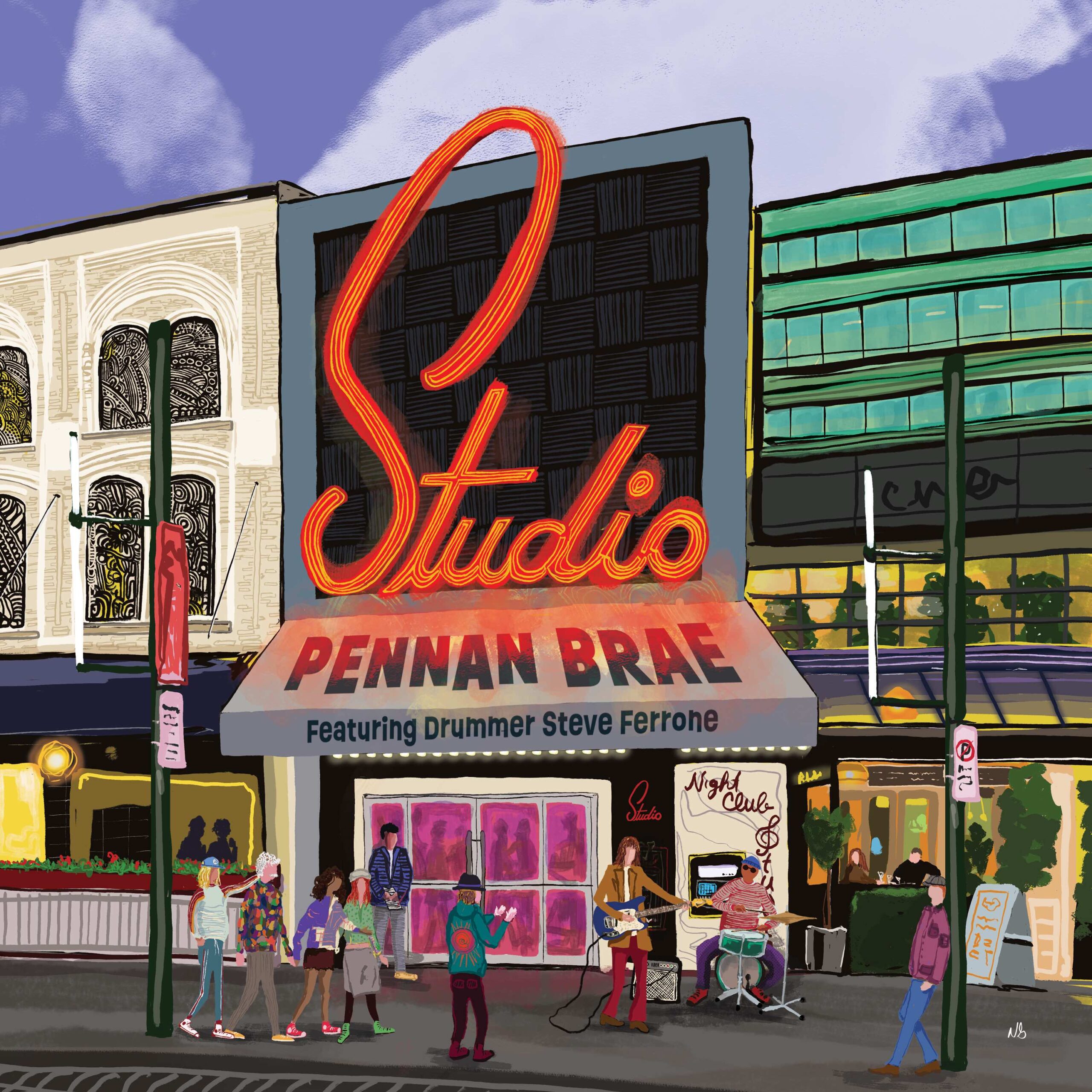
There is also a cinematic quality to the record, which makes sense given Brae’s parallel work as a film composer. He has written and scored the independent films The Astronot and 2 Below 0, and Studio often feels visual in the way it moves between moods and textures. Its artwork, created by Nathan Gowsell, reinforces this atmosphere with vintage Vancouver neon signs glowing against the night.
That image almost becomes a metaphor for the album itself. There is something old-fashioned about neon, a technology and aesthetic associated with another era, yet its glow still feels strangely contemporary. Studio operates in much the same space, taking sounds strongly associated with the 70s and 80s and allowing them to exist in the present.
The album’s final track makes that transition especially clear. “It Ain’t Perfect But It’s Free” (Dance Mix) moves away from the classic-rock centre of the record and into 80s pop-dance territory. Originally released as a funk-rock version on Paint, the song takes on a different character here. Coming after the guitar-driven opening and the classic-rock middle of the album, it feels almost like the city has suddenly changed its lighting.
That contrast gives Studio a satisfying sense of movement. “Scratch” and “It Ain’t Perfect But It’s Free” become contrasting bookends: one quirky and alternative, the other bright, rhythmic and unapologetically 80s. In between them, Brae explores the Hammond-heavy warmth of classic rock, Stones-inspired swagger and the organic interplay of guitar, bass, drums, strings and voice.
What makes the album interesting is that its influences are never particularly hidden. Bowie is there. The Stones are there. The 70s and 80s are everywhere. But the record doesn’t seem interested in disguising those references. Instead, Brae treats them as a musical vocabulary; sounds that can be picked up, rearranged and given another life.
That’s exactly where Studio finds its identity. It isn’t trying to escape the past, nor is it attempting to reproduce it perfectly. It sits somewhere in between: looking backwards while still moving forward.
By the time Pennan Brae’s Studio reaches its final dance mix, the album has travelled from quirky alternative rock through classic-rock warmth and into 80s pop without losing its sense of place. Like the vintage neon signs that frame its visual world, it takes something from another era and lets it glow again; but this time through its own particular shade of rock & roll!