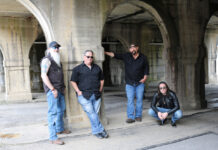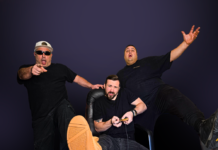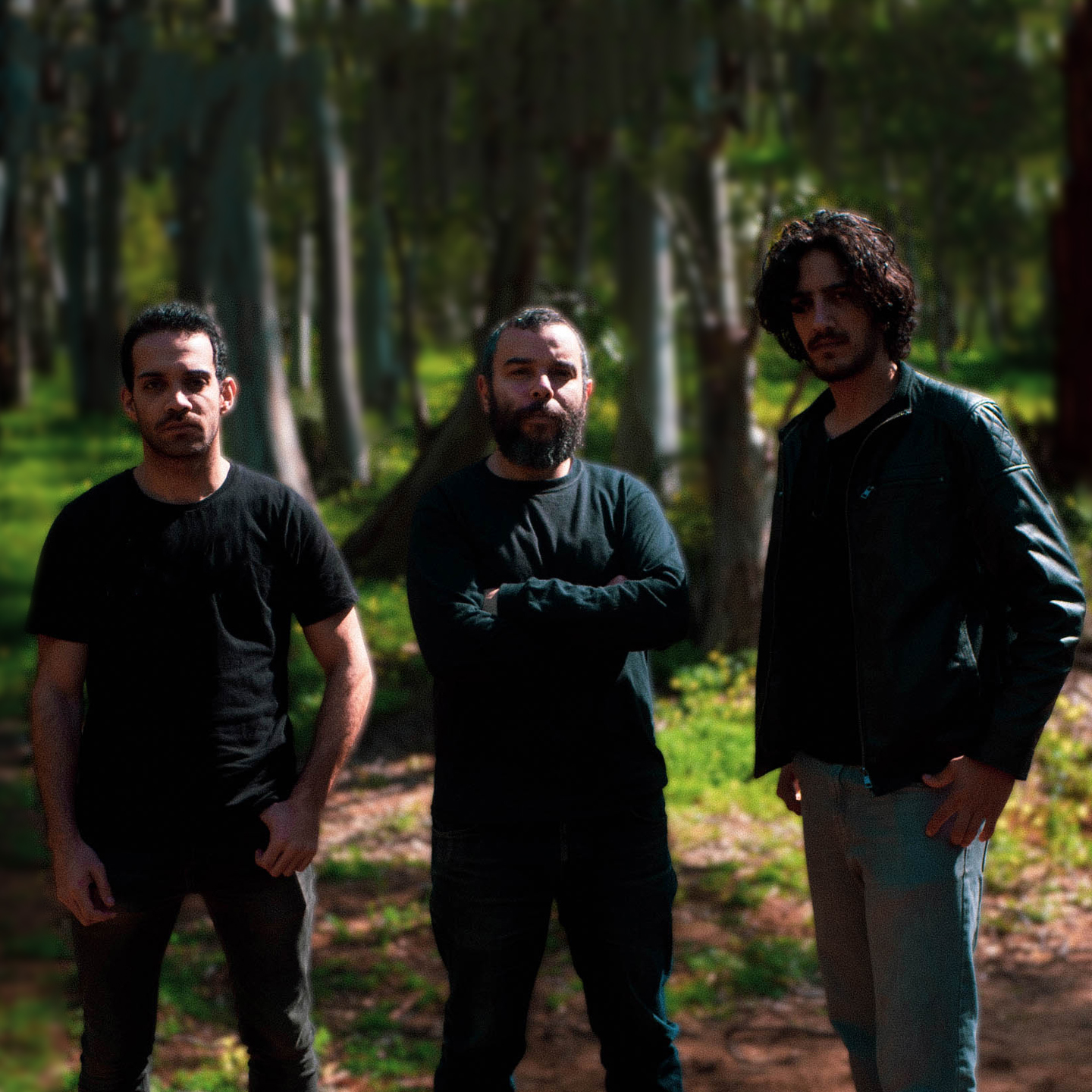
Primordial Black have moved fast for a project still early in its life. Led by Yasser Mahammedi Bouzina alongside guitarist Walid Chaaben, bassist Walter Rehouma, and drummer Selim Bouladi, the Tunisian avant-garde metal outfit followed their debut EP Monas Hieroglyphica with the full-length Dark Matter Manifesto, which featured Rotting Christ’s Sakis Tolis and went on to win Album of the Year from Mexican outlet Metalpedia. Now they’re back with Heterotopia, a record that pushes further into cinematic, progressive territory while bringing in guest contributions from Steve DiGiorgio, Karim Bouazra of Lost Insen, and Gianluca Morelli of Antiqus Infestus. We reviewed the album recently and came away struck by just how deliberately constructed the record’s atmosphere is, from the symphonic horror-movie opening of the title track to the genuinely surprising turns on “Begotten.” We sat down with the band to talk about how Heterotopia came together, what’s changed since Dark Matter Manifesto, and what it’s like building an extreme metal project from Tunisia.

- For readers just discovering Primordial Black through Heterotopia, how would you describe what this project is and where it’s headed?
Hello, thank you very much for your interest in Primordial Black 🙂
For people discovering us through Heterotopia, I’d first be tempted to say: WELCOME.
Primordial Black is a musical project that explores many different subgenres of extreme metal (with a very strong Blackened Death Metal identity), but we also draw from more eclectic territories such as avant-garde music and post-black metal.
One of our main strengths is that we’ve committed ourselves to releasing one major project each year since 2024.
As of now, we have released one EP and two full-length albums.
I would describe the project as a constant exploration of contrast and transformation. We started from a darker, more direct and cosmic approach with Dark Matter Manifesto, but with Heterotopia we expanded the world into something more cinematic, introspective and unsettling.
- Heterotopia feels like a significant step further into avant-garde territory compared to Dark Matter Manifesto. What pushed you to expand the sound this time around?
I think, Dark Matter Manifesto already contained the seeds of that evolution, but with Heterotopia we consciously stopped asking ourselves “does this still sound like black metal?” and started asking “does this serve the world we’re trying to build?”
The album’s concept naturally pushed us further into avant-garde territory. Heterotopia is built around spaces of contradiction, transformation and displacement, so staying inside a strict stylistic framework would have felt limiting.
That led us to be much more open in the writing process, introducing more textures, samples, cinematic passages, unconventional structures and moments where atmosphere became just as important as riffs.
At the same time, we never wanted experimentation for its own sake. Our roots are still deeply anchored in extreme metal, especially Blackened Death Metal. The goal wasn’t to abandon that identity but to stretch it and see how far it could go while still feeling unmistakably like Primordial Black.
In a way, Dark Matter Manifesto was about defining our language. Heterotopia was about discovering what happens once we stop speaking it conventionally.
-
The title track opens almost like a horror film score, with a stripped-back piano line before the full weight of the band comes in. How did that structure come together, and was the contrast always part of the plan?
That contrast was actually there very early in the writing process.
The title track Heterotopia was conceived almost as an act of crossing a threshold. We wanted the listener to feel like they were entering a space rather than simply hearing a song begin.
That’s why the opening is so exposed and fragile, the piano isn’t there as an intro for the sake of dynamics, it’s there to create uncertainty.
There’s something cinematic about giving silence and space room to exist before introducing impact. Horror scores do this incredibly well: they let tension build psychologically before anything violent or overwhelming happens.
We were definitely inspired by that language of restraint. Think Akira Yamaoka or the work of Takefumi Haketa
When the full band enters, the idea wasn’t “here comes the heavy part”, it was more like reality collapsing into the piece. The distortion, density and weight feel larger because they’re invading something intimate and minimal.
Structurally, we also wanted to avoid the traditional extreme metal approach of exploding immediately into riffs. Heterotopia as a concept deals with layered spaces and unstable identities, so the song mirrors that: it begins almost deceptively human and vulnerable before opening into something much larger and stranger.
So yes, I would say that the contrast was absolutely intentional. In many ways, that opening piano line became the thesis statement for the entire album.
-
That same song has an intermission of drones and breathing sounds that splits it in two. What was the thinking behind interrupting the track that way rather than letting it run straight through?
That interruption was intentional from the moment the song started taking shape.
We never saw Heterotopia as a linear composition that continuously escalates, we wanted it to behave more like an experience of entering, losing orientation, and emerging altered.
The intermission of drones and breathing acts almost like a rupture in perception.
If the track had simply kept building from section to section, it would have remained a “song.”
By interrupting it, the listener is forced out of passive listening for a moment. There’s a suspension of rhythm and expectation where you’re no longer following riffs or melody, you’re de facto occupying space.
The breathing was especially important because it introduces something intimate and physical into an otherwise abstract sonic environment.
Breathing is reassuring and unsettling at the same time, it can suggest life, presence, anxiety, exhaustion, even observation depending on context.
Combined with the drones, it creates this sensation that the track itself is alive.
That break also serves a narrative purpose: the second half isn’t meant to feel like a continuation, but like returning to the same place after something inside it has shifted.
In hindsight, that intermission became one of the clearest statements of what Heterotopia is as an album: not just transitions between songs, but transitions between states.
-
The song “Immaculate” features Steve DiGiorgio on bass, and the breakdowns really have a different vibe to the breakdowns I think. So how did that collaboration come about, and what do you think he brought to the song that wasn’t there before?
Steve DiGiorgio is someone whose work has shaped the language of progressive and extreme metal for decades, and when Immaculate started taking form, it already had a structural openness that felt like it could benefit from a bassist who doesn’t just “support” the music, but actively converses with it.
Steve was initially meant to appear on the title track Heterotopia (that was the first demo I sent him)
However after introducing the instrumental bridge in the middle of the song, it became clear to us that his role would have ended up being quite limited, or even somewhat lost within the overall arrangement.
That’s when I decided to write Immaculate from scratch. There wasn’t even a demo to begin with, it started as an experiment where I intentionally stepped outside my usual writing habits. I worked with diminished harmonies, jazz-influenced phrasing, reversed guitar textures, and a more avant-garde structural approach.
He brought to the song what was needed: motion inside stability.
The breakdowns you’re referring to gained a completely different gravity because he doesn’t treat them as static moments. Instead of simply anchoring the guitars, his bass lines move underneath them like a second narrative layer (almost contrapuntal at times)
There’s this fluidity and tension that wouldn’t exist if the bass were purely rhythmic or textural.
I would like to thank Darkside Records for making this feature possible and for believing in what was, from the start, a rather unconventional idea. They did an outstanding job in supporting it.
-
“Begotten” is one of the most unpredictable tracks on the record, moving through what sounds like throat singing, a relentless blastbeat section, and then a jazz-noir-style saxophone passage. Where did that arrangement come from, and how do you decide when a song should break from the album’s heavier instincts like that?
With Heterotopia (as an album), the guiding idea was always that heaviness is not just distortion or speed. Sometimes the most extreme moment is the one where the language of the genre stops making sense for a few seconds.
Therefore Begotten came from this very starting point.
It wasn’t built around riffs in the traditional sense, but around contrasts, almost like assembling incompatible fragments and forcing them to coexist until a new logic emerged. The throat-singing idea was one of the first sonic images I had for the track. I wanted something ancient and human at the same time, something that feels like it belongs outside of genre entirely. From there, the blastbeat section wasn’t meant as a “release” or climax in the usual extreme metal sense, but more like a violent interruption, almost as if the piece is being pulled into a different gravitational field.
The jazz-noir saxophone passage came later in the process, and that’s where the track really started to define its identity. It introduced a completely different emotional register: less aggression, more decay, ambiguity, and atmosphere.
That contrast was important because it prevents the song from locking into a single emotional direction.
-
Karim Bouazra and Gianluca Morelli also appear on the record. How did those collaborations shape the writing process, and did either of them push the songs in a direction you hadn’t anticipated?
Both Karim Bouazra and Gianluca Morelli are amazingly gifted guitarists, and their contributions were specifically focused on solo work across two tracks.
Karim’s approach brought a very instinctive, expressive dimension to his solo. It feels less like something constructed and more like something performed in real time, almost vocal in its phrasing. He tends to prioritize emotion and gesture over technical display, which ended up pushing the track into a more fluid and unpredictable direction than what was originally written.
Gianluca, on the other hand, has a more architectural way of playing. His solo work introduced a sense of structure within the chaos, even when things get intense, there’s a clear narrative logic to his phrasing. He often found melodic angles we hadn’t fully explored in the arrangement, which subtly shifted how certain sections resolve or transition.
What’s interesting is that both solos ended up influencing how we listened to the surrounding parts.
After recording them, we actually went back and adjusted small details in the rhythm guitars and dynamics to better support what they had brought.
So even though they appear as “guest solos,” they effectively reshaped the surrounding musical context in a very organic way.
-
Heterotopia explores decay, transcendence, and psychological fragmentation. Were those themes something you set out to explore from the beginning, or did they emerge as the album took shape?
The themes of Heterotopia didn’t really appear as a predefined concept from day one, they grew out of the same creative and emotional period that followed Dark Matter Manifesto.
If anything, the shift happened very naturally because the two albums come from different directions internally. Dark Matter Manifesto was more about external pressure, the forces that surround and overwhelm us in everyday life. With Heterotopia, the focus gradually turned inward, toward solitude, emotional rigidity, inner questioning, and a deeper sense of disconnection.
So when we started writing, it wasn’t “let’s explore decay or fragmentation.” It was more like working through a state of mind where those things were already present. The music became a way of organizing that internal chaos rather than illustrating a concept.
-
What’s the extreme metal scene like in Tunisia right now? Is there a community around what you’re doing locally, or does Primordial Black exist mostly in dialogue with the international scene?
The short answer is: there is a scene in Tunisia, but it’s relatively small, fragmented, and very DIY and most extreme metal projects end up operating in parallel with it while also looking outward. Tunisia has her fair share of metalheads and bands, but they tend to operate in small circles rather than one unified infrastructure.
Shows often happen in bars or occasional underground events rather than a stable circuit, and communities form around tight social groups rather than a national “scene machine.”
There’s also a long-standing issue of infrastructure and internal fragmentation: organization, support structures, and gatekeeping dynamics have historically made it harder for bands to sustain momentum locally, which pushes many projects either into semi-isolation or toward international collaboration.
And to answer your last point, for Primordial Black, the identity naturally ends up being built at the intersection between that local foundation and a much wider global extreme metal conversation.
-
Dark Matter Manifesto picked up close to 60 international reviews and an Album of the Year award. Has that recognition changed how you approach writing, or do you try to keep that noise out of the process?
It definitely registers, but it doesn’t really enter the writing room in a direct way.
With Dark Matter Manifesto, the reception, the reviews, the award, the international attention was meaningful in the sense that it confirmed there was an audience outside of our immediate circle. But if that starts influencing the actual writing process, it becomes dangerous very quickly. You start optimizing for perception instead of necessity.
It’s one of the main reasons that pushed us to make a stylistic “U-turn” on Heterotopia. It would have been easier to just do Dark Matter Manifesto Part 2 and rest on our laurels. But that’s not how we work, and the guys in the band share this desire to always push the machine further and explore new ground.
So the approach has been to keep a clear separation between creation and reception. When we’re writing, the only reference point is whether a section feels truthful to the idea we’re working with at that moment. Not whether it will be understood, reviewed, or ranked a certain way.
-
What’s next for Primordial Black after Heterotopia? Any plans to bring this material to the stage?
Right now, the focus is still on letting Heterotopia fully exist in people’s perception. We don’t see it as something that’s “done and moved on from” yet. It still has a lot of space to unfold, especially in how listeners interpret it over time.
That said, there is already a sense internally that the next step won’t be a repetition of this cycle.
Regarding the stage, we already presented the album during our release party last May. It was our first live performance with our new lineup, and next October we will share the stage at the Mena Rock Festival with Sakis Tolis, Harakiri for the Sky, and Mass Hysteria.
Thank you for taking the time to speak with us. Heterotopia is a genuinely ambitious record, and it’s clear Primordial Black are still pushing their sound forward rather than settling into a formula. Stream Heterotopia now and keep an eye on the band’s socials for upcoming news.