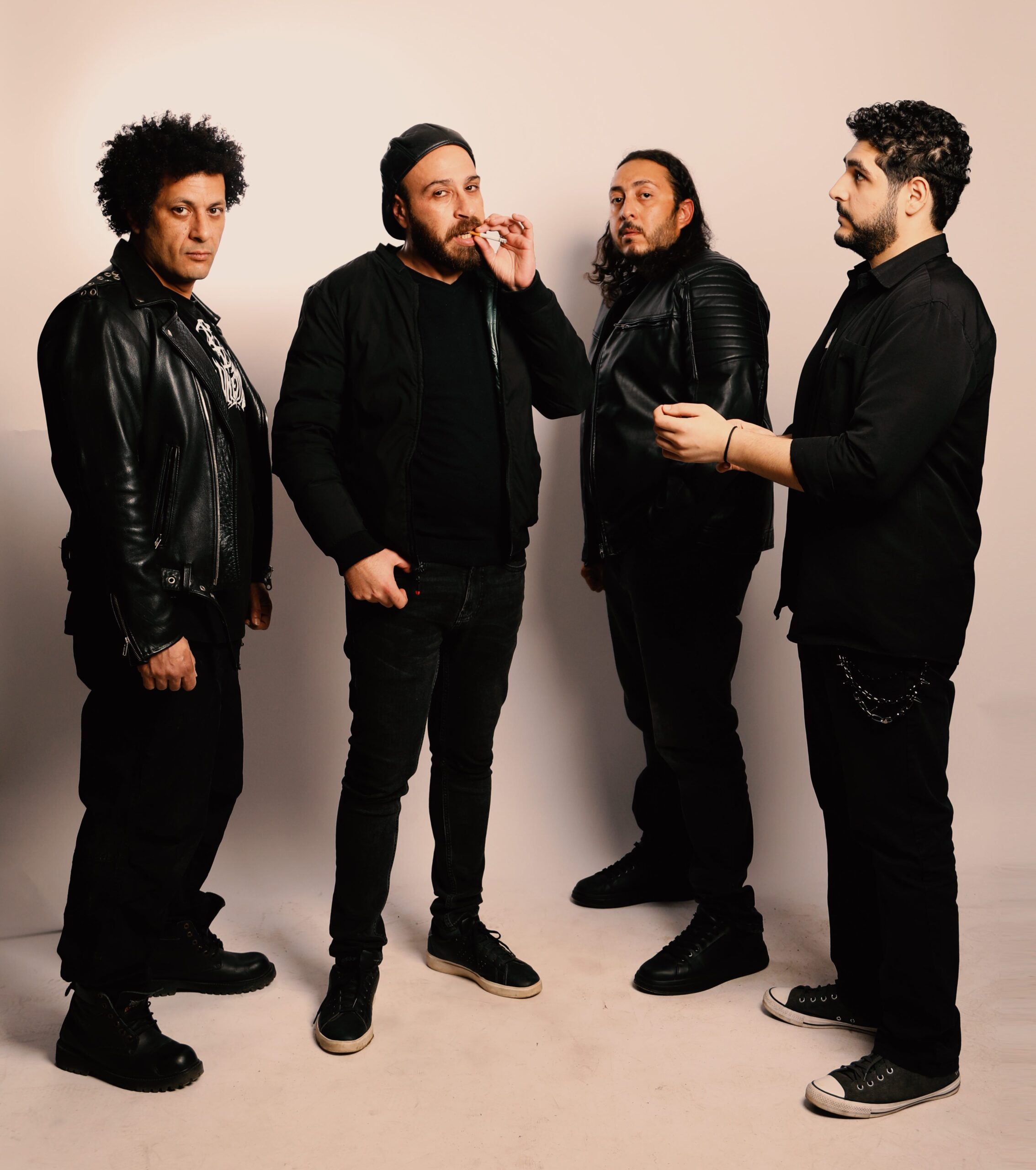
Soundsmudge are not a band that does things quickly, and based on the story behind their debut EP, that seems to be by design rather than accident. The Cairo-based melodic death metal outfit formed in 2021, released a string of singles, picked up international recognition along the way, and have spent the better part of the last two years getting their first EP exactly right. “Prelude to War” – out May 17th – is the lead single, and it was written in a single late-night session in October 2023, a few days after October 7th. The full “Devil in Disguise” EP follows shortly after. We caught up with the band to talk about the song’s origins, the video shoot, the long road to the EP, and what comes next.

- “Prelude to War” was written on the night of October 10th, 2023, just days after October 7th. Can you walk us through that night – what you were feeling, how the song came together so fast, and what it was like sending it to the rest of the band the next morning?
Eslam: We were hanging out at Samer’s house (our bass player and one of the band co-founders) I remember that we had the news channel muted at the background and the coverage of what was happening in Gaza, as you know it isn’t something new to us I mean we all grew up watching what has been happening there! But this was on another level, horrific scenes of destruction and bodies under the rubble and each few minutes the screen would show the estimated number of causalities among civilians, it was surreal just to know that within a few kilometers away there are people sitting in their houses awaiting to turn into a number, all of their hopes, dreams and memories are seconds away to be as it’s never existed. I was angry, it felt horrible, all I was thinking about was how can I channel this feeling and how to get this weight off my chest. I went back home, it was 2 AM or something around that and I was home alone, In my mind I was hearing the main riff echoing in my ears, I set up a session, press record and within 30 minutes later I recorded the basic draft of the song, of course it didn’t change things for those people who were suffering but for sure I had a momentary escape. Also, it started that stream of ideas that later completed the rest of the song.
The band really liked it, They have too, who else will write their music then 😊 since we also where adopting a new direction in our sound that started by the earlier releases (Hatred and EOT) we transferred from heavy metal to a sound closer to finish and Swedish metal, bands that me and khaled have been listening to since forever like (Amorphis, Inflames, and many more! So they were very excited about it they started throwing in ideas and it really pushed us forward to continue writing, Three days later I wrote the title track of the EP but that’s another story.
⇒ Read our full review for “Prelude to War” here.
- The chorus – “If you want peace, prepare for war” – is a line that could be read a lot of different ways depending on who’s listening. When you were writing the lyrics with Khaled, how conscious were you of that? Was there a line you were trying to walk between the personal and the political?
Khaled: That line was definitely something we were very conscious of when we wrote it. “If you want peace, prepare for war” is one of those phrases that’s been repeated so many times it almost feels unquestioned—but when you really sit with it, it’s kind of disturbing.
For us, the song is pushing back on that idea. The line isn’t meant as an endorsement, it’s almost ironic. Because right after that, we hit “nobody is counting the bodies no more,” which is where the real meaning lands. It’s about how easily people can become desensitized, how war gets framed as something necessary or even noble, while the actual human cost just fades into the background.
When were were writing, we were very aware of that tension between personal and political. On one level, it can be heard as an internal struggle—gearing yourself up for conflict just to survive mentally or emotionally. But on another level, it’s absolutely a commentary on how systems and leaders can justify violence by packaging it as a path to peace.
We didn’t want to be overly direct or preachy, but the underlying feeling is pretty clear war, in a lot of cases, is sold as a solution when it’s really just a different form of control… almost like a kind of large-scale bullying. And the people who pay the price are rarely the ones making the decisions.
So yeah, the ambiguity is intentional—but the emotion behind it isn’t.
- The music video was shot in a rage room over eight hours. Whose idea was that, and what was it actually like on the day?
Eslam: It was beyond exciting and exhausting at the same time, especially when you have three members of the band that are passed their 40’s 😊, but at the same time very exciting to work on something from scratch and watch it grow into a full production, we had on mind that we need to do this different that time, we decided to actually start hiring people with fresh ideas and to stop trying to do everything ourselves, that’s when Malek our Rhythm guitar suggested that we hire Sayed Ragai front man of the band “Erasing Mankind” who needs no introduction, We met in a coffee place in Zamalek, Sayed listened to the song and from the get go he was very excited to join that project and started giving us some ideas on where we can shot the video, then he threw in the suggestion of filming the video at one of those rage room places, then it took us around two weeks to find the suitable place to do so. We had another difficulty also because me and Ahmed (drummer) we work outside of Egypt and we get to get back on vacations every two to three months but at that time I was at Egypt and I had a few days left to go back to work, so the pressure was on, so as soon as we found the place and booked it Ahmed got himself a flight ticket from Dubai arrived on the day of the shooting actually and we started the logistic part of the process, which was transporting his drum set, Samer transporting the amps, and me just arranging the schedule and going through the process with Sayed and the venue, Khaled as all singers do just had to show up 😊. Then Sayed took over and we basically just did what he sayed. We took four direct wide angles shoots, then we repeated the process for close up and some dynamic shot focusing on Khaled, then by the time we’re taking the last few shots we had only one hour left, so we basically compressed what would take three more hours into an hour and a half. By that time we basically played the song like 13 times.
you would think the day was over but then I tell you that we’d gotten locked out of the car, It was me driving with Khaled, King (our drummer) and Sayed, we stopped to fill gas and buy some snacks, I left the car running, we got out of the market, I try to open the car door to find out that somehow the car got locked and the keys were inside 😀 😀 so we had to hang out for 2 hours at the gas station’s market until my wife sent us an uber with the spare key all the way from tagmo3 to Sahrawi 😀 :D. So yeah, a day to remember or forget :D.
- You rerecorded the song four times and tried two overseas mixing engineers before landing on Amr Hefny at Ganoub Studio. What kept not working, and how did you know when you finally had it right?
Eslam: to answer this question I’ll have to walk you through our production process, normally the first drafts will contain a plot of the song that would be focused on the song structure, tempo , tuning key etc… so it is definetly would have some changes in that sense, then I basically re-record the song starting with two main Rhythm guitars, this is time I make sure that the Ryhthm section is fixed and will not change in the future, then I send it to Ahmed, who also repeats my same process again drafting the drums, then samer with bass line, Then I get to listen to the song again and start adding Leads, fills, solos, keys etc. then khaled repeats the same process again with the lyrics, vocal lines and melodies. By this time each instrument including vocals would be recorded/rerecorded twice, then comes the part where we hire an engineer for the mixing and mastering, we hired one who was very good actually, but it wouldn’t sound right! We wanted to sound right! All the way that time in between engineers and different mixes, I was setting up all my guitars and after that I decided to rerecord all the guitars again with my guitars sounding better after the setup 😊 It was to that extent we were keen to make it right! Then we decided to work with one and only Amr Hefny, with his talent and experience and guidance we felt we were at the right place, he liked the song so much that he kept pushing us further, we recorded vocals and some bass parts again, it only made sense then. A few mixes in we landed on the final version.
- It’s been a few years since your last release. Was that gap intentional, or just the reality of getting this one done properly?
Eslam: The gap wasn’t intentional we actually have around 7 more songs in our pocket you can say the gap was because we were focusing on writing, we were obligated to divide them on two releases, given the production timeline we had we decided we release the first4 on the form of an EP and then complete 3 to 4 more songs and then release our full length album, for now our focus is to land as much gigs as we can, and with us having around 10 songs now we are ready to perform full sets which is something we are working on now, so to sum it up it took us two years to write 11 songs four of them will be on this EP and the rest will be on the album, we are expecting to start working on them starting this summer.
- The EP has four tracks and they sound pretty different from each other – an instrumental, a nearly seven-minute title track, an acoustic closer, and this single. Was there a concept tying them together, or did it just end up that way?
Khaled: It wasn’t really a concept album, to be honest. We didn’t sit down and say, “Let’s build a cohesive narrative across four tracks.” It actually came together much more organically than that.
We’ve always leaned into being a versatile band, and that’s something we’re quite intentional about. Each song was written at a completely different time, in a different headspace, and often under different circumstances. So naturally, they ended up sounding quite distinct from each other.
When it was time to put the EP together, we didn’t try to force a connection or tie everything into one central theme. It was more about capturing those moments as they were and letting each track stand on its own.
In a way, the common thread is our sound, our influences, our way of writing—but beyond that, we actually liked the idea of not drawing a direct correlation between the songs. It gives listeners the space to interpret each track on its own terms rather than being guided too heavily by a concept.
- “Devil in Disguise” as a title – what’s the story there? Is that one of the tracks or is it something broader about the EP as a whole?
Khaled: “Devil in Disguise” actually works on two levels for us.
Yes, it’s one of the tracks on the EP—but it also became the emotional anchor for the whole project.
The song itself was written as a kind of homage to people living with ADHD and Borderline personality. We weren’t trying to diagnose anything or label it in a clinical way—it was more about capturing that internal experience. The idea that sometimes your own mind can feel like something you can’t fully trust… like it’s working with you one minute, then completely turning against you the next.
That’s where the title comes from— “Devil in Disguise” isn’t about an external villain, it’s about that hidden struggle. Something that looks like strength, creativity, or intensity from the outside, but internally can feel chaotic or overwhelming. It’s that duality.
As we were building the EP, we realized that theme actually runs through everything—identity, control, emotional extremes, the fight to stay grounded. So the title kind of grew beyond the track itself and started to represent the whole body of work.
In a way, the EP is about learning to live with that “devil,” not necessarily defeating it.
- You’ve built the band from Cairo, but you’ve been competing and getting noticed internationally for a while now. How do you think about the local scene versus the wider metal community you’re trying to reach?
Khaled: The local scene has changed massively if you compare it to the late ’90s or early 2000s. Back then, everything was a lot more limited—recording, distributing, even just getting your music heard was a challenge. Now with technology and social media, bands have way more control. You can write, record, and release music much more easily, and at the same time listeners can discover new artists from anywhere in the world.
So in that sense, the gap between the local scene and the international metal community isn’t what it used to be. It feels a lot more connected now.
That said, for us, the local scene has always been a priority. It’s where we started, it’s where our core audience is, and it’s a big part of our identity as a band. At the same time, we’ve always had the ambition to reach beyond that and be part of the wider metal community.
So, it’s not really one versus the other—it’s about staying rooted locally while pushing outward globally.
Thanks for taking the time. “Prelude to War” is out now along with the music video, and the “Devil in Disguise” EP follows soon after – keep an eye on Soundsmudge‘s socials and give the single a listen when it drops.