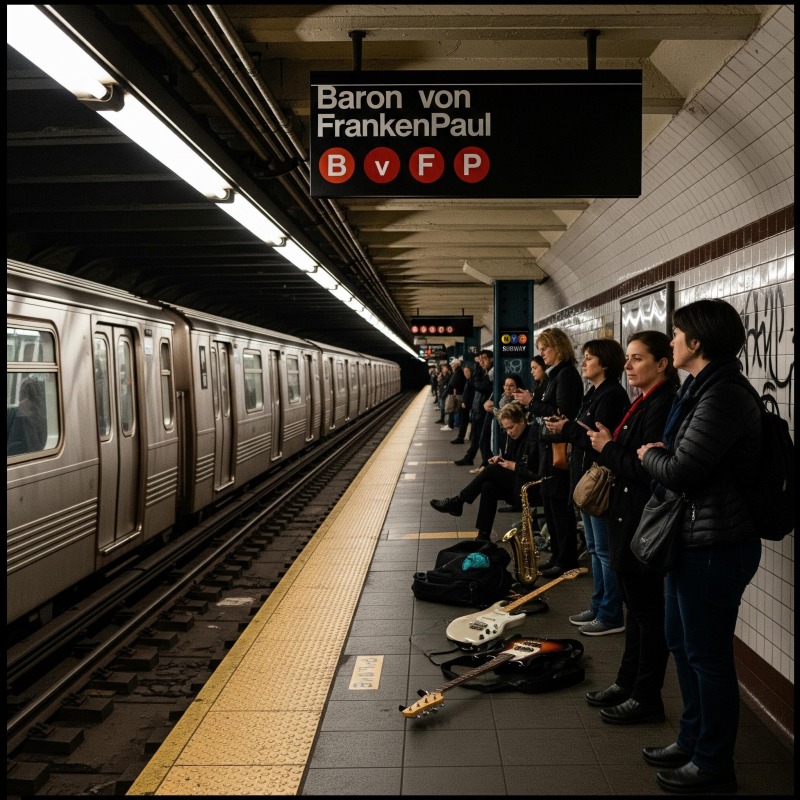
Some albums introduce themselves politely, others open a door just like what Baron von FrankenPaul did in their latest album, holding the same name, Baron von FrankenPaul! This one builds an entire world the moment you press play. What emerges across these ten tracks is not merely a fusion of genres but a sonic identity so confidently forged that every stylistic shift feels like another facet of the same character. Whether reimagining Coltrane, The Doors, Miles Davis, or Alice in Chains, or unfolding original compositions with striking emotional intelligence, the band never loses its center. They experiment boldly, but they never wander. They transform, but they never fracture. At every moment, the trempette stands as the album’s main narrator: shaping atmospheres, carving melodies, and binding the narrative with a tone that is unmistakably its own. What results is an album that feels like a journey through ten landscapes seen through one pair of eyes.
In Camera Obscura, this unity is palpable. The trempette strides into the mix with a crisp brilliance that effortlessly slices through the heavy, almost metallic guitar riffs, as if declaring itself the compass of the entire record. Glittering chimes fracture around the edges, giving the music a cinematic depth, and the electric guitar solo arrives not as a contrast but as an extension of the same emotional space. When the trempette returns with a virtuosic solo, it feels like a statement of intent: technical command, yes, but also a sharp sense of narrative direction. The band sets the tone here, proving that even in dense textures, clarity can reign.
That clarity continues in BVFP, though the mood shifts entirely. A drum-forward opening tumbles unexpectedly into a breezy, beach-tinged groove, effortlessly light yet rhythmically grounded. The trempette floats through the melody with ease, reshaping it through different scale degrees as if turning a familiar phrase inside out. What’s striking is how the groove relaxes without losing precision; the band plays with freedom, but the identity remains intact, cohesive, unshaken.
Their re-imagining of Coltrane’s Naima reveals their emotional intelligence. The track widens the atmosphere, taking the original’s suspended hush and blending it with the album’s textures: chimes, understated drums, guitar bends that ripple like softened glass. It shifts the piece from solitary contemplation to a shared, collective breath. The trempette solo is tender but confident, elevating the emotional warmth of the composition and giving the ending a luminous glow that dissolves into fading chimes. It is homage and reinvention at once: respectful, yet unmistakably theirs.
Then comes Man in the Box, where the album bares its teeth. Here the trempette becomes something entirely different: edgy, defiant, almost insurgent, pushing back against the heavy rock instrumentation that surrounds it. The reinterpretation holds onto the tension of the original, not through mimicry but through psychological fidelity. The rhythmic tightness gives the track a coiled power, and the trempette’s refusal to “stay in the box” becomes the narrative conflict. It’s a musical struggle rendered with such focus that even the intensity feels controlled rather than chaotic.
Cactus offers a complete shift in scenery while maintaining the band’s unmistakable cohesion. The opening snare flicks like the sting of cactus thorns, mirrored by the trempette’s staccato – tenuto phrasing. There is Americana warmth here, a dusty glow under the subtle textures, yet the track never dulls its edges. The trempette plays with mischievous sharpness, emerging like a playful antagonist before the ending slips away unexpectedly, as though the cactus simply pulled back into itself.
In Lullaby for Zoey, the band leans into spaciousness: soft, dreamlike expanses where wide rhythms drift like slow-moving clouds. The trempette shapes emotion through delicate dynamics rather than virtuosic leaps, giving the piece an intimate glow. It rises toward the end, figuratively and literally, as if offering a final, gentle ascent before letting the dream settle.
Kasbah Knights jolts the album awake again: fiery, overdriven, charged with hints of Middle Eastern color. The trempette and guitar converse like two seasoned warriors sparring with mutual respect. Their interplay builds momentum and tension until a sudden moment of quiet enters: light percussion, a subdued breath before the final burst. The track feels like a cinematic chase, an adventure rendered with precision and narrative flair.
Their take on Riders on the Storm keeps the mysteries of the original but strips away excess. Clean, simple guitar lines drift under a quiet rhythmic pulse, allowing the trempette to glide through the melody with gentle restraint. Nothing is overworked; the band trusts the atmosphere enough to leave space, letting the calm breathe.
When In a Silent Way begins, a serene wave of sound unfurls: vast, sustained, meditative. The shift into the more upbeat passage feels like motion after stillness, brightening the sonic horizon before returning once more to introspective calm. The piece honors Miles Davis while interpreting the concept through the band’s own language: wide, luminous, and grounded in their distinct palette.
Finally, Tall Shoes Mary closes the album with its only lyrical moment. Americana warmth blends with rock guitar textures and jazz-tinged trempette lines, while the vocals, supported by soft, beautifully layered backing paint scenes of wandering cities, near-misses, fog, infidelity, unburned bridges, countless lifetimes, want, timing, and longing without collapse. The lyrics drift between clarity and fragmentation, like memories revisited in flashes, and the song wraps the album in storytelling that feels lived-in, tender, and real.
Across these ten tracks, the through-line is unmistakable: a sonic identity crafted with confidence, depth, and unmistakable mastery. No matter how far the album travels: across genres, reinterpretations, moods, or emotional terrains, it always returns to itself. And that is the brilliance of Baron von FrankenPaul: a sound so coherent, so intentional, that transformation becomes a form of continuity. This is not just fusion. It is authorship. It is a musical voice speaking ten different dialects with the same unmistakable tongue..