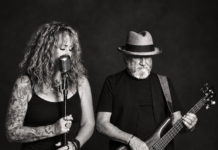
Few artists today conjure the kind of eerie beauty and cinematic sweep that The Curse of KK Hammond brings to the modern blues. With her trademark slide guitar, she has carved out a sound that fuses the raw soul of 1930s Delta pioneers with the spectral shadows of Gothic horror and the widescreen drama of Spaghetti Westerns. From her chart-topping debut Death Roll Blues to her latest single, Walk With Me Through the Fire, Hammond proves that independent music can be both fearless and timeless. In this conversation, she opens up about her inspirations, creative process, and the haunting power of music to connect across darkness, despair, and hope.
K.K., people often describe your sound as haunting, raw, and completely your own. When you first started experimenting with slide guitar, did you ever picture yourself blending Delta blues with elements of Gothic horror and Spaghetti Westerns?
I don’t think I ever intentionally set out to blend these elements together but rather it just naturally transpired that way as my favorite things love to sneakily weave themselves into my various forms of expression! It starts subconsciously I think and then I pick up on it happening and just run with it! I think I’ve always felt a draw towards morose, dark and gothic themes and after a while my style just solidified itself there no matter what artform I pursue.
Your latest single, “Walk With Me Through the Fire,” feels almost like a film in song form—sweeping, cinematic, and powerful. What sparked the idea behind it, and how did you go about turning that vision into both a track and a video?
I think I’ve lost track of whether I first wrote the song to compliment a music video I had in mind or vice versa! I wanted them to flow seamlessly with one another whilst also being able to stand alone to tell the story. As I wrote the song, I was picturing how the events of the music video may unfold! I think the beautiful cello part played by the very talented Ian Davidson brought a great deal of drama to the song which certainly gives it a very cinematic feel.
In the modern day so much music has been “Tiktokified” in order to put the emphasis on a short, attention-grabbing soundbite moments causing a decrease in the prevalence of traditional bridges and choruses. I approach every song as a mini symphony and love the excitement an energy shift in the way of a surprising bridge or chorus, or powerful solo, can bring. This song particularly emphasises this approach.
Your videos look and feel like short films—beautiful, eerie, and full of atmosphere. Do you think of yourself more as a musician who tells stories, or a storyteller who uses music? Or is it impossible to separate the two?
Music is my first love and a musician is definitely what I define myself as but I also have a real soft spot for cinema and always said that, if I could borrow another lifetime, I would lean all the way into film making primarily!
You’ve often mentioned your admiration for the Delta blues pioneers of the 1930s. What is it about that time period and its music that continues to resonate with you so strongly?
I love the rawness and realness of the music of that era. Not only does it represent the birth of the blues but the birth of all music which came thereafter. The early blues was the backbone of rock n’ roll and foundation of every modern music style we have. It was a time where the only tools available to the musicians were their instruments and their voice. No electric amplification or fancy studio tools, no autotune or retakes. The takes in the 1930s recordings were pure and true with mistakes, background sounds and all present. When music is laid bare so is the humanity behind it and that is very beautiful indeed.
Your debut album, “Death Roll Blues”, reached the top of the charts in the UK, the US, and even Billboard—an incredible achievement for an independent artist. How did it feel to see that success unfold, and what did it mean to you on a personal level?
It really brought me a level of elation and gratitude that I can’t describe as I wasn’t expecting it to happen at all! It’s very validating knowing something you poured so much blood, sweat and tears into was enjoyed so much by others.
You’ve built a creative circle with collaborators like Ian Davidson and Kaspar “Berry” Rapkin. How important is it for you to have partners who understand and share your vision so completely?
I think one of the biggest gifts in the world is being able to work with great friends on a shared passion. We all have very similar musical influences so never struggle to find common ground but also all have our own unique flair and talents to bring to the table to keep things fresh and exciting. It really is wonderful how fast and readily the ideas flow when you work with like-minded people. Bouncing off each other is very inspiring and motivating.
Your music has connected with fans all over the globe, and it’s played regularly on blues stations worldwide. Has there been a particular fan reaction or message that completely surprised you?
I’ve received messages from people who said my music helped them get through some very dark and difficult times. That was extremely heart-warming and humbling and really took me by surprise. Sometimes I suffer with self-doubt and hearing that my art, which is often born of my own dark thoughts and feelings, helped someone else get past theirs definitely gives me a sense of purpose.
Your songs embrace dark themes but with a certain beauty and hope woven through them. When listeners hear “Walk With Me Through the Fire,” especially in today’s uncertain times, what do you hope they walk away feeling?
My music is open to interpretation by all and if it brings comfort to those who are feeling discomforted then that makes me happy to hear. That having been said, ‘Anhedonia’ from my album ‘Death Roll Blues’ is a protest song that really touches on themes pertaining to the current state of the world.